News Summary
- Pirelli has confirmed C3, C4 and C5 tyres for Las Vegas, repeating the selection used in 2025.
- The 6.201km Strip Circuit features long straights, heavy braking zones and night-time conditions that make tyre warm-up a central performance challenge.
- Ferrari’s recent tyre problems and McLaren’s substantial aerodynamic upgrades make Las Vegas an important test of the competitive order ahead of Qatar and Abu Dhabi.
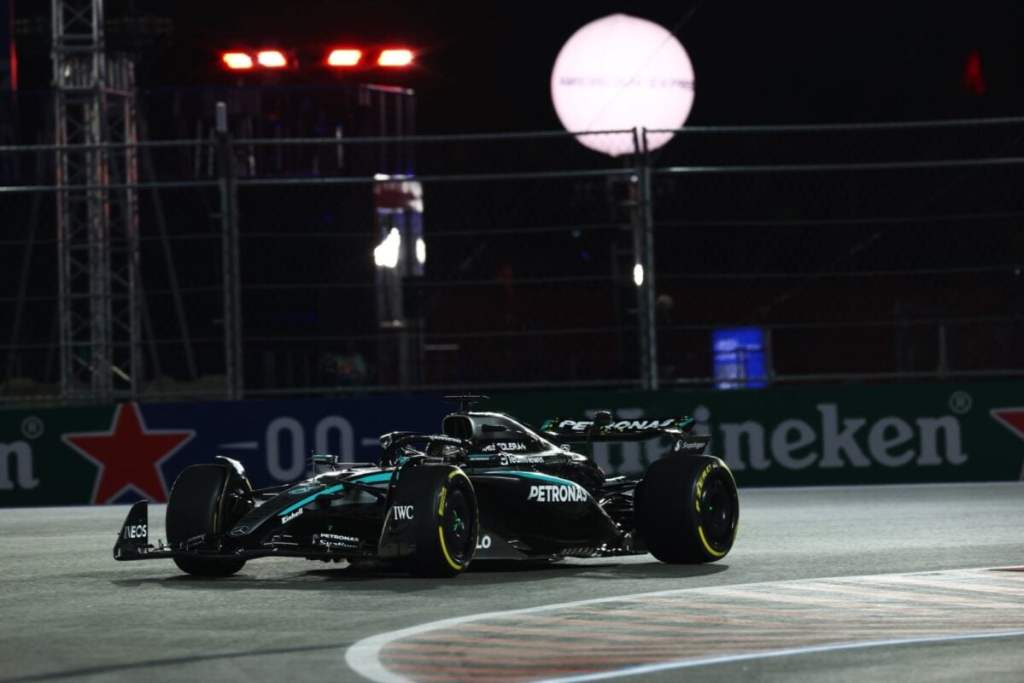
Las Vegas presents Formula 1 teams with a challenge unlike most circuits on the 2026 calendar: generating sufficient tyre temperature while racing at high speed through some of the coldest conditions of the season.
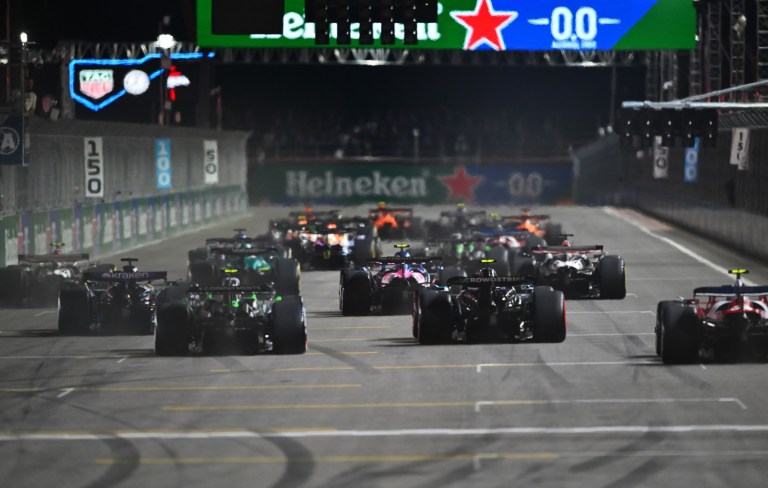
The Grand Prix takes place on Saturday evening, November 21, with the Strip Circuit combining long periods of full-throttle running and major braking zones with relatively few sustained high-energy corners.
Pirelli has chosen the softest available combination — C3, C4 and C5 — specifically because of the difficulty of bringing tyres into their operating window.
The decision is particularly relevant after the São Paulo Grand Prix exposed major differences between teams in their ability to generate and maintain tyre temperature.
Why Las Vegas creates a unique tyre challenge
The Las Vegas Strip Circuit measures 6.201 kilometres and features 17 corners. The Grand Prix runs for 50 laps, covering 309.958km.
Its layout produces some of Formula 1’s highest average speeds, with lengthy straights connected by slow corners and substantial braking zones.
That combination makes tyre management difficult.
On circuits with several fast corners, sustained lateral forces help generate energy in the tyres. Las Vegas offers fewer opportunities for that process, while long straights allow surface temperatures to fall.
As a result, drivers can reach braking zones with tyres below their preferred operating range.
The consequences are significant: reduced braking grip, sliding on corner entry and difficulty accelerating without excessive wheelspin.
Sliding also creates an additional problem. The tyre surface may become excessively hot while the underlying structure remains comparatively cool, increasing the possibility of graining.
For qualifying, getting the preparation lap right can therefore be as important as finding additional aerodynamic performance.
Pirelli confirms the softest three compounds
Pirelli announced on November 13 that Las Vegas would use the same compound selection as 2025.
| Compound | Weekend designation | Principal consideration |
|---|---|---|
| C3 | Hard | Potential durability, but more difficult warm-up |
| C4 | Medium | Balance between warm-up and stint length |
| C5 | Soft | Faster warm-up and single-lap performance potential |
The tyre supplier specifically identified low temperatures and the need to reach the correct operating window quickly as reasons for selecting the C3-C5 range.
The decision contrasts with Qatar, where C1, C2 and C3 have been selected to withstand the substantial energy generated by high-speed corners.
The softest compound is not automatically the fastest throughout a race stint, however.
Performance depends on degradation, track evolution, fuel load and each car’s capacity to maintain tyre temperature without damaging the surface.
This means teams must evaluate both single-lap performance and long-run consistency during practice.

Ferrari’s problems make Las Vegas a critical test
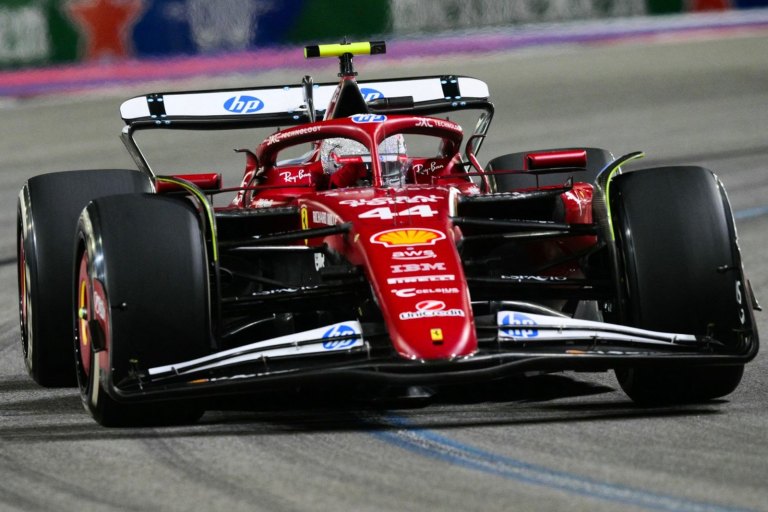
Ferrari enters the weekend after a difficult São Paulo Grand Prix, where Lewis Hamilton finished ninth and Charles Leclerc eighth.
Team principal Frédéric Vasseur acknowledged that the team’s performance had been heavily affected by tyre-temperature management.
The Frenchman explained that operating outside the ideal window could cost around half a second per lap — a much larger loss than the gains normally delivered by individual aerodynamic updates.
That makes Las Vegas an important technical examination for Ferrari.
A team struggling to generate temperature in the tyres could lose time through the slow corners, even with competitive acceleration and speed on the straights.
Vasseur also raised concerns about Ferrari’s straight-line performance in Brazil, meaning the Italian team must find a compromise between aerodynamic efficiency and sufficient grip.
As GRANDE PRÊMIO’s analysis of Hamilton’s recent results showed, the seven-time champion has recovered 36 points on George Russell across the last five Grands Prix.
Maintaining that momentum will require a more consistent technical weekend than Ferrari experienced at Interlagos.
McLaren must adapt its upgraded car
McLaren has a different challenge.
The team introduced significant aerodynamic updates in São Paulo, where Lando Norris secured victory and Oscar Piastri finished sixth.
McLaren racing director Randy Singh confirmed on November 16 that the new components worked well, but acknowledged that the team was still learning how to maximise their performance.
He also identified the colder conditions and reduced grip in Las Vegas as important differences from Interlagos.
The upgraded MCL40 must therefore demonstrate that its improvements are transferable to a circuit with a very different performance profile.
That will matter in McLaren’s fight with Red Bull for third place in the Constructors’ Championship.
GRANDE PRÊMIO has already examined Piastri’s difficulty adapting his driving style to the 2026 McLaren, making the team’s technical progress especially significant for the Australian.
The areas to watch during practice
There are four principal indicators of whether teams are controlling tyre performance effectively.
First, the improvement between a driver’s preparation lap and qualifying simulation can reveal how quickly a compound reaches its working range.
Second, sector times through the slower corners can identify cars struggling with braking stability or traction.
Third, long-run lap-time consistency will show whether teams can maintain performance without excessive degradation or graining.
Finally, speed-trap measurements will help establish whether teams are sacrificing too much straight-line efficiency in pursuit of cornering grip.
None of those variables can be conclusively ranked before the first practice session.
The first opportunity to measure the true competitive order will come when FP1 begins at 4:30 PM local time on Thursday, November 19.
GRANDE PRÊMIO is following every session of the Las Vegas Grand Prix and the final rounds of the 2026 Formula 1 season.