News Summary
- Ferrari scored just six points in São Paulo after Lewis Hamilton and Charles Leclerc struggled with tyre temperatures, straight-line performance and grid penalties.
- Frédéric Vasseur says operating outside the correct tyre window can cost around half a second per lap, making the issue more significant than many individual car upgrades.
- Hamilton has outscored George Russell by 36 points in five races, while Leclerc has scored 70 points over the same period, underlining Ferrari’s recent improvement despite Brazil’s setback.
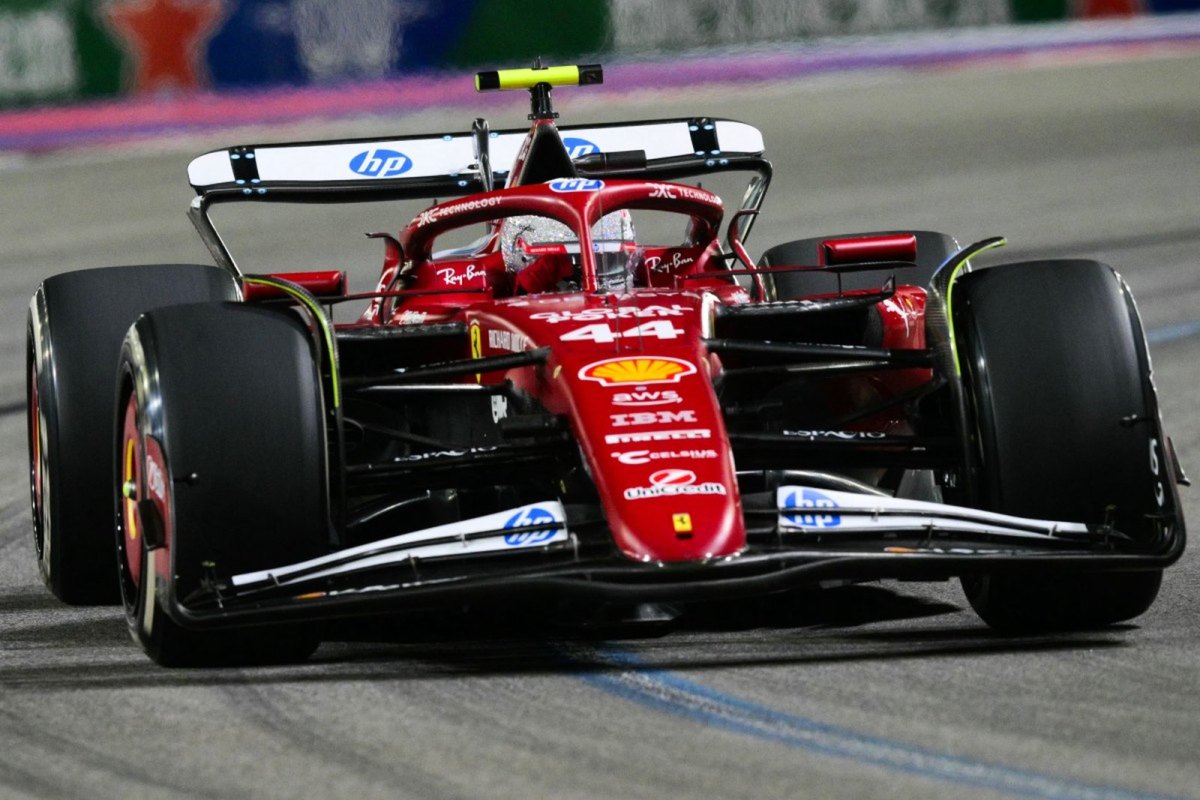
Ferrari enters the Las Vegas Grand Prix facing a critical technical challenge after its difficult performance in São Paulo exposed major problems with tyre management.
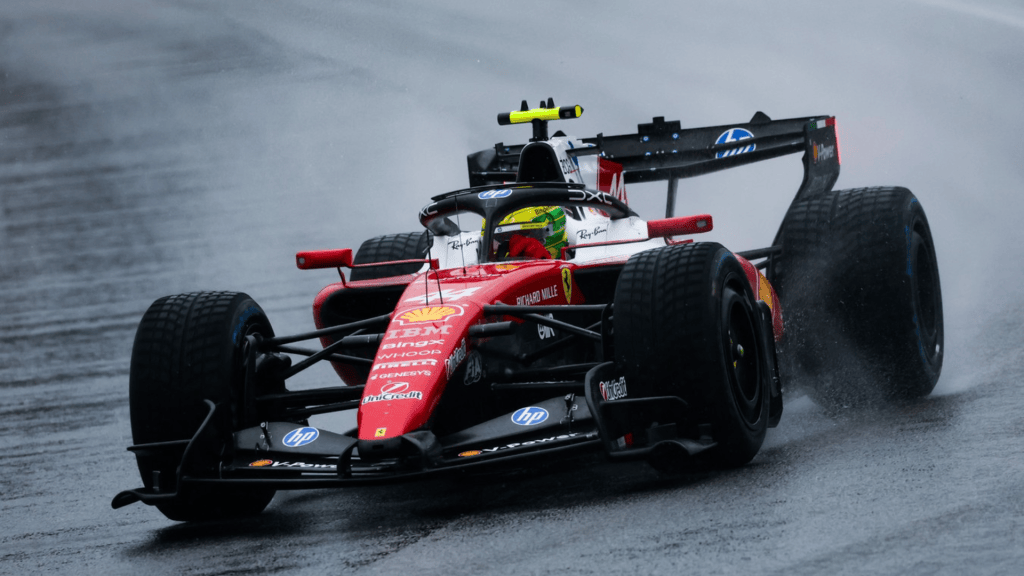
Lewis Hamilton and Charles Leclerc finished ninth and eighth respectively in Brazil, a disappointing result for a team that had been considerably more competitive in Mexico City one week earlier.
Team principal Frédéric Vasseur identified tyre temperatures as one of the main causes of Ferrari’s performance fluctuations.
The concern is especially relevant to Las Vegas, where low night-time temperatures and long straights can make generating and retaining tyre heat unusually difficult.
Ferrari’s immediate objective is not simply to find more outright performance, but to ensure that its existing speed remains accessible throughout a qualifying lap and race stint.
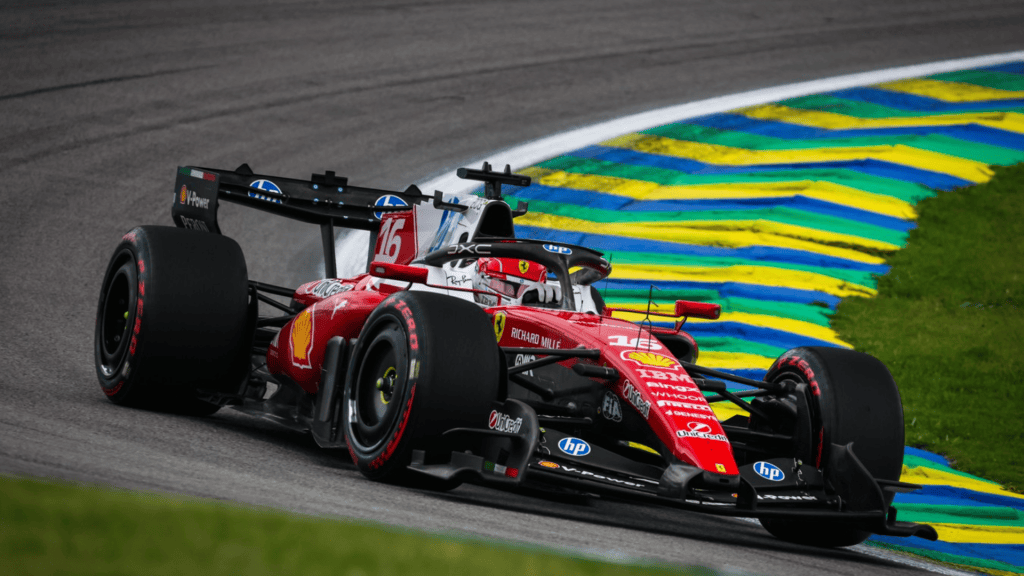
Ferrari’s São Paulo performance exposed a half-second problem
Ferrari’s Brazilian Grand Prix was compromised by several factors.
Both drivers faced ten-place grid penalties after taking additional power-unit components, while Hamilton also suffered an engine-related problem during the final practice session.
The penalties complicated their starting positions and forced Ferrari to pursue alternative strategies.
However, the team’s difficulties continued during the race.
Hamilton struggled to maintain temperature in the intermediate tyres before switching to slicks earlier than most of his rivals.
Leclerc also experienced inconsistent grip, particularly during the opening stages of his dry-tyre stint.
Vasseur subsequently explained that tyre-temperature problems could have a considerably greater impact than individual aerodynamic updates.
According to the Ferrari team principal, the difference between operating inside and outside the ideal temperature window could reach approximately half a second per lap.
That figure is particularly significant in modern Formula 1, where upgrades often deliver gains measured in hundredths or tenths of a second.
It also helps explain why a car that was competitive at one circuit can struggle dramatically at another.
Why Las Vegas could magnify Ferrari’s difficulties
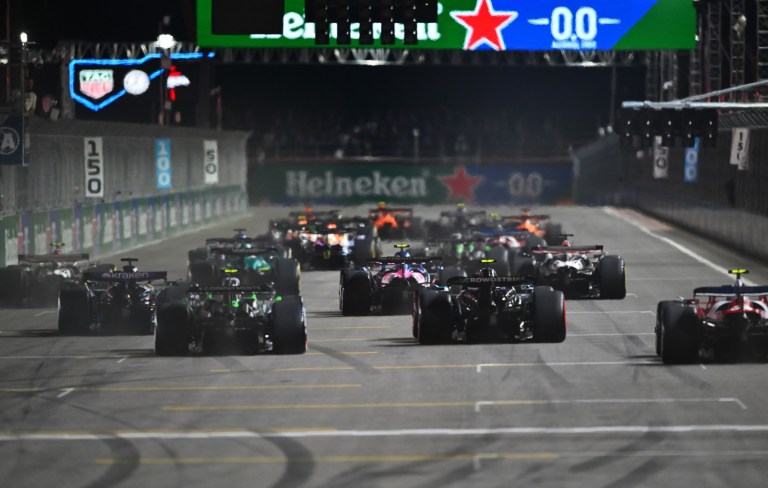
The Las Vegas Strip Circuit combines long straights, heavy braking zones and relatively low ambient temperatures.
Pirelli has selected the C3, C4 and C5 compounds for the weekend, the softest three tyres in its range.
The tyre supplier identified the challenge of reaching operating temperature quickly as a major reason for that selection.
Ferrari’s recent problems raise several questions.
Can the SF-26 generate enough temperature in its front tyres during qualifying preparation?
Will Hamilton and Leclerc be able to maintain the tyres in their preferred operating window over longer stints?
And can Ferrari strike the right balance between straight-line efficiency and cornering grip?
The answers will depend on the team’s setup choices and the actual conditions experienced during the race weekend.
No evidence yet establishes that Ferrari will be slower than its rivals in Las Vegas, but the similarities between the track’s technical demands and the weaknesses identified in Brazil make tyre management a particularly important area to monitor.
Hamilton’s recent form offers Ferrari encouragement
Despite Ferrari’s problems in São Paulo, Hamilton enters Las Vegas with considerably stronger championship momentum than earlier in the season.
A GRANDE PRÊMIO analysis of the latest five races showed that Hamilton scored 62 points, compared with 26 for George Russell.
That represents a 36-point swing in Hamilton’s favour.
The seven-time world champion now trails his former Mercedes team-mate by only one point in the Drivers’ Championship.
| Driver | Championship points | Latest five races |
|---|---|---|
| G. RUSSELL | 262 | 26 |
| L. HAMILTON | 261 | 62 |
| C. LECLERC | 249 | 70 |
Leclerc has been even more productive over that five-race period, collecting 70 points.
Together, the Ferrari drivers scored 132 points, compared with 114 for Mercedes.
Those figures illustrate a substantial recovery from Ferrari’s weakest part of the season.
They do not, however, prove that Ferrari has the fastest car.
Mercedes has already secured both 2026 world championships, and Ferrari’s recent competitiveness has varied considerably between circuits.
Leclerc faces a different challenge from Hamilton
Leclerc enters Las Vegas with 249 championship points, 12 behind Hamilton and 13 behind Russell.
The Monegasque driver has frequently been competitive over a single lap, but Ferrari’s difficulties in Brazil demonstrated how quickly changes in tyre behaviour can undermine its race pace.
At Interlagos, Leclerc qualified fourth before penalties moved him backwards on the grid.
He subsequently struggled early in the race but became more competitive during the closing stages of his stint on slick tyres.
That progression highlighted the importance of tyre temperature.
Hamilton’s challenge has been different.
The Briton has improved his points-scoring consistency during the second half of the season, but has still struggled to produce competitive results when Ferrari cannot get the tyres working effectively.
The two drivers therefore enter Las Vegas with a shared technical concern, despite their contrasting championship trajectories.
Ferrari still has second place to protect
Ferrari has already lost the opportunity to win the Constructors’ Championship.
Mercedes secured the title in São Paulo, extending Ferrari’s wait for another team championship.
However, Ferrari remains comfortably ahead of Red Bull in second place.
| Team | Points |
|---|---|
| Mercedes | 652 |
| Ferrari | 510 |
| Red Bull | 415 |
| McLaren | 398 |
Ferrari’s advantage over Red Bull stands at 95 points before Las Vegas.
The team’s finishing position remains important, while Hamilton and Leclerc are also involved in the tightly contested battle for the highest remaining places in the Drivers’ Championship.
Five drivers are separated by just 33 points, with Max Verstappen leading Russell, Hamilton, Leclerc and Lando Norris.
A successful Las Vegas weekend could strengthen Ferrari’s position in both championships, but the team must first address the performance inconsistency highlighted by Vasseur.
What Ferrari must establish during practice
Three areas will be particularly important when the cars begin running on Thursday.
The first is tyre warm-up on qualifying simulations, especially the ability to generate front-tyre grip before the opening timed sector.
The second is straight-line performance.
Vasseur acknowledged that Ferrari had struggled for top speed in Brazil, which could become an additional concern on the lengthy Las Vegas straights.
The third is race-stint consistency.
Ferrari must establish whether it can maintain competitive lap times without overheating the tyre surface or allowing its temperatures to fall outside the preferred range.
Those measurements will provide a more reliable picture of the team’s prospects than general predictions based on previous races.
GRANDE PRÊMIO is following every session of the Las Vegas Grand Prix and the final rounds of the 2026 Formula 1 season.
FAQ
Why did Ferrari struggle in São Paulo?
Ferrari suffered from tyre-temperature problems, grid penalties and limited straight-line performance. Frédéric Vasseur said tyre operating temperatures were a major factor in the team’s difficulties.
How far is Hamilton behind Russell before Las Vegas?
Hamilton has 261 points, just one behind Russell, after outscoring the Mercedes driver by 36 points across the last five Grands Prix.
Could Las Vegas’s cold temperatures affect Ferrari?
Yes. Low track temperatures can make tyre warm-up difficult. Ferrari’s recent problems make this an important technical concern, although the team’s actual competitiveness will only become clear during practice.