
News Summary
- The FIA recognised the Yangwang U9 Xtreme as the first production car to exceed 500 km/h.
- The record came on the fourth pass of a two-day test, after the car reached 490 km/h on the opening day.
- Guinness awarded two records for peak speed in a single direction, one for production cars overall and one for electric production cars.
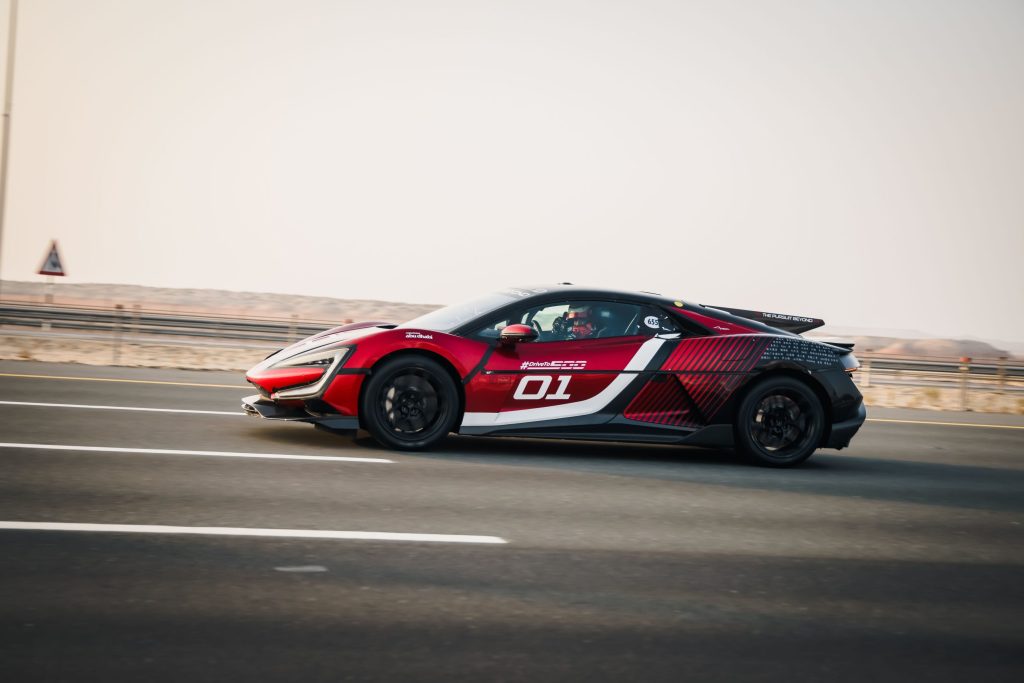
The Yangwang U9 Xtreme reached 503.17 km/h (312.65 mph) on a closed highway in Abu Dhabi, becoming the first production car to break the 500 km/h barrier. The FIA recognised the speed on Friday, 6 November, five days after German racing driver Marc Basseng made the run on the E11 in the emirate’s Al Dhafra region.
Basseng already knew what it took to get close. The 2012 FIA GT1 world champion had driven the U9 Xtreme to 496.22 km/h at the ATP Papenburg proving ground in Germany in September 2025. For the next attempt, Yangwang and local authorities secured a 10 km section of the Sheikh Khalifa Bin Zayed International Road, giving Basseng a seven-kilometre straight for the high-speed runs.
How Yangwang found another 13 km/h overnight
Two runs on 31 October produced a best of 490 km/h, short of both the Papenburg mark and the target in Abu Dhabi. Before Basseng went back out, Yangwang’s engineers adjusted the aerodynamics, suspension settings and tyre pressures to improve stability at speed. He made two more passes on 1 November and hit 503.17 km/h on the last one.
That was 13.17 km/h faster than the opening day’s best. Guinness says the speed was verified using the car’s onboard speedometer and a calibrated VBOX data logger. An FIA representative reviewed the data and supplied written confirmation for the Guinness verification.
What the FIA and Guinness recognised
The FIA recognised the speed Basseng reached, while Guinness recorded the result under two single-direction categories. Both use the peak speed from one pass. A two-way test averages the speeds from runs in opposite directions, reducing the influence of wind and road gradient.
The SSC Tuatara’s 455.3 km/h (282.9 mph) figure, independently verified by Racelogic in Florida in 2021, was measured under that second method. Its two runs produced peak speeds of 450.1 km/h and 460.4 km/h. The two figures published for the Tuatara and the Yangwang therefore answer different questions about how fast each car went.
From 309 km/h in China to a sub-seven-minute Nürburgring lap
The original U9 reached 309 km/h in testing in China in January 2024 and 391.94 km/h at Papenburg that October. The Xtreme version reached 472.41 km/h in August 2025 before Basseng added almost 24 km/h at the same German facility the following month.
After the 2025 Papenburg run, Basseng described what the electric drivetrain felt like from the cockpit. “Thanks to the electric motor, the car is quiet, there are no load changes, and that allows me to focus even more on the track,” he told BYD.
The Xtreme uses four independently controlled electric motors producing more than 3,000 PS, a 1,200-volt electrical system and active suspension. Yangwang developed its high-speed tyres with Giti Tire, and BYD has capped production at 30 cars. For a separate look at how electric racing cars are developing, GRANDE PRÊMIO has covered the move to permanent all-wheel drive and 600 kW in Formula E’s Gen4 cars.
The U9 Xtreme had already set a different benchmark at the Nordschleife, the circuit where Max Verstappen made his Nürburgring 24 Hours debut. With Moritz Kranz driving, the Yangwang lapped the 20.832 km course in 6:59.157 on 22 August 2025, the first time an electric super sports car went under seven minutes in the Nürburgring’s official classification.
FAQ
Is Yangwang part of BYD?
Yes. Yangwang is BYD’s luxury brand. The U9 Xtreme is a limited-production version of its U9 electric hypercar.
Who drove the Yangwang U9 Xtreme past 500 km/h?
Marc Basseng drove the car in Abu Dhabi. He won the 2012 FIA GT1 drivers’ title alongside Markus Winkelhock and also won the Nürburgring 24 Hours that year.
How fast did the Yangwang U9 Xtreme go in miles per hour?
Guinness World Records lists the peak at 312.65 mph, equivalent to 503.17 km/h, during a single-direction run.