
Key takeaways
- Grid penalty set for Monza: Andrea Kimi Antonelli confirmed he will serve a major engine penalty at his home race, the Italian Grand Prix, taking new power unit components.
- Strategic overtaking venue: Monza was selected because its high-speed layout offers significantly better overtaking opportunities than tighter circuits like Zandvoort.
- Component management: Antonelli arrives at the second half of the season on the brink of allocations across multiple power unit parts, aiming to refresh his pool of engines for the remainder of the championship battle.
The paddock knew it was coming, but the venue has now been fixed. Speaking to reporters on Thursday (20) in Zandvoort, Andrea Kimi Antonelli announced where he will take his first major grid penalty of the season: his home race, the Italian Grand Prix.
Antonelli enters the second half of the campaign at the maximum limit of used components in four of the six power unit elements: the Internal Combustion Engine (ICE), Exhaust Systems (EX), Energy Store (ES), and Control Electronics (CE). The plan is to change all six elements for Monza, which will force the championship leader to start from the back of the grid.
The decision to take the drop at Monza stems from the track’s ultra-high-speed nature and multiple overtaking opportunities, making a recovery drive far more viable than at a tight, high-downforce circuit like Zandvoort.
“The penalty for the new engine will be in Monza,” he confirmed. “It was a joint decision because it is one of the easiest tracks to overtake.”
“It’s true that it’s also my home race, but at the end of the day, we are focused on the championship. I have to assess where I can give myself the best chance to recover positions and score a good result. That’s why Monza is at the top of the list for the penalty,” he added.
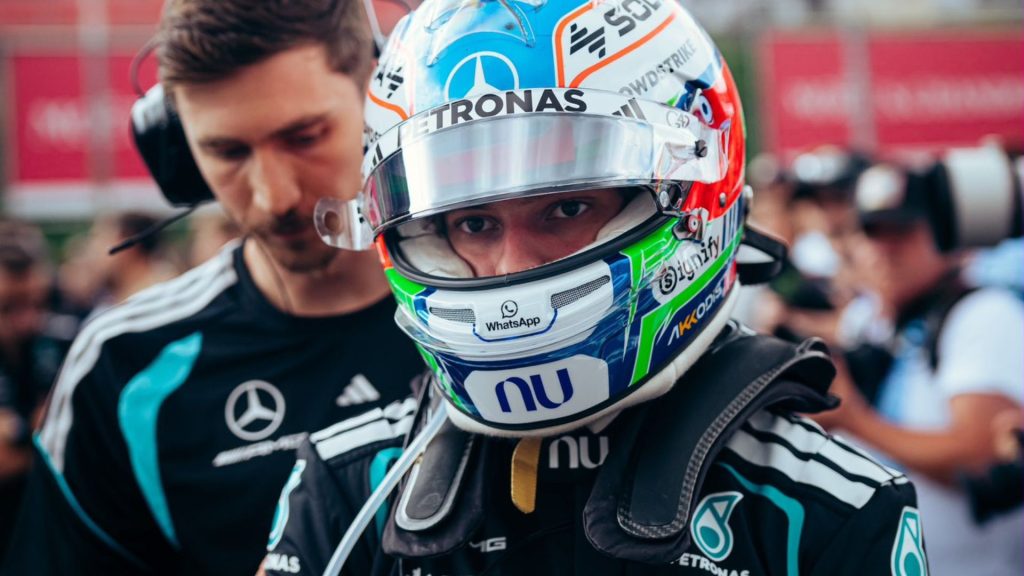
“Monza will still be a great weekend with fantastic fan support. I can’t wait. It will be very different from last year, with a different atmosphere, but I’m looking forward to it. I’ll also have a really cool special helmet,” Antonelli concluded.
In theory, Antonelli remains within the limit on the remaining two power unit elements — the MGU-K and Auxiliary Components (ANC) — but Mercedes may opt to introduce those elements in Zandvoort to reach the limit across the board and take the full penalty at once in Italy. This approach would leave the Italian driver with two lightly used units of each element to cycle through without incurring further penalties for the rest of the year.
For any of the six power unit elements, exceeding the baseline limit triggers a 10-place grid drop for the first new element introduced. Drivers are only penalized when introducing brand-new components beyond their allocation, not when swapping between previously used elements already in their pool.
Formula 1 returns this weekend, from August 21 to 23, for the Dutch Grand Prix — the 12th round of the 2026 season. GRANDE PRÊMIO covers all the track action live from Zandvoort with reporter Leonid Kliuev. Catch up on all the paddock news on our news page.
Session schedule: Dutch Grand Prix 2026
| Session | Local time (CEST) | UTC |
| Free Practice 1 | Friday, August 21 – 12:30 | 10:30 |
| Free Practice 2 | Friday, August 21 – 16:00 | 14:00 |
| Free Practice 3 | Saturday, August 22 – 11:30 | 09:30 |
| Qualifying | Saturday, August 22 – 15:00 | 13:00 |
| Race | Sunday, August 23 – 15:00 | 13:00 |
Frequently asked questions (FAQ)
1. Why did Andrea Kimi Antonelli choose Monza to take an engine penalty?
Antonelli and Mercedes chose Monza because its long straights and heavy braking zones offer much better overtaking opportunities compared to other tracks, giving him a higher chance to recover positions from the back of the grid.
2. How many places on the grid will Antonelli drop for introducing new engine components?
Exceeding the allowed limit on power unit elements results in a minimum 10-place grid drop for each new element introduced beyond the baseline limit, which will result in starting at the back of the grid for Monza.
3. Does swapping back to a previously used power unit trigger a grid penalty?
No. Penalties are only applied when a driver introduces a completely new engine component that exceeds their seasonal allocation limit. Swapping between previously used, healthy components already in the driver’s pool incurs no penalty.