News Summary
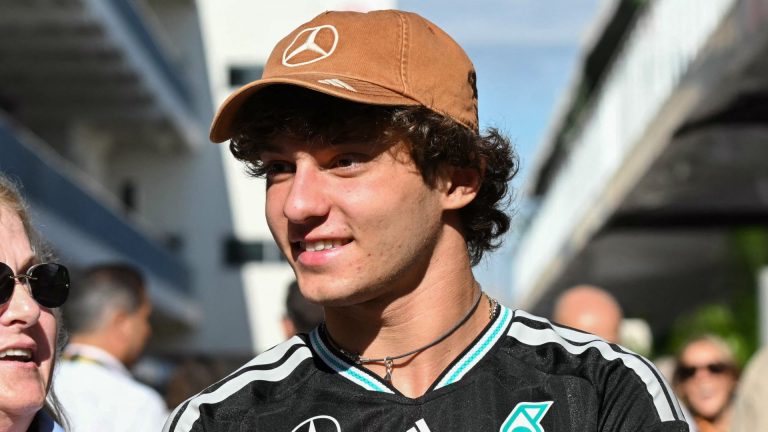
- Kimi Antonelli surprised Mercedes and its rivals by taking pole position for the United States Grand Prix after the team struggled with tyre overheating and balance problems throughout the Austin weekend.
- Max Verstappen and Isack Hadjar start second and third for Red Bull, while Ferrari remains a serious contender after Charles Leclerc and Lewis Hamilton dominated all three free practice sessions.
- Antonelli can secure the 2026 Formula 1 World Championship on Sunday, but race pace, tyre degradation and strategy could prove decisive in a battle involving Mercedes, Red Bull and Ferrari.
Kimi Antonelli delivered one of the most important qualifying performances of his Formula 1 career by securing pole position for the United States Grand Prix on Saturday (October 24), putting himself in position to potentially clinch the 2026 World Championship. But the Mercedes driver’s remarkable lap at Circuit of The Americas told only part of the story. Red Bull and Ferrari remain firmly in contention for victory, and the factors that troubled Mercedes before qualifying could become decisive over Sunday’s 56-lap race.
The Italian produced a 1min34s035 lap in Q3 to defeat Max Verstappen by 0.179 seconds, with Isack Hadjar completing the top three just 0.215 seconds behind. Charles Leclerc and Lewis Hamilton followed in fourth and fifth, confirming that Ferrari’s impressive practice pace had not entirely disappeared. George Russell, Antonelli’s closest championship rival, qualified only sixth, giving the championship leader a valuable opportunity to extend his 102-point advantage — provided he can withstand the challenge from the cars immediately behind.
How Antonelli turned Mercedes’ Austin problems into a surprise pole
Mercedes did not arrive at the decisive qualifying session looking like the team to beat. Ferrari had set the pace in all three practice sessions, while Red Bull demonstrated the performance needed to challenge at the front.
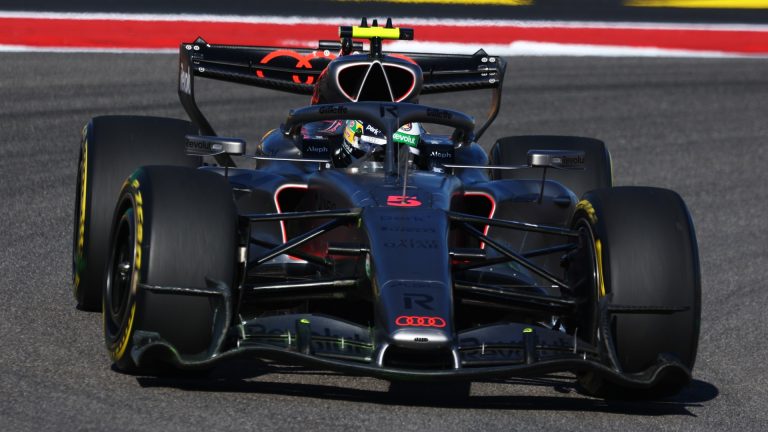
The German manufacturer faced persistent difficulties with the balance of its revised W17, particularly in Austin’s slower corners. An even greater concern involved tyre temperatures, with Mercedes struggling to maintain performance through the final sector, especially between Turns 19 and 20.
That problem is particularly significant at Circuit of The Americas, where the combination of high-speed direction changes, slower corners and heavy braking places considerable energy into the tyres. A driver who attacks too aggressively in the opening sectors can reach the final corners with insufficient grip to complete a competitive lap.
Antonelli managed to overcome that limitation at precisely the right moment.
The Mercedes driver produced an exceptionally clean opening Q3 attempt, maintaining enough grip through the final sector to establish a benchmark that none of his rivals could match. Even Antonelli himself could not reproduce the performance on his second attempt, which he ultimately abandoned.
The pole was Antonelli’s seventh of the 2026 season, but its importance extended beyond the starting position. It demonstrated that Mercedes had found a way to unlock the potential of its updated car despite an increasingly narrow operating window.
Team principal Toto Wolff acknowledged that the result had exceeded expectations.
“Getting pole position today was beyond our expectations,” Wolff admitted after qualifying.
“We worked hard to get the car into a good window throughout the weekend and improved step by step. Before qualifying, though, I thought we would probably still be fighting for the front row, but more likely for P3 or P4.”
The Austrian also emphasised the quality of Antonelli’s lap and the unexpected performance improvement in the final sector.
“Kimi put together an incredible lap in Q3 to take pole and surprised us all,” he added.
According to Wolff, Mercedes had been particularly vulnerable in the closing corners because its tyres were overheating. A setup adjustment improved the situation, although the team was still surprised by how effectively Antonelli maintained his pace through the final sector.
The improvements introduced to the W17 appear to have increased its ultimate performance, but also made the car more sensitive to setup and operating conditions.
That distinction is crucial heading into the race. A car capable of delivering exceptional performance over one lap is not necessarily capable of maintaining the same advantage over a long stint, particularly when tyre temperature management has already proved difficult.
Verstappen and Hadjar make Red Bull the biggest threat to Mercedes
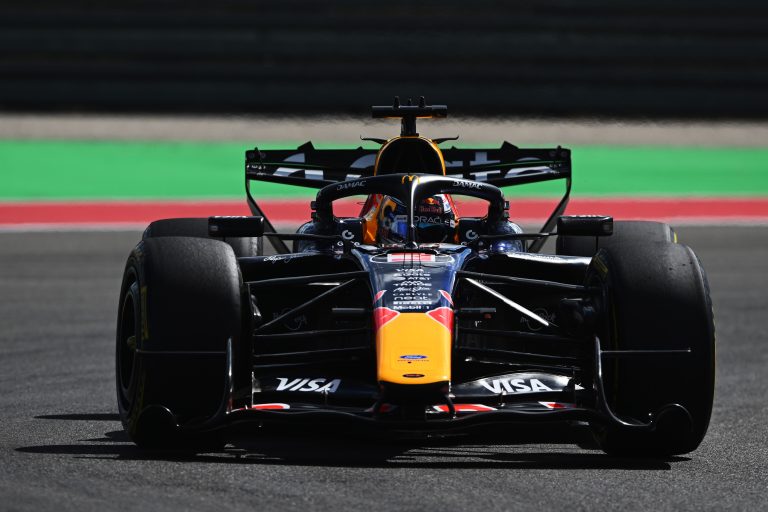
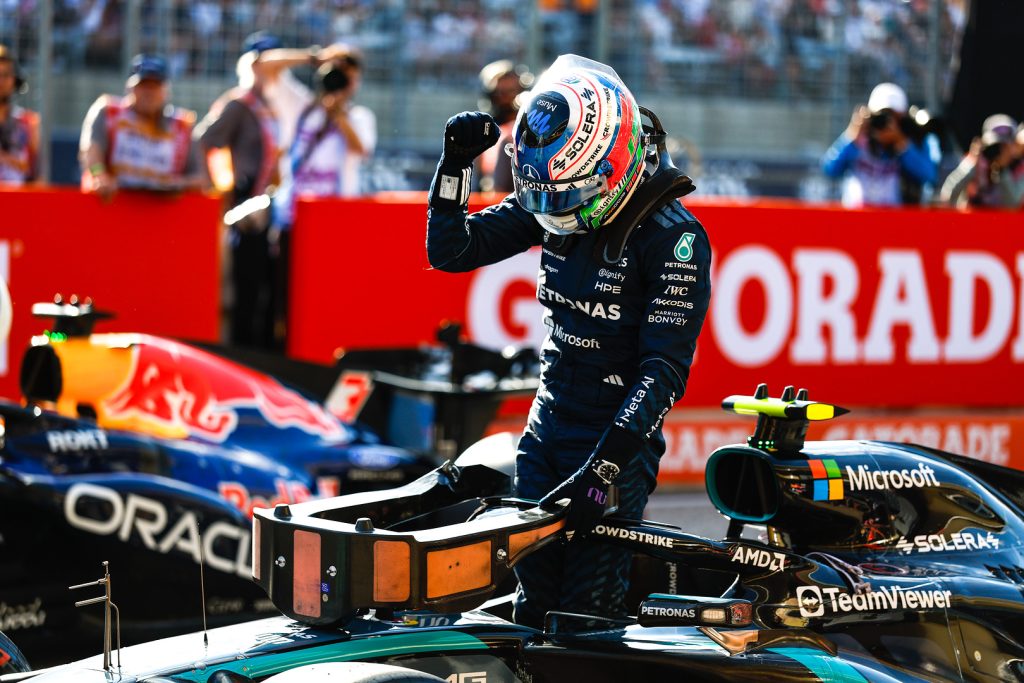
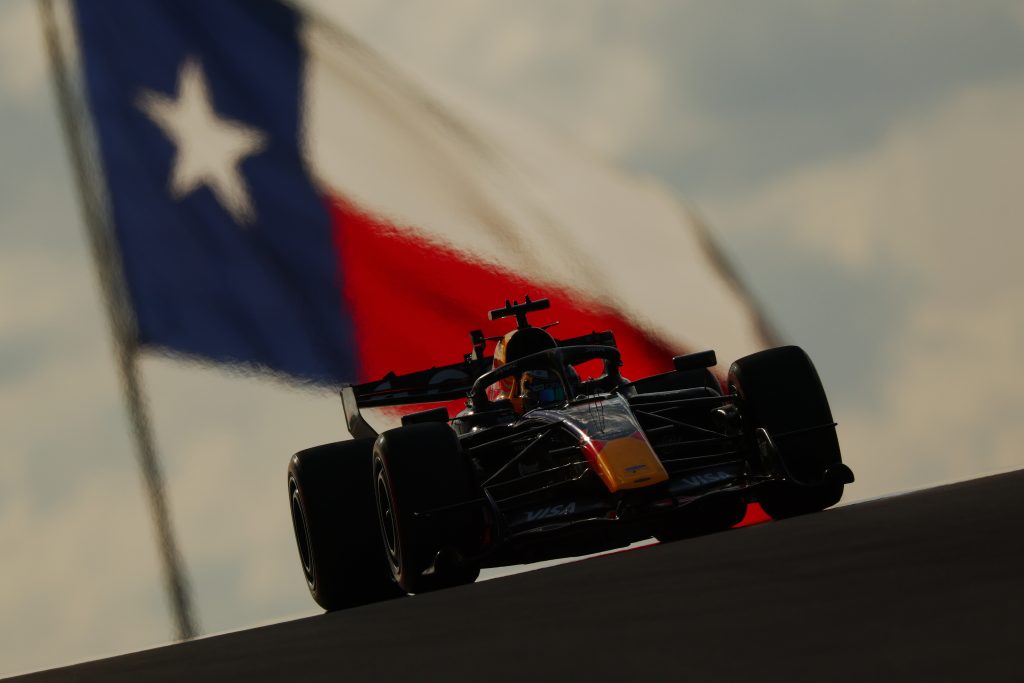
Red Bull represents the most immediate challenge to Antonelli’s hopes of converting pole into victory. Verstappen starts alongside the Italian on the front row, while Hadjar occupies third position, giving the Austrian team two cars inside the top three.
The qualifying result reinforces the recovery Red Bull has achieved during the second half of the championship. After struggling with competitiveness and consistency earlier in the year, the team has become increasingly effective at extracting performance from its 2026 package.
Verstappen arrived in Austin following consecutive victories in Malaysia and Singapore, and the Dutchman’s pace throughout Saturday suggested that Red Bull remains capable of fighting Mercedes on equal terms.
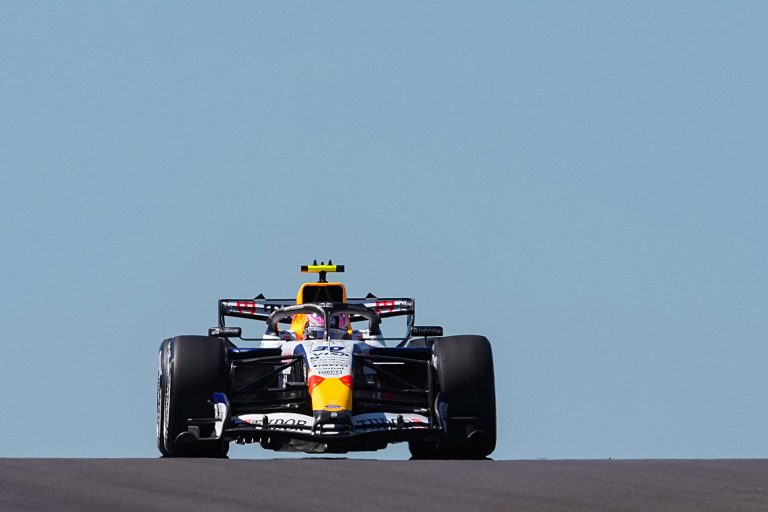
The performance of Hadjar is equally significant. His lap of 1min34s250 placed him just 0.036 seconds behind Verstappen, confirming that Red Bull’s competitiveness was not limited to the four-time world champion.
That gives the team greater flexibility in the race, particularly if both cars can maintain contact with Antonelli during the opening stint.
The strongest argument in Red Bull’s favour may be its long-run performance. The team demonstrated encouraging consistency on the soft tyres during practice, suggesting that it could remain competitive even if Mercedes enjoys a slight advantage over a single lap.
If Red Bull can manage degradation more effectively, Antonelli’s qualifying advantage could disappear as the opening stint develops.
However, the start remains a potential weakness. Red Bull has experienced difficulties with launches during the season, and Austin’s first corner provides little margin for error.
The run from the start line climbs sharply towards a wide uphill left-hander. Drivers can attack on different lines under braking, while those who lose momentum through Turn 1 risk being exposed through the high-speed sequence that follows.
Verstappen does not necessarily need a faster car than Antonelli to take control of the race. A better start could be sufficient, particularly if Red Bull can subsequently protect its tyres while running in clean air.
Team principal Laurent Mekies acknowledged that Red Bull had been hoping for pole after Verstappen’s performance in Q1 and Q2, but was satisfied with the team’s overall result.
“It was a solid qualifying session,” Mekies said. “Max was obviously aiming for pole after Q1 and Q2, especially as he did very few laps in those sessions.”
The Frenchman also pointed to the challenging conditions during Q3, suggesting that changing wind conditions may have affected the drivers’ ability to improve.
Mekies nevertheless believes the race will involve considerably more competitors than the two drivers starting on the front row.
“I’m sure Ferrari and Mercedes will be in the fight, and hopefully we will be there with Max and Isack,” he explained.
“Although McLaren was a little slower, we saw at several moments that Lando was incredibly quick. So I think there will be five or six cars fighting for victory.”
That assessment reflects the unusually close margins among the leading contenders. Just 0.276 seconds separated Antonelli from fifth-placed Hamilton, leaving several teams with realistic opportunities to influence the outcome.
Ferrari loses pole but remains dangerous after dominating practice
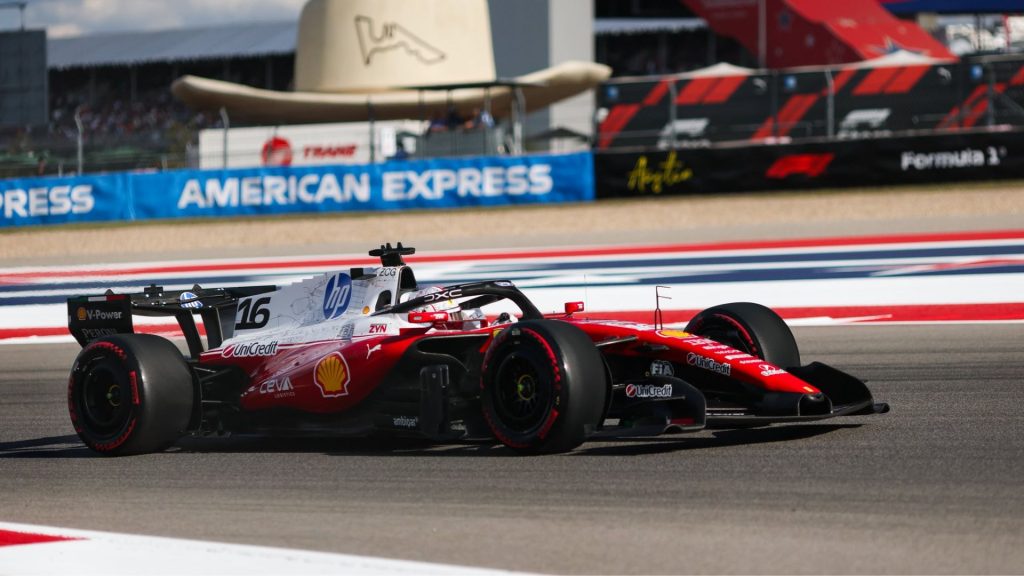
Ferrari’s qualifying result was disappointing, particularly considering the pace the Italian manufacturer demonstrated throughout the weekend.
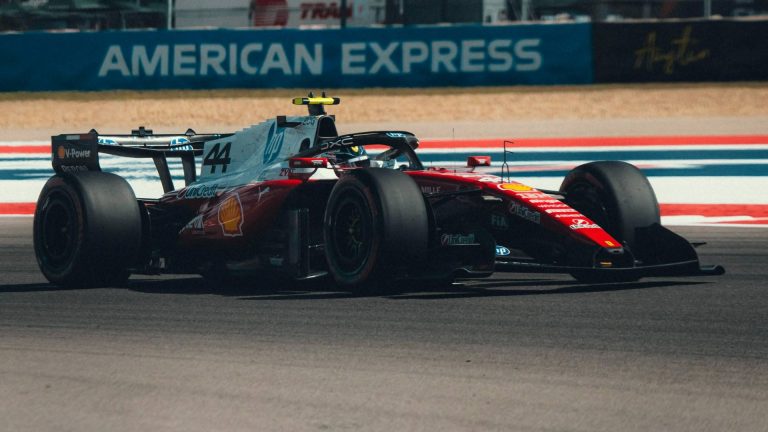
Leclerc led both Friday sessions, while Hamilton topped Saturday’s final practice session as Ferrari appeared increasingly comfortable with the demands of Circuit of The Americas.
The team’s improvement was especially evident in the second and third sectors, where its balance and tyre performance suggested that it had found an effective operating window.
For much of the weekend, Ferrari appeared capable of securing its first Grand Prix pole position of 2026.
But the decisive phase of qualifying exposed a different picture.
Track temperatures changed, affecting tyre behaviour, while both Leclerc and Hamilton made small mistakes that prevented them from reproducing their strongest practice performances.
Leclerc finished fourth, 0.232 seconds behind Antonelli, with Hamilton fifth at 0.276 seconds. Neither driver managed to improve sufficiently during the final attempts to challenge Mercedes or Red Bull.
Yet Ferrari’s failure to take pole should not be confused with a lack of race-winning potential.
The Italian team demonstrated competitive long-run pace during practice, while its ability to launch effectively could become an important advantage when the lights go out.
Leclerc starts immediately behind Hadjar, while Hamilton begins alongside Russell. Both Ferrari drivers are close enough to attack the front-running group during the opening corners.
The team’s main concern will be whether the tyre behaviour that affected qualifying also appears during longer stints.
If Ferrari can maintain its practice pace without excessive degradation, Leclerc and Hamilton could challenge not only for the podium but also for victory, especially if the leading drivers become involved in a prolonged battle.
Team principal Frédéric Vasseur acknowledged that Ferrari had failed to maximise its qualifying performance.
“We need to focus on ourselves and be careful about what we’re doing,” Vasseur said.
“I think we didn’t do our best in the last two sectors compared to what we had done before. The most important thing is to focus on that and fix it.”
The Frenchman insisted that the team still had the potential to deliver a stronger result during the remainder of the weekend.
Ferrari’s situation is therefore considerably more promising than its starting positions might suggest. The Scuderia missed an opportunity to lead the field away, but its underlying performance has given both drivers reasons to approach Sunday’s race with confidence.
Why tyre degradation could decide the battle between Mercedes, Red Bull and Ferrari
The central question ahead of the United States Grand Prix is not simply which car is fastest, but which team can sustain its performance while controlling tyre degradation.
Mercedes’ qualifying recovery showed that the W17 has enough speed to defeat its rivals over one lap. However, its difficulties with overheating raise questions about how consistently Antonelli and Russell can manage the tyres across a complete race stint.
Red Bull appears to have a competitive long-run package, particularly on the soft compound, while Ferrari has demonstrated both strong single-lap speed and encouraging race pace.
That creates the possibility of a contest in which the fastest car changes depending on the compound, track temperature and phase of the race.
Pirelli expects a one-stop strategy to be the most efficient option under normal conditions, although the choice of compounds remains open.
According to Pirelli’s Dario Marrafuschi, simulations indicate that a single pit stop offers the fastest overall race time, but several combinations could be effective.
The soft tyre’s superior initial grip makes it an attractive option for drivers seeking an advantage at the start, while the medium offers a potentially more balanced compromise between performance and durability.
The hard compound is also considered a viable choice for the second stint, regardless of whether a driver begins on softs or mediums.
If degradation proves greater than expected, teams could turn to a two-stop approach, potentially using a soft-medium-soft sequence.
The strategic picture is further complicated by the relatively small projected difference between one-stop and two-stop solutions. Track position, traffic and the timing of pit stops may therefore become just as important as outright tyre performance.
Main strategic factors for the United States Grand Prix
| Factor | Potential impact |
|---|---|
| Mercedes tyre overheating | Could limit Antonelli’s long-run pace |
| Red Bull soft-tyre consistency | May favour Verstappen and Hadjar early |
| Ferrari’s strong starts | Could help Leclerc and Hamilton gain positions |
| One-stop strategy | Expected to offer the best overall race time |
| Soft and medium compounds | Different opportunities for opening-stint performance |
| Hard tyre | Potential option for a longer final stint |
| Two-stop strategy | Alternative if degradation exceeds expectations |
| Track temperature and wind | Could change the competitive order |
A decisive factor will be the ability to avoid overheating the tyres while following another car.
Circuit of The Americas offers several overtaking opportunities, including the long straight towards Turn 12, but drivers operating in turbulent air can experience increased tyre temperatures and reduced aerodynamic performance.
For Antonelli, maintaining the lead at the start could therefore prove essential. Running in clean air would give the Mercedes driver more control over his tyre temperatures, while an early battle with Verstappen or Ferrari could accelerate degradation.
For Red Bull and Ferrari, the challenge is to stay close enough to exploit any weakness without damaging their own tyres in the process.
The outcome may ultimately depend less on Saturday’s qualifying margins than on which team can preserve performance over 20 or 30 consecutive laps.
McLaren’s difficult qualifying leaves Norris and Piastri chasing from behind
McLaren remains an important variable in the battle at the front, although its starting positions make victory considerably more difficult.
Oscar Piastri qualified seventh, 0.768 seconds behind Antonelli, while Lando Norris will start eighth after his fastest Q3 lap was deleted for exceeding track limits.
The British driver’s deleted time would have placed him sixth, but his next-best legal lap left him behind his teammate and both Mercedes, Red Bull and Ferrari cars.
The result was particularly frustrating because Norris had shown flashes of competitive pace during qualifying.
However, McLaren struggled to reproduce that speed consistently, and the team must now confront the challenge of recovering positions against several cars that appear closely matched on race pace.
The first lap will be important, especially given the possibility of overtaking into Turn 1. Yet McLaren’s recovery is likely to depend heavily on strategic decisions and its ability to preserve tyre performance while running in traffic.
A strong undercut or a well-timed pit stop could bring Norris and Piastri back into contention for the leading positions, particularly if the cars ahead become involved in close battles.
Nevertheless, McLaren begins the race at a disadvantage that Red Bull and Ferrari do not face. Its drivers must first clear traffic before they can fully exploit the car’s potential.
Antonelli can win the title in Austin, but Russell and Hamilton hold the key
The battle for victory carries additional significance because Antonelli has his first opportunity to secure the 2026 Formula 1 World Championship.
The Mercedes driver arrived in Austin with a 102-point lead over Russell and a 111-point advantage over Hamilton.
With five Grands Prix remaining after the United States Grand Prix, the maximum points available following Sunday’s race will be 125.
Antonelli therefore needs a specific combination of results to become champion.
What Antonelli needs to win the 2026 F1 title in Austin
| Driver | Required result |
|---|---|
| K. ANTONELLI | Win the United States GP |
| G. RUSSELL | Finish 9th or lower |
| L. HAMILTON | Finish 5th or lower |
Russell’s sixth-place qualifying result is particularly relevant. Although the British driver failed to match his teammate’s pace, he starts three places ahead of the position he would need to finish in for Antonelli to clinch the championship.
Hamilton, meanwhile, starts fifth for Ferrari, exactly the highest position he can occupy without preventing Antonelli from mathematically securing the title, provided Russell also finishes ninth or lower.
If Antonelli wins and Russell finishes ninth, the championship gap would reach exactly 125 points. However, the Italian would hold an insurmountable advantage on countback because of his superior number of Grand Prix victories.
The championship situation also changes the context of Mercedes’ race strategy.
Antonelli must win to secure the title in Austin, but the team also has a responsibility to maximise its Constructors’ Championship result. Russell remains an important part of that objective, even though his performance could delay his teammate’s title celebrations.
There is no indication that Mercedes intends to compromise Russell’s race for the sake of an early championship coronation.
That means Antonelli must focus primarily on defeating Verstappen, Hadjar, Leclerc and Hamilton rather than relying on his teammate’s result.
The full mathematical scenarios are detailed in GRANDE PRÊMIO’s guide to how Antonelli can win the 2026 F1 World Championship in Austin.
Antonelli has the grid advantage, but the race remains wide open
The United States Grand Prix presents a fascinating contrast between qualifying performance and race expectations.
Mercedes has the fastest driver over one lap, Red Bull appears particularly strong over longer runs, and Ferrari has shown enough pace throughout practice to remain a legitimate contender.
Antonelli’s performance deserves recognition because he succeeded precisely when Mercedes appeared most vulnerable. The Italian delivered the lap his rivals could not reproduce and placed himself in the strongest possible starting position.
Yet the performance of Verstappen and Hadjar means Red Bull has every reason to believe it can challenge for victory. Ferrari’s presence immediately behind adds another layer of uncertainty, particularly given the team’s strong starts and competitive practice pace.
The first stint should reveal whether Mercedes has truly solved its overheating problems or merely found a way to minimise their impact during qualifying.
If Antonelli can maintain the lead and control tyre temperatures, he will have a strong opportunity to convert pole into victory.
If Verstappen moves ahead at the start, Red Bull’s long-run performance could make the Dutchman difficult to dislodge. And if Ferrari reproduces the speed it demonstrated during practice, Leclerc and Hamilton could turn the race into a multi-team fight.
The most compelling aspect of Austin is therefore that Antonelli’s potentially championship-winning weekend remains far from straightforward.
He has already completed the first part of the task by securing pole position. The greater challenge is still ahead: defeating rivals whose race pace may be stronger than Saturday’s qualifying result suggests, while hoping Russell and Hamilton finish far enough behind for the championship to be settled.
The United States Grand Prix starts at 15:00 local time on Sunday, October 25, equivalent to 20:00 GMT in the United Kingdom, 16:00 Eastern Time in the United States, 01:30 IST on Monday in India and 09:00 NZDT on Monday in New Zealand.
GRANDE PRÊMIO is following every session of the United States Grand Prix at Circuit of The Americas this weekend, with breaking news, full coverage and real-time updates in its Formula 1 section.