Summary
- Audi brought a broad upgrade package to the Azerbaijan Grand Prix, including changes to the floor and bodywork.
- Auto motor und sport reports that the floor stay’s junction with the sidepod allows a sharper aerodynamic edge than the bodywork rules would otherwise permit.
- Red Bull used the same approach in its Austrian GP upgrade. Baku’s results did not establish how much performance Audi gained from the new package.
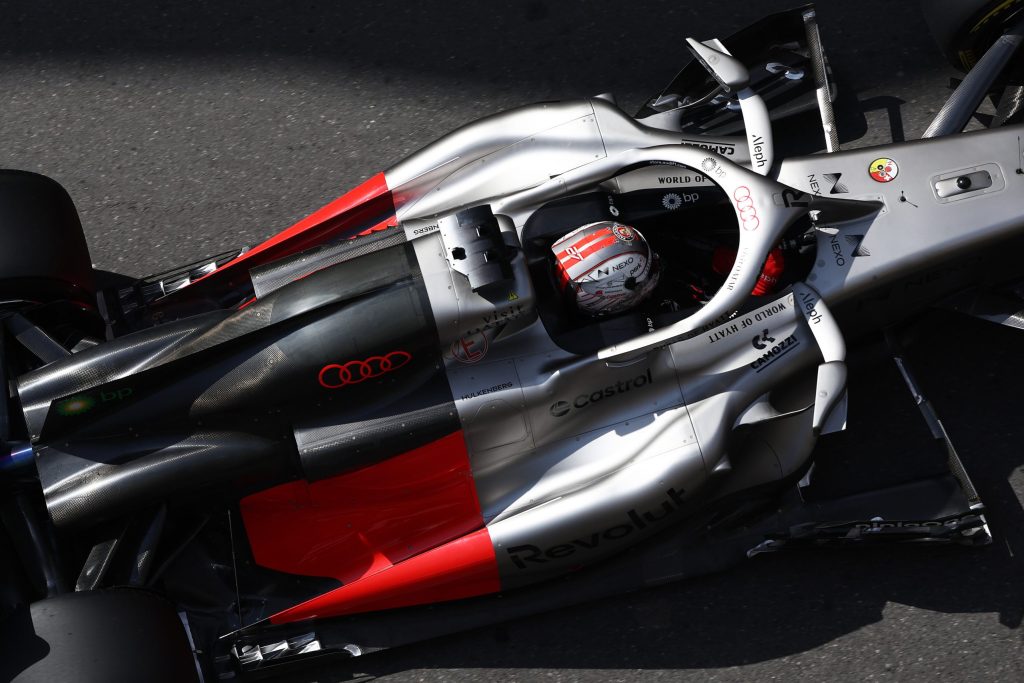
Audi’s Azerbaijan Grand Prix upgrade contained a small detail with a larger aerodynamic purpose. Where a support for the floor meets the sidepod, the R26 now has a sharp edge that helps define the channel carrying air towards the rear of the car.
The explanation, reported by auto motor und sport, lies in how that junction is classified under the regulations. The edge is formed at the floor support’s attachment rather than treated simply as part of the surrounding bodywork. According to the German publication, that distinction gives designers room to make the contour sharper despite the radius restrictions that apply to the sidepod surface.
A floor stay normally braces the floor and limits movement. In this arrangement, its attachment also serves an aerodynamic purpose: it helps hold the airflow within the channel running along the upper sidepod.
Red Bull introduced the same idea with its major sidepod upgrade at the Austrian Grand Prix at the end of June. Audi’s Baku design follows that approach. The resemblance identifies an adopted design principle; it does not establish how Audi developed its version or how much lap time this particular detail is worth.
How does the Audi sidepod detail work?
The relevant part is the point where the floor stay joins the sidepod. A stay is a structural support, but its attachment changes the shape of the surface around it. By placing a pronounced contour at that junction, Audi can better define the edge of the channel through which air travels rearwards.
The regulation detail matters because a team cannot freely draw a knife-sharp edge anywhere on the sidepod. The treatment of the floor attachment creates an exception to the radius constraints at the point where the two parts meet.
That makes the solution more specific than a general claim that Audi “copied Red Bull’s sidepods”. The reported similarity concerns the use of the floor support and its junction with the bodywork. It does not mean the cars have identical sidepods, floors or overall aerodynamic packages.
Audi submitted changes across 14 categories for Baku, including the front and rear wings, floor and bodywork. The floor-stay detail was one element of a substantially revised R26, following the team’s first major upgrade since June.
Did the Baku upgrade make Audi faster?
Audi’s initial assessment was encouraging, but the Azerbaijan weekend did not produce a clear competitive breakthrough. Team principal Mattia Binotto said after practice that the early data matched the team’s expectations.
“The package is delivering as expected,” Binotto said.
Gabriel Bortoleto was tenth in FP1 and 14th in FP2. Speaking to GRANDE PRÊMIO after the second session, he said the car had lost grip and that the team still needed to understand why. His account of Audi’s difficult practice day showed why the timing sheet alone could not settle the question of whether the upgrade worked.
The distinction is between the package behaving as Audi predicted in its data and the car immediately moving forward against its rivals. The first was Binotto’s preliminary assessment. The second remained uncertain after Baku.
Sepang offers another test. Its corners, heat and long runs place different demands on the car from Baku’s long straights and slow sections. If Audi carries the package into the Malaysian weekend, engineers will have another set of conditions in which to compare its behaviour with their simulations.
For Formula 1 teams, studying a rival’s useful idea and developing their own version is routine. The question now is whether Audi’s interpretation of Red Bull’s floor-stay concept helps the R26 deliver more consistent performance on track.
F1 today: FAQ
What time is Singapore GP sprint qualifying today?
Sprint qualifying starts at 20:30 Singapore time on Friday, October 9, equivalent to 13:30 BST in the UK, 08:30 ET in the United States and Canada, and 18:00 IST in India. The session determines the starting grid for Saturday’s sprint.
Who was fastest in Singapore GP FP1?
George Russell topped FP1 with a 1:32.274, driving Mercedes’ older W17 aerodynamic specification. Charles Leclerc finished second, 0.198s behind, followed by Lando Norris in third. Kimi Antonelli was seventh with the upgraded Mercedes, while Gabriel Bortoleto finished 16th.
Why is George Russell using the old Mercedes at the Singapore GP?
Mercedes is comparing its previous W17 specification with the aerodynamic upgrade introduced at Sepang. Russell is using the older package, while championship leader Kimi Antonelli retains the new version. Russell led FP1, but differences in tyre compounds and run programmes mean the result alone does not establish which specification is faster.
Did Audi copy Red Bull’s sidepod?
Auto motor und sport reports that Audi adopted the same floor-stay concept Red Bull introduced in Austria. The available account supports a similarity in that specific design solution, not a claim that the entire sidepod or upgrade package was copied.