News Summary
- Ferrari squandered its strongest opportunity to win in 2026 after Lewis Hamilton and Charles Leclerc collided in a battle for the lead during the Mexican Grand Prix.
- The incident exposed a recurring problem in Ferrari’s management of its drivers, with Frédéric Vasseur expressing anger but refusing to assign individual responsibility.
- Ferrari must establish clear rules and consequences for its drivers, rather than allowing internal disputes to undermine the technical progress made by the team.
Analysis | Based on an opinion column by Evelyn Guimarães, GRANDE PRÊMIO Brazil
Ferrari may have reached a point of no return. The 2026 Mexico City Grand Prix offered the Italian team its clearest opportunity of the season to return to winning ways, with Lewis Hamilton on pole position and Charles Leclerc starting third. Instead, an aggressive opening-lap confrontation between the teammates handed Max Verstappen the opportunity he needed and exposed a much deeper problem within the Scuderia.
Ferrari’s problem is no longer simply whether Hamilton and Leclerc can race each other. It is whether Frédéric Vasseur has the authority and willingness to prevent their rivalry from compromising the team’s interests.
The Frenchman has repeatedly called for unity and respect, but those appeals have not prevented another damaging confrontation. After Mexico, words alone are no longer enough.
Ferrari finally had the car to win — and threw away its opportunity
Ferrari’s technical progress in recent weeks had been unmistakable.
Following a difficult stretch of the season, the SF-26 became increasingly competitive, particularly in its tyre management and aerodynamic balance. Mexico provided the clearest evidence of that improvement.
The car adapted exceptionally well to the characteristics of the Autódromo Hermanos Rodríguez, where altitude, cooling demands and tyre behaviour can expose weaknesses in even the strongest packages.
Hamilton’s first pole position for Ferrari was no accident. Leclerc’s third place reinforced the impression that Ferrari finally possessed the machinery to challenge for victory on equal terms.
But having a competitive car is only half the equation. The other half is executing a race without allowing internal competition to become self-destructive.
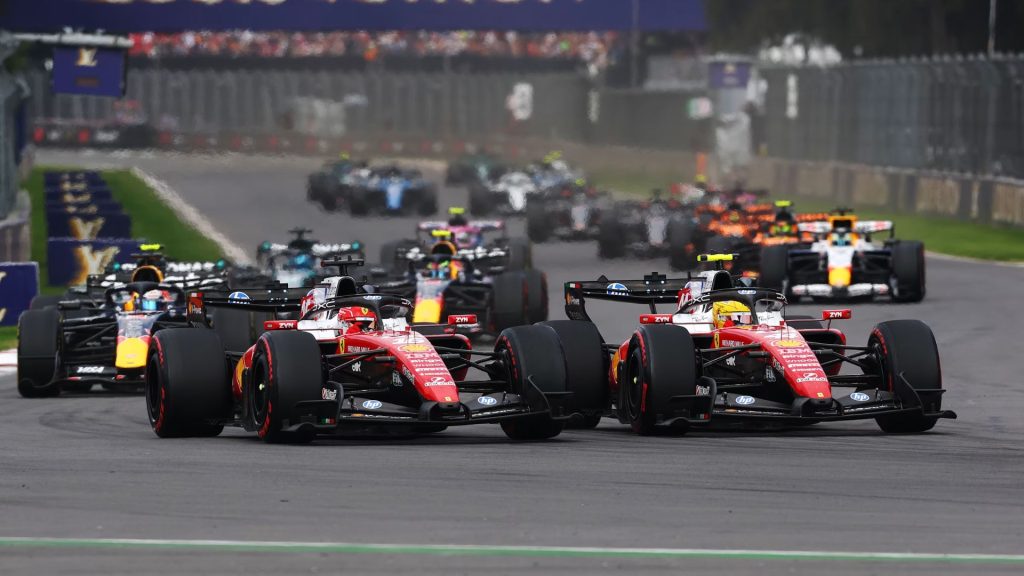
Hamilton made a strong start and retained the lead, while Leclerc moved into contention after passing George Russell.
The Monegasque then attacked his teammate through the opening corners, with their confrontation escalating at Turn 4.
Leclerc left the circuit and completed an overtake outside the track limits, while Hamilton also ran wide. The incident allowed Verstappen to move ahead of the seven-time champion.
The stewards eventually imposed a five-second penalty on Leclerc, ruling that he had gained a lasting advantage. They reduced the standard ten-second sanction because Hamilton had also failed to remain within the track limits.
Ferrari had entered the opening sequence with a chance to control the race. Within moments, its drivers had compromised that advantage themselves.
Leclerc’s aggression raises questions Ferrari can no longer avoid
Leclerc is unquestionably one of the fastest and most naturally talented drivers on the Formula 1 grid.
His qualifying speed and ability to extract performance from difficult machinery have repeatedly made him Ferrari’s reference point.
But talent alone is not sufficient for a team attempting to return to championship contention.
Mexico was not an isolated episode.
Earlier in the season, tensions emerged over team orders and differing strategies at Zandvoort. Another confrontation at Monza added to the friction between the drivers.
Those incidents were damaging, but Mexico represented a more serious escalation because Ferrari had a genuine opportunity to win.
Hamilton’s post-race criticism was unusually direct.
The British driver argued that the opening-lap incident cost Ferrari victory and demanded serious discussions behind closed doors.
His frustration was understandable. Ferrari had finally produced a car capable of fighting at the front, yet the internal battle created an opening for Red Bull.
Leclerc, for his part, argued that Hamilton had also pushed him wide and that aggressive racing was inevitable when victory was at stake.
That perspective deserves consideration. Formula 1 drivers cannot be expected to surrender every opportunity simply because their teammate is alongside them.
But there is a fundamental difference between a legitimate contest and a manoeuvre that places the entire team’s result at risk.
Knowing when not to attack is as important as knowing how to overtake.
That is the distinction Ferrari needs its drivers to understand.
Vasseur demands respect but avoids the hardest decision
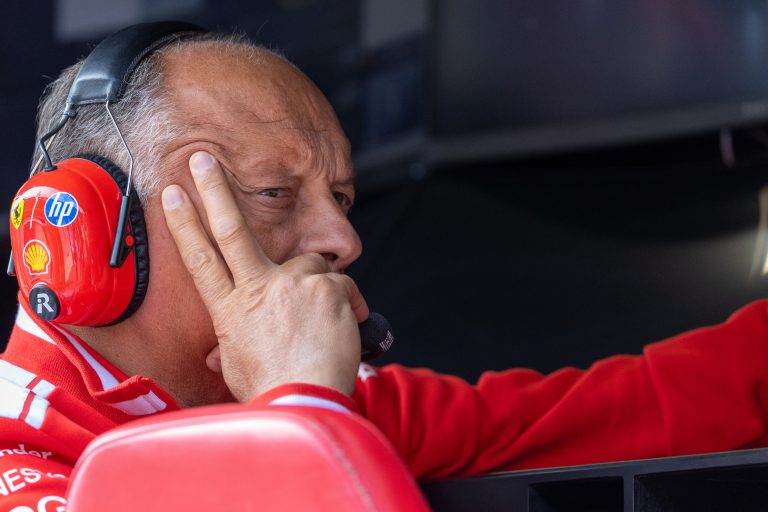
Vasseur’s response after the race revealed the scale of his frustration.
The Ferrari team principal described the lost victory as a lack of respect for the manufacturer, its sponsors and the approximately 2,000 people working behind the Formula 1 operation.
He also acknowledged that the team had made a significant step forward in performance, making the missed opportunity particularly difficult to accept.
However, Vasseur refused to single out Leclerc, pointing out that Hamilton had also run wide.
That is where Ferrari’s leadership problem becomes apparent.
Vasseur is entitled to avoid publicly humiliating either driver. Internal disciplinary matters do not necessarily need to be settled through the media.
But refusing to identify responsibility publicly must not become an excuse for avoiding difficult decisions internally.
If Ferrari wants its drivers to respect the team, the team must establish what happens when those expectations are ignored.
The distinction matters because the problem is recurring.
Ferrari cannot continue treating each confrontation as an isolated misunderstanding, particularly when similar tensions have surfaced across different races and strategic circumstances.
Vasseur has repeatedly emphasised that the drivers represent something larger than themselves. Mexico demonstrated why that principle needs to be enforced rather than merely repeated.
Hamilton’s experience offers Ferrari an uncomfortable comparison
Hamilton arrived at Ferrari with seven world championships and extensive experience managing the relationship between individual ambition and collective responsibility.
His years at Mercedes included some of the most intense teammate rivalries in modern Formula 1, particularly with Nico Rosberg.
He understands that competition between teammates can become unavoidable when both have the machinery to win.
But Hamilton has also seen what happens when internal battles consume a team’s attention and create opportunities for rivals.
After Mexico, he argued that Ferrari could have achieved a one-two finish had the opening-lap confrontation been handled differently.
That claim cannot be established with certainty. Verstappen’s pace, race strategy and the subsequent red flag would still have influenced the outcome.
Nevertheless, the essential point remains: Ferrari made its task more difficult through a confrontation between its own drivers at the very moment it needed coordinated execution.
Hamilton also questioned the mentality behind taking excessive risks against a teammate when the team is fighting for victory.
It is an uncomfortable issue for Ferrari, particularly given Leclerc’s long-standing status within the organisation.
The Monegasque has spent eight seasons with the Scuderia, becoming central to its ambitions and identity.
But Ferrari must ask whether its approach to managing him has delivered the consistency and collective discipline required to win championships.
That question does not diminish Leclerc’s talent. It recognises that individual speed and leadership within a championship-winning operation are different qualities.
Ferrari must choose between accountability and another season of frustration
There is no requirement for Ferrari to declare Hamilton its number-one driver or permanently subordinate Leclerc.
Taking sides does not necessarily mean imposing a fixed hierarchy for every race.
It means deciding what kind of behaviour is acceptable, establishing clear expectations and applying consequences consistently.
The team must define how its drivers should approach the opening laps when both are fighting for victory, when position exchanges are necessary and when preserving the collective result takes priority over individual ambition.
It must also demonstrate that those rules apply regardless of reputation, contractual status or previous achievements.
Ferrari cannot demand teamwork while allowing each driver to interpret the team’s interests according to his own circumstances.
The next race at Interlagos provides an immediate opportunity to respond.
Ferrari has shown that its technical development is producing results. Hamilton’s pole in Mexico and the team’s recent race pace suggest that the SF-26 can compete for victories.
But another competitive weekend will mean little if the team once again loses control of the battle between its drivers.
Vasseur has said he intends to speak with Hamilton and Leclerc. That conversation now needs to produce more than another appeal for mutual respect.
Ferrari must decide whether it is prepared to enforce the standards required of a winning team.
Because the greatest threat to Ferrari’s next victory may no longer come from Red Bull, Mercedes or McLaren — but from its inability to manage the competition inside its own garage.
GRANDE PRÊMIO is following the 2026 Formula 1 World Championship with breaking news, full coverage and real-time updates in its Formula 1 section.