News Summary
- The FIA identified a software issue that caused unexpected power losses at low engine speeds during the Sepang formation lap.
- The emergency configuration introduced in Malaysia will remain available for Singapore if similar wet conditions are expected.
- A further wet-weather software update is planned before the United States GP on October 25.
The FIA has completed its investigation into the software failure that disrupted the start of the Bahrain GP in Malaysia and confirmed that the emergency correction introduced at Sepang will remain available for the Singapore GP if similar wet-weather conditions are expected.
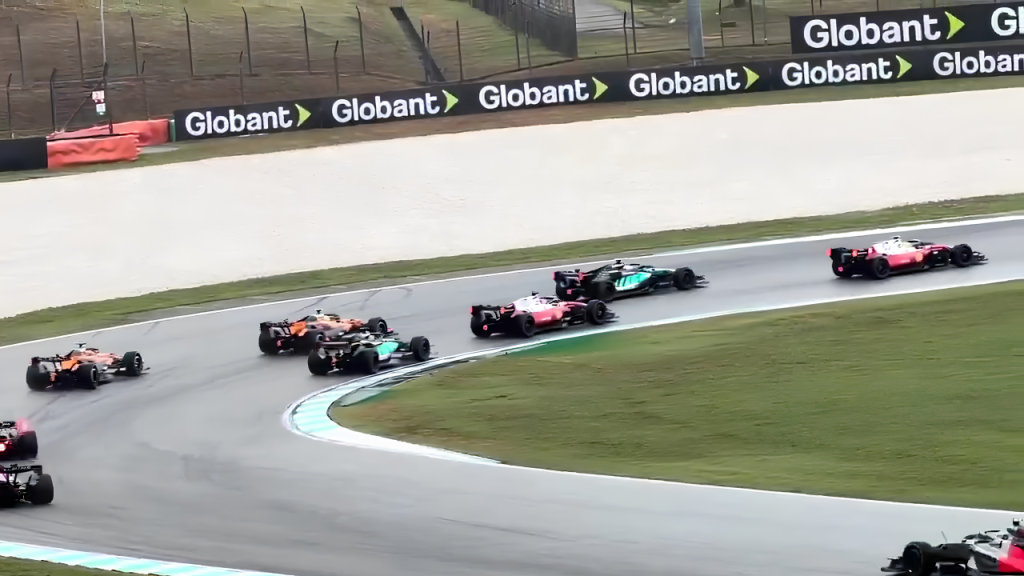
Several cars experienced sudden power losses during the formation lap in Malaysia, forcing race control to interrupt the start procedure while Formula 1 and its power-unit manufacturers investigated the problem. The race eventually began after an emergency software configuration was distributed.
The FIA has now identified why the original system behaved unexpectedly.
Software reduced engine power beyond intended limits
The problem occurred when cars were running at low engine speeds in circuit sectors where the software applied a 250kW power reduction under wet-weather energy-management settings.
According to the FIA, the reduction exceeded its intended effect in certain circumstances, leaving affected cars unable to recover power while remaining in those sectors.
The malfunction was particularly disruptive because the cars were travelling slowly during the formation lap, rather than operating at normal racing speeds. Several drivers suddenly found themselves without the expected engine response, creating confusion across the field.
The FIA and power-unit manufacturers responded by introducing a revised configuration before restarting the race.
Singapore will retain the emergency solution
The governing body confirmed that the configuration used to resolve the Sepang problem will be reinstated in Singapore if comparable weather conditions are forecast.
That decision is particularly relevant because rain remains a possibility at Marina Bay, where Formula 1 will race at night on a street circuit that offers little margin for unexpected changes in vehicle behaviour.
The FIA is also preparing another wet-weather software update for the United States GP on October 25, rather than treating the emergency configuration as the final solution.
Its investigation identified the need for stronger validation procedures, including additional independent assessment and closer collaboration with teams, power-unit manufacturers and the supplier of Formula 1’s standardised electronic control unit.
Limited wet-weather testing contributed to the problem
Formula 1’s 2026 regulations introduced substantially different power-unit energy-management requirements, increasing the importance of software controlling electrical deployment and recovery.
Although the relevant configurations had undergone simulation and limited track testing, opportunities to reproduce extreme wet-weather conditions had been restricted.
The FIA’s review therefore recommended improvements to the testing and verification process, particularly for situations in which low engine speeds interact with wet-weather power restrictions.
Singapore’s sprint format adds another complication. Teams have only one free-practice session before sprint qualifying on Friday, leaving limited time to evaluate any unexpected behaviour.
The complete Singapore GP schedule and session times are available in GRANDE PRÊMIO‘s weekend guide.
F1 today: FAQ
What time is the 2026 Singapore GP?
The Singapore GP starts at 20:00 local time on Sunday, October 11. That is 13:00 in the UK, 08:00 ET in the US and Canada and 17:30 in India. Singapore is a sprint weekend, with sprint qualifying on Friday and the sprint on Saturday.
Why does George Russell have a grid penalty in Singapore?
Russell has exhausted his permitted allocation of four engines after suffering a power-unit failure at Sepang. Mercedes must introduce another unit, triggering a grid penalty for Sunday’s Grand Prix. The penalty does not apply to Saturday’s sprint.
Can Kimi Antonelli win the F1 championship in Singapore?
No. Antonelli leads Russell by 84 points, 320 to 236, but cannot mathematically secure the 2026 title in Singapore. His first opportunity to become world champion comes at the United States GP in Austin.
What caused the F1 software failure at Sepang?
The FIA identified a problem involving a 250kW power reduction applied at low engine speeds. Under certain conditions, cars lost more power