News Summary
- Lance Stroll retired from the São Paulo Grand Prix with a battery-related problem after losing power during the race.
- Honda suspects the ERS issue may be related to a problem detected earlier in the weekend, but has not confirmed the underlying cause.
- Fernando Alonso finished 12th after qualifying eighth, highlighting Aston Martin’s improved cornering performance but continuing straight-line deficit.
Honda is investigating another energy recovery system failure after Lance Stroll retired from the São Paulo Grand Prix, raising fresh reliability concerns for Aston Martin just one week after both cars failed to finish in Mexico City.
The Canadian lost power during Sunday’s race at Interlagos and was forced to retire, leaving Fernando Alonso as the team’s only finisher. Although Aston Martin showed encouraging performance in changing conditions, its Honda power unit again prevented the team from completing a race with both cars.
Honda trackside general manager and chief engineer Shintaro Orihara confirmed that the manufacturer suspects a connection with a problem encountered earlier during the Brazilian weekend, but stressed that the exact cause remains unknown.
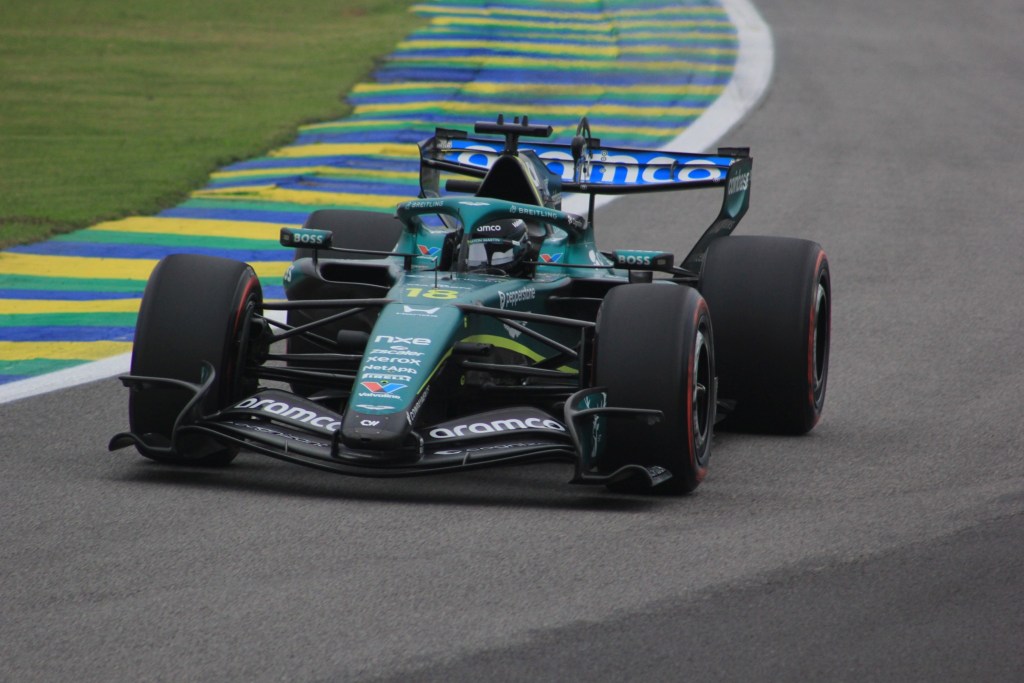
Honda investigates another ERS failure
Stroll started 16th and struggled to make progress during the opening stages as the track gradually dried. He was running outside the points when his Aston Martin developed a power problem.
The Canadian managed to return towards the pits, but the issue prevented him from continuing.
“We had to retire the car on Lap 30 due to a battery issue,” Stroll said in Honda’s official post-race report.
“It’s been another challenging weekend at the end of a long triple header, but we know the areas we need to work on for next year. We now focus on the final push of the season and will use the time before we head to Las Vegas to see where we can make improvements on our current performance.”
Orihara acknowledged that the failure had interrupted what had otherwise been a more encouraging weekend for Honda.
“The race began well from a power unit perspective until we suffered an ERS issue on Lance’s car on Lap 30. From the data, we suspect it’s the same problem as yesterday and we need to find the root cause of this before the next race.”
The manufacturer has not confirmed whether the failure was caused by the same cooling problem that affected Aston Martin in Mexico City. The distinction is important because Honda had introduced countermeasures before travelling to Brazil.
Aston Martin suffers another setback after Mexico disaster
The latest retirement follows a particularly difficult Mexican Grand Prix, when Fernando Alonso and Lance Stroll both retired within the opening laps.
Honda subsequently acknowledged that the high altitude at the Autódromo Hermanos Rodríguez had placed greater stress than anticipated on its ERS cooling circuit.
Alonso had already experienced an MGU-K problem during qualifying, and the same issue returned during Sunday’s race. Stroll was also forced to stop, leaving Aston Martin without either car after just five completed laps.
The manufacturer identified the cooling system as a major factor behind the Mexican failures, prompting hardware and software countermeasures for Interlagos.
Brazil’s lower altitude and cooler conditions were expected to reduce the demands on the power unit. Nevertheless, Stroll’s retirement demonstrated that Honda still has unresolved reliability concerns.
Orihara said the manufacturer would continue analysing the data in the United Kingdom and Japan before Las Vegas.
“The overall result today is better considering the tough outcome we had at the last event. The work will now continue in the UK and Japan to prepare for Las Vegas Grand Prix.”
Alonso highlights Aston Martin’s strong cornering performance
Despite Stroll’s retirement, Alonso completed the São Paulo Grand Prix in 12th place after qualifying eighth, Aston Martin’s best starting position of the season.
The two-time world champion was involved in several battles, including an opening-lap incident with Oliver Bearman and a later fight with Alexander Albon.
Alonso acknowledged that the AMR26 had performed competitively through the corners, although a lack of straight-line speed prevented him from turning that advantage into points.
“The car felt strong today, particularly in the corners, and we were having some good fights out on track,” Alonso said.
“I think it was one of our most competitive races, but we were struggling for performance on the straights.”
“We made a strong start in the wet conditions, but then I couldn’t avoid contact with Ollie [Bearman] who lost some control of his car in Turn 3. There are positives to take from this weekend, and we need to keep working hard to close the gap for next year.”
Aston Martin chief trackside officer Mike Krack also highlighted the team’s improved competitiveness.
“Mixed fortunes for us today: a strong drive from Fernando to finish P12 and Lance unfortunately retiring with a battery issue.”
“Overall we must be satisfied with the outcome of the weekend as we were ahead of competitors with faster cars in Qualifying and Race.”
Honda turns attention to Las Vegas reliability
The contrast between Aston Martin’s chassis performance and its power-unit reliability remains a significant concern heading into the final three races.
Orihara welcomed Alonso’s qualifying performance, describing eighth place as an encouraging result for the partnership.
“Fernando’s eighth place on the grid is our highest starting position of the year with the Aston Martin Aramco Formula One Team and that is encouraging.”
“In the mixed weather conditions during the race, we kept adapting the power unit settings well to the wet and the dry running.”
Honda now has until the Las Vegas Grand Prix on November 19–21 to investigate Stroll’s failure and determine whether additional measures are required.
GRANDE PRÊMIO is following the final rounds of the 2026 Formula 1 championship, with breaking news and real-time updates in its Formula 1 section.