News Summary
- Bahrain confirmed intercepting Iranian aerial attacks on November 15, while Tehran claimed to have launched six drones against a US military radar installation.
- The reported target at Riffa Air Base is approximately 110 km in a straight line from Lusail International Circuit, which is scheduled to host Formula 1 on November 27–29.
- Formula 1 reaffirmed plans to race in Qatar and Abu Dhabi on November 10, releasing Imola from its standby arrangements but retaining the option to reassess security.
Iranian attacks on Bahrain have renewed security concerns surrounding Formula 1’s final two Grands Prix of 2026, just five days after the championship confirmed its intention to race in Qatar and Abu Dhabi. Bahrain reported intercepting Iranian aerial attacks on Sunday, November 15, while Tehran claimed to have targeted a US military radar installation approximately 110 km from Lusail International Circuit.
The escalation comes at a particularly sensitive moment for Formula 1. The Qatar Grand Prix is scheduled for November 27–29, followed by the Abu Dhabi season finale on December 4–6.
Both races remain on the calendar, and neither Formula 1 nor the FIA has announced a change following Sunday’s developments.
However, the renewed hostilities challenge the security assessment underpinning the decision to proceed with both events.

Iran claims six-drone attack on US radar in Bahrain
Bahrain’s Interior Ministry issued emergency alerts on Sunday morning, urging residents to remain calm and seek shelter as the country’s air defences responded to aerial threats.
The Bahrain Defence Force subsequently confirmed that its systems had intercepted Iranian attacks.
Iran’s Islamic Revolutionary Guard Corps claimed responsibility for launching six drones against an American air-defence radar at Riffa Air Base, a helicopter facility in Bahrain.
According to Reuters, the Iranian military described the operation as retaliation for what it considered hostile US actions.
The claimed destruction or damage of the radar has not been independently verified. At the time of the initial reports, neither American nor Bahraini authorities had confirmed that the installation had been struck.
The incident followed another Iranian claim on November 13 involving a US radar facility in Bahrain. On that occasion, the United States said it had intercepted two drones without casualties or damage.
The latest exchange marks a renewed escalation in the conflict that has disrupted security across the Gulf since February.
How close were the attacks to Qatar’s Lusail F1 circuit?
The reported target, Riffa Air Base, is located in Bahrain’s Southern Governorate.
Using the publicly documented coordinates of the airbase and Lusail International Circuit, the distance between the two facilities is approximately 110 km (68 miles) in a straight line.
That is a geographical measurement between the reported target and the Formula 1 venue, not evidence that drones entered Qatari airspace or approached the circuit.
| Location | Relevance to F1 |
|---|---|
| Riffa Air Base, Bahrain | Reported target of the Iranian drone operation |
| Lusail International Circuit, Qatar | Approximately 110 km away in a straight line |
| Qatar Grand Prix | November 27–29, 2026 |
| Abu Dhabi Grand Prix | December 4–6, 2026 |
The proximity illustrates why developments in Bahrain remain relevant to events taking place elsewhere in the Gulf.
However, there is no confirmed report that Sunday’s drones targeted Qatar, Lusail or any Formula 1 facility.
The distinction is important: the renewed military activity raises regional security questions without establishing an immediate threat to the race circuit.
F1 dropped Imola backup only five days before new attacks
On November 10, Formula 1 informed organisers at Imola that the Italian circuit would no longer be required as a potential replacement for the season finale.
The decision followed months of uncertainty over the viability of racing in Qatar and Abu Dhabi during the conflict involving Iran, the United States and Israel.
Imola had prepared for a possible December event, but the championship concluded that the available security assessments supported maintaining the original calendar.
As GRANDE PRÊMIO reported when F1 abandoned the replacement plan, organisers also acknowledged that the decision could be reviewed if circumstances deteriorated.
In its explanation, Formula 1 said that commercial activity had resumed in both countries, travel arrangements remained viable and major sporting events were taking place.
The championship nevertheless stressed that the safety of personnel would remain its priority.
Sunday’s attacks do not automatically invalidate those assessments, but they represent a new development that organisers must consider.
With Imola released from its contingency arrangements, Formula 1 has also lost its most developed alternative for replacing a Middle Eastern race at short notice.
Middle East conflict has already disrupted 2026 F1 calendar
The uncertainty surrounding Qatar and Abu Dhabi is not new.
The current conflict intensified on February 28, when the United States and Israel launched military operations against Iran. Tehran responded with attacks targeting American military facilities and infrastructure across the Gulf.
The consequences quickly reached Formula 1.
Activities involving teams and tyre supplier Pirelli were disrupted, while travel restrictions and concerns over regional airspace complicated preparations.
The Bahrain and Saudi Arabian Grands Prix were subsequently affected by the conflict. Formula 1 ultimately abandoned its original plans for the events, with the Bahrain round relocated to Malaysia and the Saudi Arabian race removed from the schedule.
The championship then spent several months evaluating whether Qatar and Abu Dhabi could safely host the final rounds.
In October, GRANDE PRÊMIO reported that Imola was being prepared as a possible alternative.
The situation also prompted warnings for international travellers.
British government travel advice examined by GRANDE PRÊMIO highlighted the potential for airspace closures, flight disruption and sudden changes to security conditions.
Those concerns remain relevant even when racing venues are not directly threatened.
FIA and F1 face difficult security decisions
FIA president Mohammed Ben Sulayem has repeatedly expressed confidence that the championship can conclude its season in Qatar and Abu Dhabi.
On November 10, he reaffirmed the governing body’s commitment to both events.
“We are ready for Qatar and Abu Dhabi,” Ben Sulayem said.
The statement was followed by Formula 1’s decision to release Imola from its standby arrangements.
As GRANDE PRÊMIO reported, the FIA president presented the remaining Grands Prix as central to the planned conclusion of the championship.
However, staging a Grand Prix requires more than determining whether the circuit itself is safe.
Teams must transport equipment, move hundreds of personnel between countries and maintain access to airports, hotels, hospitals and emergency services.
Formula 1 has already discussed contingency arrangements with its teams, including scenarios in which personnel might need to leave the region at short notice.
GRANDE PRÊMIO previously detailed those logistical preparations, with equipment assigned to the final two rounds before the paddock’s arrival.
The latest attacks in Bahrain could prompt fresh assessments of those arrangements.
Could the 2026 F1 season end in Las Vegas?
The possibility remains open if the final two Grands Prix cannot proceed.
Las Vegas is scheduled to host the next race on November 21, before the championship moves to Qatar and Abu Dhabi.
With Imola no longer preparing to replace a cancelled event, Las Vegas could become the final round if both Middle Eastern races were abandoned without replacements.
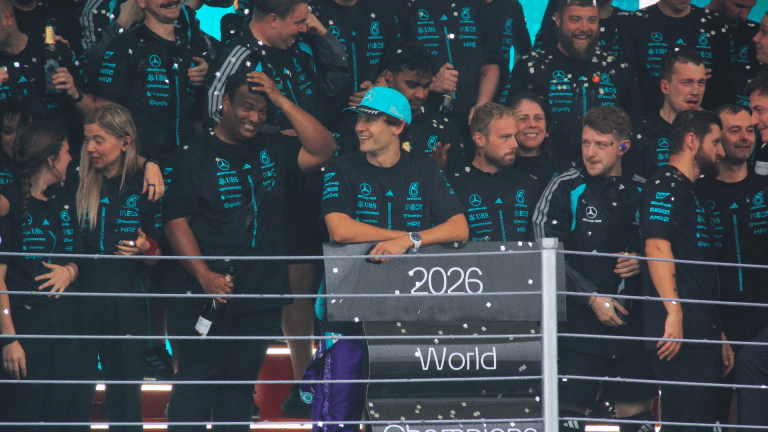
That would be a significant change to the championship’s conclusion, even though Andrea Kimi Antonelli and Mercedes have already secured the drivers’ and constructors’ titles.
Several other positions remain undecided, including the battle for second place in the drivers’ championship and important constructors’ standings.
For now, the official programme remains unchanged.
The renewed attacks in Bahrain have nevertheless brought the security question back into focus less than two weeks before Formula 1 is scheduled to race in Qatar.
GRANDE PRÊMIO is following developments affecting the final rounds of the 2026 Formula 1 championship.