
News Summary
- Lando Norris identified straight-line speed as one of McLaren’s main weaknesses after its difficult Malaysian GP.
- The reigning champion says the team has been working to understand why its performance declined compared with Budapest, Zandvoort and Madrid.
- Norris believes Singapore could reduce the impact of that weakness because outright straight-line speed is less important at Marina Bay.
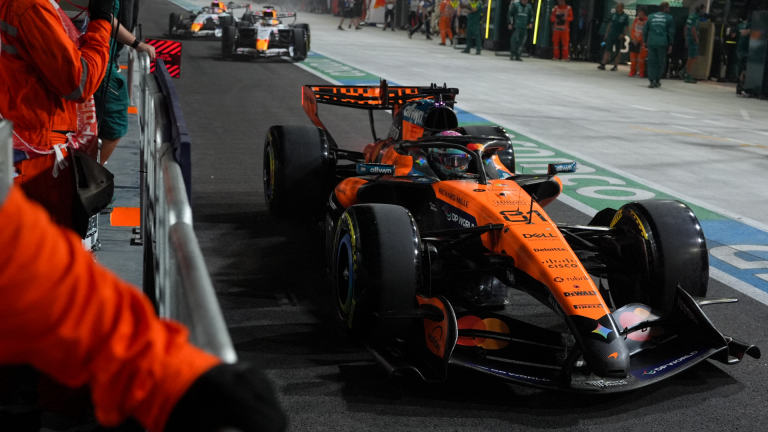
Lando Norris believes Singapore could provide McLaren with an opportunity to recover from its recent Formula 1 struggles, revealing that the team has been investigating persistent straight-line speed problems following its disappointing performance at Sepang.
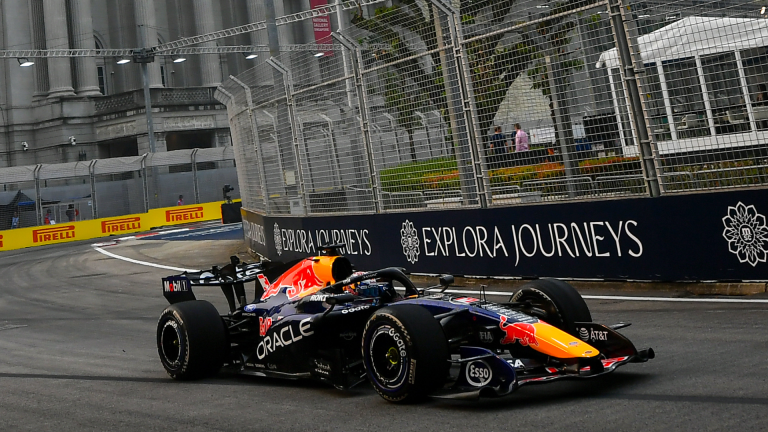
The reigning world champion arrived at Marina Bay after finishing ninth in Malaysia, where McLaren struggled to match Red Bull, Mercedes and Ferrari. Norris acknowledged that the team had identified several areas requiring improvement, including problems affecting his car’s speed on the straights.
Speaking during Thursday’s FIA press conference, Norris said McLaren had spent the days between races analysing its performance.
“There were some obvious ones, such as the straight-line speed and the issues I’ve been having with the car, which are obvious ones,” he said.
The Briton added that the investigation also involved more complex technical questions concerning how to extract additional performance from the MCL40.
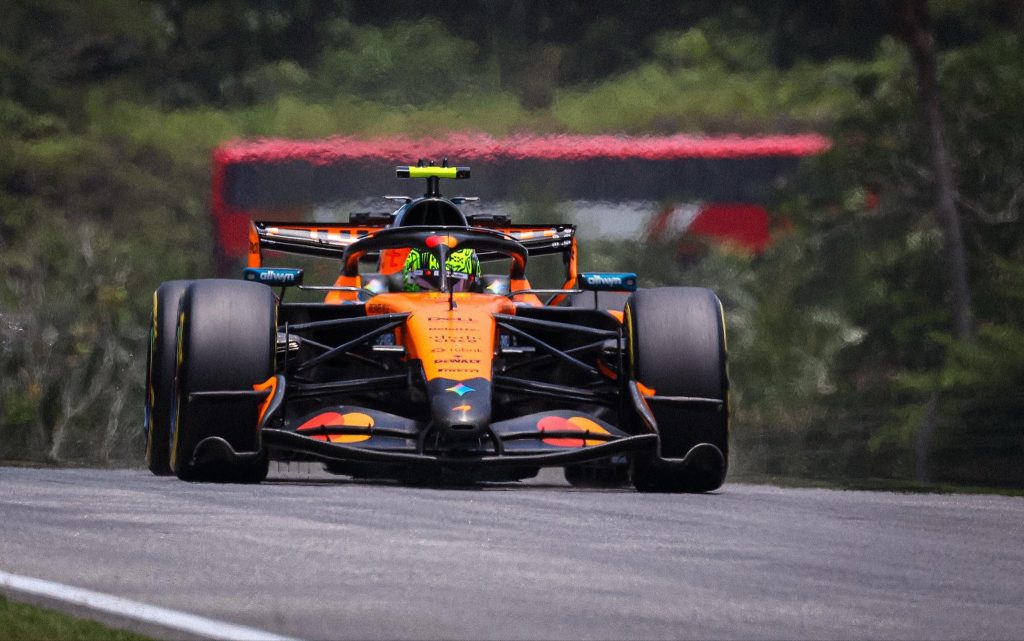
Norris explained that the team’s objective is to return to the competitiveness demonstrated during the middle phase of the season, when McLaren performed strongly at Budapest, Zandvoort and Madrid.
“We’ve all worked very hard to understand what we could learn from last weekend, what we can and need to do better,” he said.
He also identified the need to understand how the team could recover its previous level.
“The exact things, specifics of it, I don’t need to go into, but there was a good amount.”
McLaren’s difficulties became particularly visible at Sepang, where Norris struggled to compensate for a straight-line speed deficit that team principal Andrea Stella estimated was costing approximately one to two tenths of a second per lap.
The problem affected McLaren’s qualifying competitiveness and contributed to a weekend in which neither Norris nor Oscar Piastri could seriously challenge the leading cars.
Norris believes Singapore could reduce McLaren’s disadvantage
Marina Bay presents a different combination of circuit characteristics from Sepang.
The Singapore street circuit features relatively short straights, frequent braking zones and numerous slow-speed corners, reducing the importance of outright top speed compared with Malaysia.
Norris acknowledged that the characteristics could work in McLaren’s favour, although he warned that the team still needs to demonstrate improvement on track.
“Yes, I’m hopeful, but we’ll have to see on track what we’ve improved,” Norris said in comments reported by the Spanish press.
“Straight-line speed at this circuit isn’t a priority and doesn’t penalise you as much.”
The Briton also acknowledged the frustration of repeatedly trying to understand why McLaren had been losing performance on the straights.
That gives the team an opportunity to evaluate whether its recent difficulties were amplified by circuit characteristics or reflect a broader limitation of the MCL40.
Norris says McLaren needs to unlock more from its car
Beyond the straight-line deficit, Norris believes Formula 1’s 2026 regulations have introduced additional demands on drivers and engineers.
The current generation of cars requires careful management of electrical energy deployment alongside traditional aspects of driving, such as tyre management and cornering performance.
Norris explained that he has adapted to those demands during the season, even though McLaren’s results have not consistently reflected that progress.
“I think this year you have to drive the car in a different way, and I’ve had to adapt a lot to how you have to drive this year’s car,” he said.
He also distinguished between extracting conventional performance from the chassis and maximising the combined performance of the power unit, tyres and driving technique.
For McLaren, that means the recovery depends not only on addressing the straight-line speed deficit but also on finding a more effective operating window for the complete package.
The Singapore GP begins on Friday, October 9, with the sprint on Saturday and the Grand Prix on Sunday. GRANDE PRÊMIO follows all the latest Formula 1 news throughout the Singapore GP weekend.
F1 today: FAQ
What time is Singapore GP sprint qualifying today?
Sprint qualifying starts at 20:30 Singapore time on Friday, October 9, equivalent to 13:30 BST in the UK, 08:30 ET in the United States and Canada, and 18:00 IST in India. The session determines the starting grid for Saturday’s sprint.
Who was fastest in Singapore GP FP1?
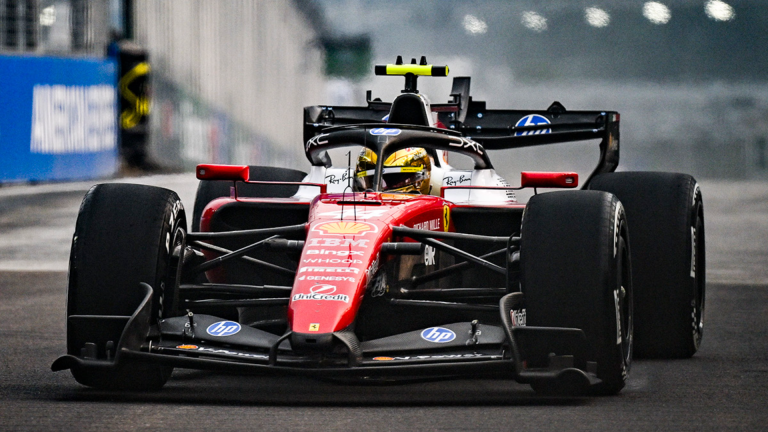
George Russell topped FP1 with a 1:32.274, driving Mercedes’ older W17 aerodynamic specification. Charles Leclerc finished second, 0.198s behind, followed by Lando Norris in third. Kimi Antonelli was seventh with the upgraded Mercedes, while Gabriel Bortoleto finished 16th.
Why is George Russell using the old Mercedes at the Singapore GP?
Mercedes is comparing its previous W17 specification with the aerodynamic upgrade introduced at Sepang. Russell is using the older package, while championship leader Kimi Antonelli retains the new version. Russell led FP1, but differences in tyre compounds and run programmes mean the result alone does not establish which specification is faster.
What is McLaren’s main problem in F1 2026?
Norris has identified straight-line speed as one of McLaren’s principal weaknesses, particularly after the team’s difficult performance at Sepang.