
News Summary
- George Russell secured Azerbaijan GP pole by 0.837s
- It was F1’s largest dry-track qualifying margin since Nigel Mansell at Silverstone in 1992
- Russell improved by 0.936s between Q2 and Q3, while Leclerc and Oscar Piastri were separated by only 0.001s
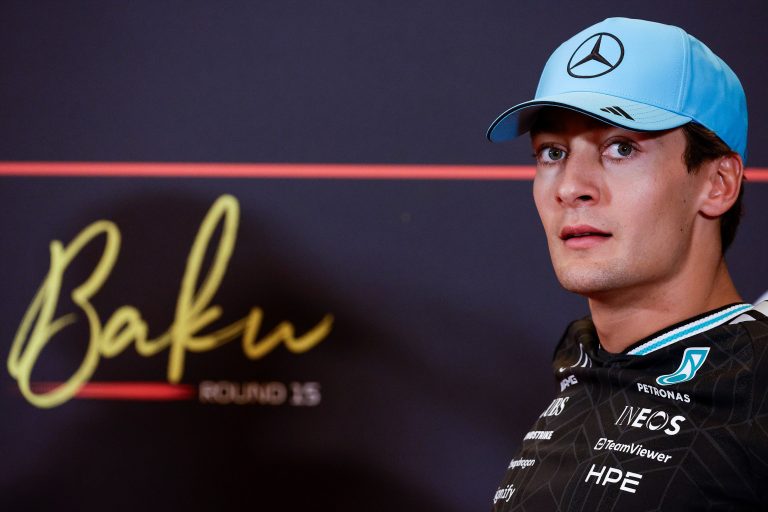
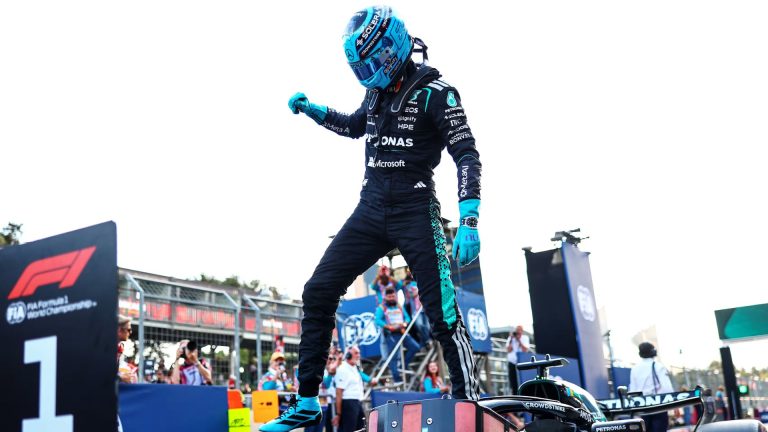
George Russell did more than secure pole position for the Azerbaijan Grand Prix. The Mercedes driver produced Formula 1’s largest qualifying advantage in completely dry conditions for almost 34 years.
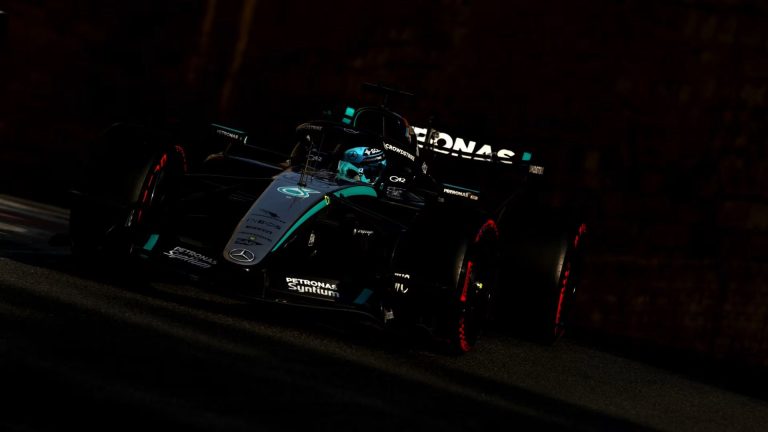
Russell completed the Baku City Circuit in 1:42.526, beating Ferrari’s Charles Leclerc by 0.837s. Oscar Piastri qualified third for McLaren, only 0.001s behind Leclerc.
The previous larger gap under comparable conditions came at the 1992 Japanese Grand Prix. Nigel Mansell set a 1:37.360 for Williams at Suzuka and defeated team-mate Riccardo Patrese, who recorded a 1:38.219, by 0.859s.
Russell therefore fell only 0.022s short of Mansell’s advantage. No qualifying session held entirely on a dry circuit had produced a larger gap between the two fastest drivers since then.
Largest dry F1 qualifying margins since 1992
| Year | Grand Prix | Fastest driver | Second | Gap |
|---|---|---|---|---|
| 1992 | Japan | N. MANSELL | R. PATRESE | +0.859 |
| 2026 | Azerbaijan | G. RUSSELL | C. LECLERC | +0.837 |
| 2016 | Europe — Baku | N. ROSBERG | S. PÉREZ | +0.757 |
| 2018 | Australia | L. HAMILTON | K. RÄIKKÖNEN | +0.664 |
| 2022 | Belgium | M. VERSTAPPEN | C. SAINZ | +0.632 |
| 2015 | Australia | L. HAMILTON | N. ROSBERG | +0.594 |
| 2023 | Japan | M. VERSTAPPEN | O. PIASTRI | +0.581 |
| 2025 | Austria | L. NORRIS | C. LECLERC | +0.521 |
The comparison concerns the fastest qualifying times rather than the final starting order. Sergio Pérez in 2016 and Max Verstappen in 2022, for example, were affected by grid penalties after setting their respective times.
Russell’s lap confirmed the performance Mercedes had displayed throughout the weekend. The Briton led FP1 and FP2 before Verstappen narrowly moved ahead in FP3, but Mercedes recovered its advantage when qualifying began.
The scale of the margin remained unexpected. Russell improved from 1:43.462 in Q2 to 1:42.526 in Q3, finding 0.936s between the two sessions.
“I definitely was very surprised with the lap, but I knew I had the pace,” Russell said. “I was building up throughout the whole session. I didn’t want to push the boundaries in Q1 or Q2, and I wanted to leave it to the last lap.”
Leclerc secured second with a 1:43.363, only 0.001s ahead of Piastri. Isack Hadjar placed fourth, followed by Lando Norris, Lewis Hamilton, Pierre Gasly and Verstappen.
Carlos Sainz and Franco Colapinto completed the original top ten, although Sainz subsequently received a five-place grid penalty. Championship leader Kimi Antonelli crashed at Turn 1 during Q1 and could take no further part, leaving him 16th.
Why some larger F1 pole margins do not count
Russell’s result was not the largest qualifying margin of the hybrid era when every weather condition is included. Three sessions since 2014 produced wider gaps, but all were influenced by rain or a rapidly changing circuit.
| Year | Grand Prix | Fastest driver | Gap | Conditions |
|---|---|---|---|---|
| 2014 | Great Britain | N. ROSBERG | +1.620 | Drying track |
| 2020 | Styrian GP | L. HAMILTON | +1.216 | Wet |
| 2017 | Italy | L. HAMILTON | +1.148 | Wet |
| 2026 | Azerbaijan | G. RUSSELL | +0.837 | Dry |
Changing conditions can create large artificial differences because drivers complete their decisive laps at different stages of the session. Baku remained dry throughout qualifying, making Russell’s advantage a more direct measurement of outright performance.
The largest dry qualifying margin of Formula 1’s modern era remains Mansell’s performance at the 1992 British Grand Prix. He beat Patrese by 1.919s at Silverstone, setting a 1:18.965 against his team-mate’s 1:20.884.
Russell’s Baku margin is therefore not the outright modern record, but it is the largest recorded on a fully dry circuit since Mansell’s 0.859s advantage at Suzuka later in that same 1992 season.
GRANDE PRÊMIO follows every session of the Azerbaijan GP LIVE and in REAL TIME.

F1 today: FAQ
What time does the 2026 Azerbaijan GP start?
The race starts on Saturday, September 26, at 12:00 UK time. It begins at 07:00 ET and 04:00 PT in the US, 16:30 in India and 21:00 AEST in eastern Australia.
Who starts on pole for the Azerbaijan GP?
George Russell starts from pole for Mercedes, ahead of Charles Leclerc and Oscar Piastri. Isack Hadjar qualified fourth, followed by Lando Norris and Lewis Hamilton.
Why is the Azerbaijan GP being held on Saturday?
The race was moved to Saturday because Sunday, September 27, is Azerbaijan’s Remembrance Day, a national day of mourning. The entire F1 weekend was brought forward by one day.
What was George Russell’s pole margin in Baku?
Russell beat Charles Leclerc by 0.837s, recording a 1min42s526 lap.