- Max Verstappen has ruled out participating in Formula 1’s new physiological data-sharing initiative, saying he does not want his heart rate monitored or broadcast.
- Charles Leclerc welcomes the technology, while George Russell supports its potential entertainment value but warns against misleading comparisons between drivers.
- The partnership between Formula 1 and Whoop will introduce new ways of presenting drivers’ physical data from 2027, with participation and public data-sharing subject to drivers’ agreement.
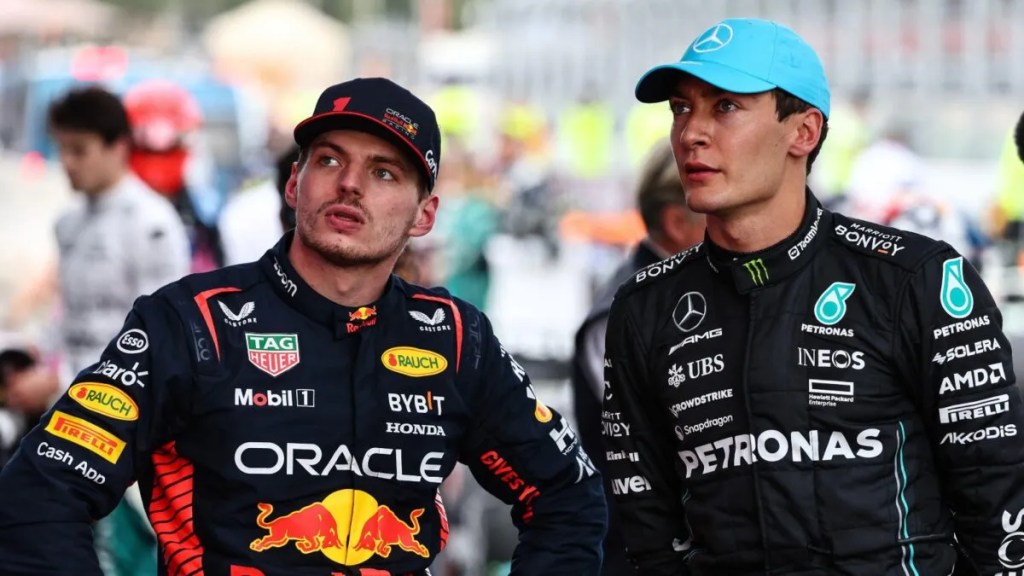
Max Verstappen has rejected the prospect of sharing his heart-rate data during Formula 1 broadcasts, insisting that his physical condition is a private matter and that he has no interest in wearing the monitoring equipment introduced through the championship’s new partnership with Whoop.
The four-time world champion made his position clear during media activities ahead of the Las Vegas Grand Prix, attended by GRANDE PRÊMIO, shortly after Formula 1 announced a multi-year agreement with the American wearable-technology company.
The initiative aims to give fans greater insight into the physical demands placed on drivers during races, potentially showing real-time physiological information alongside the images and timing data already available during television coverage.
The distinction is that drivers will not be required to make their personal data public. Participation in the proposed broadcasts will depend on their consent, and Verstappen has already indicated that he will not be joining.

Verstappen says he does not want to be tracked
Asked about the initiative, Verstappen made clear that he does not use wearable devices even as part of his personal training programme. “I won’t be involved. I don’t use any device, also not for my training, I don’t use anything,” the Red Bull driver said during the Las Vegas media session.
He explained that he dislikes being tracked and believes he can recognise the signals from his own body without a device telling him when he is tired or when his heart rate is changing. Verstappen also stressed that he has no objection to other drivers choosing to participate. His opposition concerns the collection and publication of his own information, rather than an attempt to prevent the project from going ahead.
“People don’t need to know my heart rate,” he added when the discussion turned explicitly to privacy.
The Dutchman insisted that he already knows when his heart rate is unusually high or low and has no desire to monitor those measurements during training, let alone make them available to television audiences.
His position is therefore broader than refusing a new television graphic: Verstappen rejects the personal use of such tracking technology in the first place.

Leclerc admits he has already worn a tracker inside his Ferrari
Charles Leclerc offered a sharply different perspective. The Ferrari driver, who has become a Whoop ambassador, revealed that he had already been using the company’s technology to monitor his sleep, recovery and physical condition, including while driving. Leclerc confirmed that the availability of an FIA-certified device makes its use inside the cockpit more straightforward.
“I don’t have anything to hide in particular,” the Monegasque said. He nevertheless distinguished between the benefits of collecting his own physiological data and allowing that information to be displayed to millions of viewers.
Leclerc considers the device useful for his personal preparation, but said the details of public disclosure still need to be discussed.
His position is not an unconditional endorsement of releasing every measurement. Rather, he is comfortable with the concept and open to participating once the relevant arrangements have been established.
The contrast with Verstappen illustrates the different ways Formula 1 drivers approach personal performance data, even when they share the same competitive environment.

Russell warns heart-rate comparisons could mislead viewers
George Russell also welcomed the potential entertainment value of the technology, but warned that its presentation must account for physiological differences between individuals. The Mercedes driver explained that he would find heart-rate information interesting as a television viewer, particularly during moments of intense pressure such as race starts.
However, he pointed out that a lower heart rate does not necessarily prove that one driver is calmer or coping better than another. Age, individual physiology and natural differences in resting heart rate could significantly affect the numbers.
Russell used Fernando Alonso as an example, suggesting that viewers might interpret the Spaniard’s lower heart rate as evidence of exceptional composure without understanding the influence of age and individual characteristics.
He also compared Alonso with his own father, who is older and would naturally be expected to have a different physiological profile.
Russell’s concern is that television coverage could turn biological differences into misleading sporting narratives. A driver whose natural heart rate is 20 beats per minute higher than a rival’s might appear more nervous or physically stressed even when both are performing normally.
For that reason, Russell considers context essential. The technology could help explain the demands of racing, but the numbers should not become a simplistic ranking of drivers’ courage, fitness or composure.

Lawson wants to know whether rivals are feeling the pressure
Liam Lawson sees another potential application for the data: understanding how opponents respond during direct battles. The Racing Bulls driver suggested that information about an opponent’s physiological response could be particularly interesting when following another car and attempting to force a mistake.
A driver may notice that the rival ahead has begun making small errors, but cannot currently see what is happening to that driver’s physical condition. Lawson believes heart-rate information could add a new dimension to how fans interpret those battles, revealing whether sustained pressure is having a measurable effect.
His comments also illustrate one of the potential complications of the system: physiological information might be treated as a competitive signal, rather than simply a storytelling device.
What Formula 1 and Whoop plan for 2027
The agreement, announced on November 18, makes Whoop an official Formula 1 partner and includes a separate partnership with F1 Academy. Formula 1 intends to combine selected physiological information with its existing broadcast and digital coverage to help viewers understand the demands of acceleration, braking, concentration and sustained physical effort.
The initiative could also support explanatory content about recovery, conditioning and preparation between race weekends. The project does not mean that every driver will wear a tracker or that all recorded health information will be publicly accessible. The information presented, the technical procedures and individual participation remain subject to further arrangements.
Verstappen has already removed himself from that discussion. Leclerc, Russell and Lawson, by contrast, see different opportunities in the technology.
The contrasting positions give Formula 1 an additional question to resolve before the first broadcasts: how to make the information meaningful without compromising the privacy of the athletes whose bodies generate it.
For the latest from the Las Vegas paddock, Verstappen has also raised concerns about the demanding energy-management requirements of the circuit.
GRANDE PRÊMIO is following every session of the Las Vegas Grand Prix and the latest developments in Formula 1.
FAQ
Why is Max Verstappen refusing Formula 1’s Whoop initiative?
Verstappen says he does not like being tracked and considers his physiological information private. He does not use similar devices during his personal training.
Will all F1 drivers have to share their heart-rate data?
No. The planned public data-sharing arrangements depend on drivers agreeing to participate.
Which drivers support the technology?
Charles Leclerc, George Russell and Liam Lawson have expressed varying degrees of support, while also raising different questions about how the data will be presented.