
News summary
- Lorenzo Savadori says Michelin and Pirelli are “very different”, describing the switch between the two tire manufacturers as “really challenging.”
- The Aprilia test rider has spent months working with the new 850cc prototype and said returning to the current 1000cc MotoGP bike highlighted how different the tires are.
- Savadori believes riders moving up from Moto2 and those coming from World Superbike could benefit from already having experience with Pirelli tires.
Aprilia test rider Lorenzo Savadori believes MotoGP’s switch from Michelin to Pirelli will be “really challenging”, with the Italian highlighting the different way the two tire manufacturers’ products work.
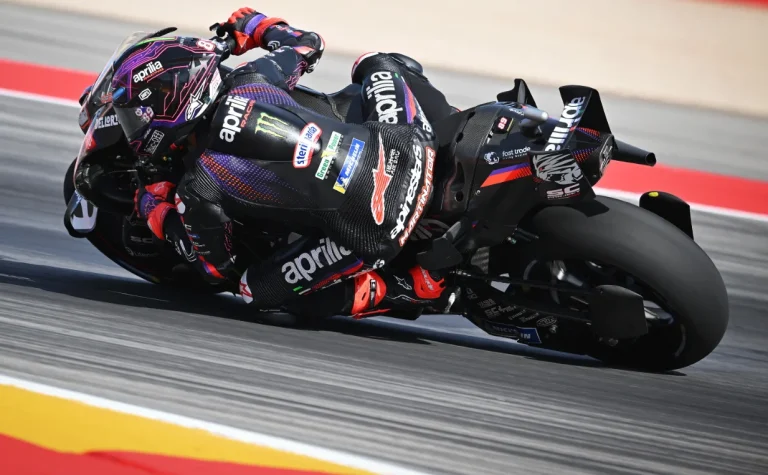
Savadori has been heavily involved in Aprilia’s development of the new 850cc prototype ahead of the major technical overhaul coming to MotoGP in 2027. After replacing the injured Ai Ogura at Trackhouse in Aragón, however, he returned to the current 1000cc machine and had to readapt to a bike he had not ridden for several months.
“It’s challenging… Really challenging,” Savadori told GPOne after Friday’s practice sessions.
“Not so much because of the engine capacity, but because of a different tire that works differently, and you need to get used to it,” he added.
Savadori explained that he had gone approximately five and a half months without riding with Michelin tires, as his development work had focused on Aprilia’s 850cc prototype and the Pirelli rubber that will become MotoGP’s exclusive tire supplier from 2027.
“It had been five and a half months since I last used Michelin tires, so I mainly need to regain confidence with the tire. I can guarantee that they are very different,” the Italian said.
Savadori: “Two completely different worlds”
The change in tire supplier will coincide with a broader technical reset in MotoGP. From 2027, the premier class will move from 1000cc to 850cc engines, while aerodynamic restrictions will become tighter and ride-height devices will be banned.
For Savadori, however, the tire change could prove to be just as significant.
Asked how different Michelin and Pirelli are, the Aprilia test rider was emphatic.
“They are two completely different worlds. One works one way and the other works another way. They are two opposite extremes,” Savadori explained.
Pirelli was confirmed as MotoGP’s exclusive tire supplier from 2027 in March 2025, ending Michelin’s tenure in the premier class after the French manufacturer replaced Bridgestone in 2016. The change will also affect how riders arriving from other categories adapt to MotoGP.
That could create an advantage for riders coming directly from Moto2 or the World Superbike Championship, where Pirelli tires are already used. Pol Espargaró has made a similar assessment, warning that riders coming from those championships could have a significant head start when the new era begins.
Savadori agrees, particularly regarding the transition from Moto2.
“I think the jump from Moto2 to MotoGP will be less challenging,” he said.
“Having the same tires will make the transition easier, even though, logically, reaching a certain level of performance will always be difficult,” the Aprilia test rider added.
The difference will be particularly relevant for the riders entering MotoGP in 2027. Daniel Holgado, David Alonso and Izan Guevara are among those confirmed to make the move from Moto2, while Nicolò Bulega is expected to join the premier class from World Superbike.
Savadori’s experience in Aragón provided a useful reminder of just how much adaptation will be required when MotoGP enters its new technical era. After months focused on the 850cc project, returning to the current 1000cc machine with Michelin tires immediately exposed a major difference in the behavior of the two tire packages.
Pirelli is already developing the tires that will be used from 2027. The manufacturer supplied 400 prototype tires at Aragón as part of the development program, while the entire MotoGP grid is scheduled to gain access to the full range during the post-season test in Valencia.
The 2027 season will therefore bring a combination of changes that goes well beyond engine displacement. New 850cc motorcycles, reduced aerodynamics, the removal of ride-height devices and the arrival of Pirelli will force the entire grid to adapt to a substantially different MotoGP environment.
MotoGP returns to action from September 11-13 at the San Marino and Rimini Riviera Grand Prix, the 14th round of the 2026 season. The GRANDE PRÊMIO will follow the entire weekend, as well as all other categories of the World Motorcycle Championship, in the MotoGP section.

FAQ
Why will the switch from Michelin to Pirelli be challenging in MotoGP?
According to Lorenzo Savadori, Michelin and Pirelli work in very different ways, meaning riders will need to adapt their riding styles and learn how to extract performance from the new tires.
Who could benefit from Pirelli becoming MotoGP’s tire supplier?
Riders moving up from Moto2 and World Superbike could have an advantage, as Pirelli already supplies both categories. They will therefore arrive in MotoGP with previous experience of the manufacturer’s tires.
What changes will MotoGP introduce in 2027?
The premier class will move from 1000cc to 850cc engines, while aerodynamic development will be restricted, ride-height devices will be banned and Pirelli will replace Michelin as the exclusive tire supplier.