Summary
- Bagnaia considers a top-seven finish a realistic target for the Japanese Grand Prix.
- The Ducati rider dominated last year’s Motegi weekend, winning both races from pole.
- New asphalt and a revised tyre allocation complicate comparisons with his successful 2025 performance.
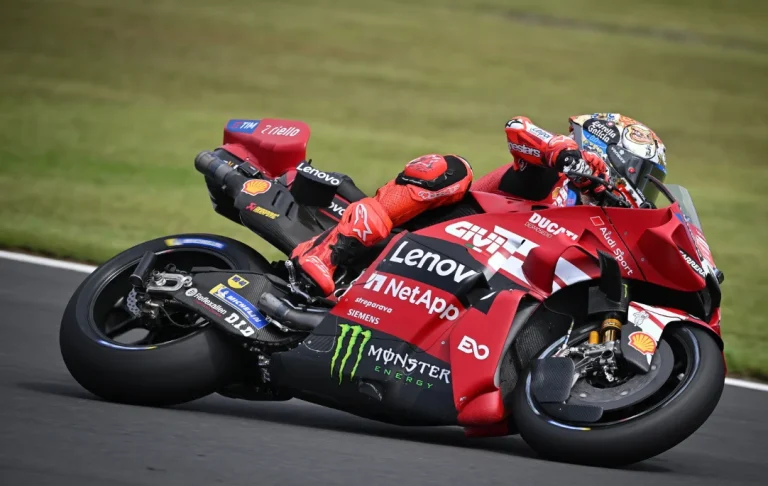
Francesco Bagnaia has set a top-seven target for the Japanese MotoGP weekend, returning to Motegi with substantially lower expectations than the performance that delivered a dominant double victory one year ago.
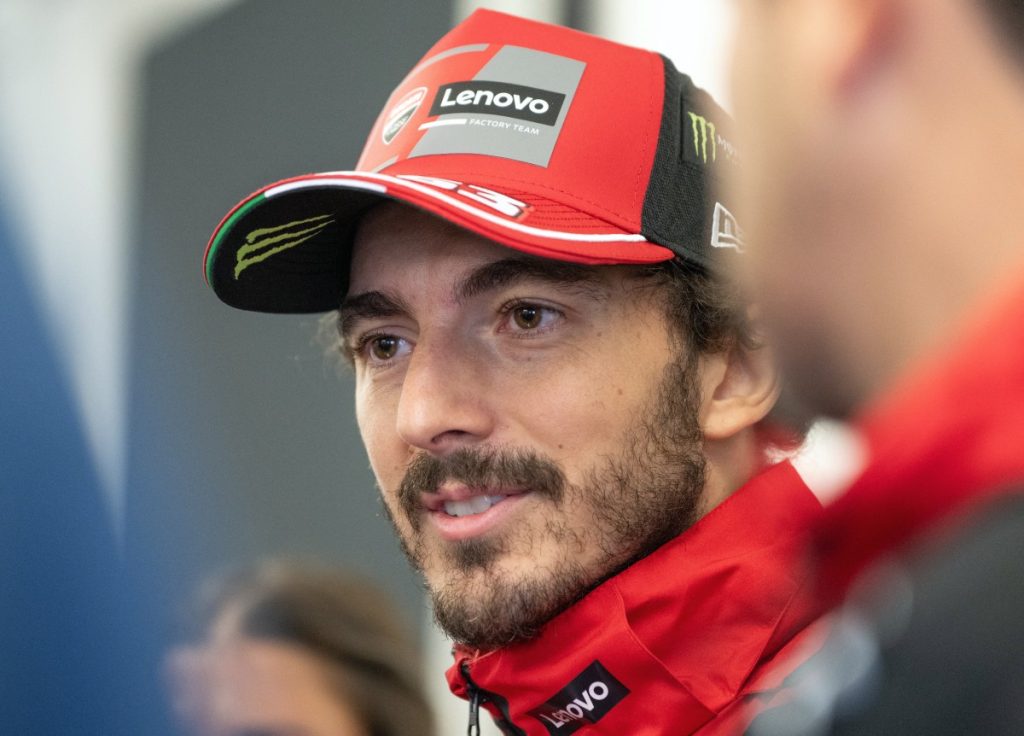
Speaking at the circuit on Thursday, the factory Ducati rider acknowledged that his previous success offers limited reassurance amid his current difficulties.
“The reality is that we need to focus, and the objective is to fight for the top seven, to be realistic,” Bagnaia said.
From a dominant double to a modest target
Bagnaia took pole position and won both the Sprint and Grand Prix at Motegi in 2025. His Sunday victory came ahead of teammate Marc Márquez, who secured the world championship with second place, while Joan Mir completed the podium for Honda.
It was a weekend in which Bagnaia recovered the confidence and control that had frequently eluded him during a difficult season.
Asked what he remembered most clearly about that performance, the Italian recalled the freedom to ride naturally and exploit the bike.
“Fantastic feeling. I was riding at 100%, and I was riding in my way…. Like Frank Sinatra!” Bagnaia said.
That feeling has remained difficult to reproduce. The two-time MotoGP champion returns ninth in the standings, without a Grand Prix victory this season. His last podium came at Brno, where he also won the Sprint.

New asphalt limits comparisons with 2025
Motegi’s resurfacing means Ducati cannot simply approach the weekend by reproducing last year’s successful setup.
Bagnaia needs to understand how the new surface interacts with the tyres, particularly whether it can help alleviate his grip problems. He also acknowledged that direct comparisons with his previous Motegi data would be difficult.
His recent results explain the caution. After a stronger summer period, his form deteriorated following the championship’s return at Silverstone. A run of three consecutive retirements ended with a points finish in Austria.
Michelin has expanded its Japanese GP allocation because it has no testing data from the new asphalt. The selection includes a hard rear with the reinforced construction used in Austria, alongside soft and medium rear tyres with the standard casing.
That adds another consideration for Ducati after its difficulties with the reinforced tyre at the Red Bull Ring. The technical background is explained in the examination of Motegi’s new asphalt and Michelin’s Japanese GP allocation.
Braking offers Bagnaia a reason for hope
Despite the uncertainty, Motegi’s emphasis on braking gives Bagnaia some encouragement. He believes the circuit could reduce his disadvantage compared with other venues.
Friday’s opening sessions will establish whether that expectation translates into better sensations on the bike. For now, his stated ambition remains a top-seven challenge, rather than a prediction that last year’s victories will be repeated.
MotoGP today: FAQ
Who was fastest in Japanese MotoGP practice?
Álex Márquez topped Friday’s Practice at Motegi with a 1:42.811, beating Pedro Acosta by 0.076s. Marc Márquez finished third, while championship leader Jorge Martín was eighth.
What time is Japanese MotoGP qualifying?
Qualifying begins on Saturday, 3 October, with Q1 at 02:50 BST in the UK, 07:20 IST in India and 11:50 AEST in Sydney and Melbourne. In the US and Canada, that is 21:50 EDT or 18:50 PDT on Friday, 2 October. Q2 starts 25 minutes later.
Why is Takaaki Nakagami out of the Japanese MotoGP?
Nakagami fractured his collarbone in a crash during Friday’s opening practice at Motegi. The injury ruled him out of the remainder of his home Grand Prix weekend.
What is Bagnaia’s target for the 2026 Japanese MotoGP?
Bagnaia says fighting for the top seven is a realistic objective at Motegi.