Summary
- Motegi’s complete resurfacing reduces the usefulness of previous tyre data.
- Michelin has revised its rear allocation and included a reinforced construction as a backup.
- Friday practice will establish how the new surface behaves before qualifying, the Sprint and Sunday’s race.
Motegi’s new asphalt has become a major unknown for Michelin and MotoGP ahead of the Japanese Grand Prix. The circuit has been completely resurfaced, leaving teams to establish how its grip, abrasion and temperature characteristics affect their motorcycles and tyres.
Michelin has prepared a broader allocation to cover that uncertainty, with three front and three rear specifications available. Its head of two-wheel competition, Piero Taramasso, says learning the surface will be the central task when practice begins on Friday.
“This year, however, our main challenge will be to get to know the new asphalt, as the entire circuit has been resurfaced,” Taramasso said in Michelin’s preview.
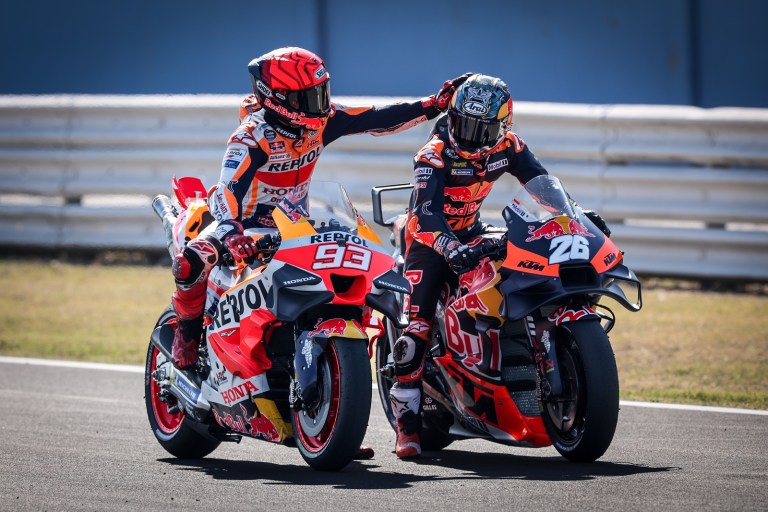
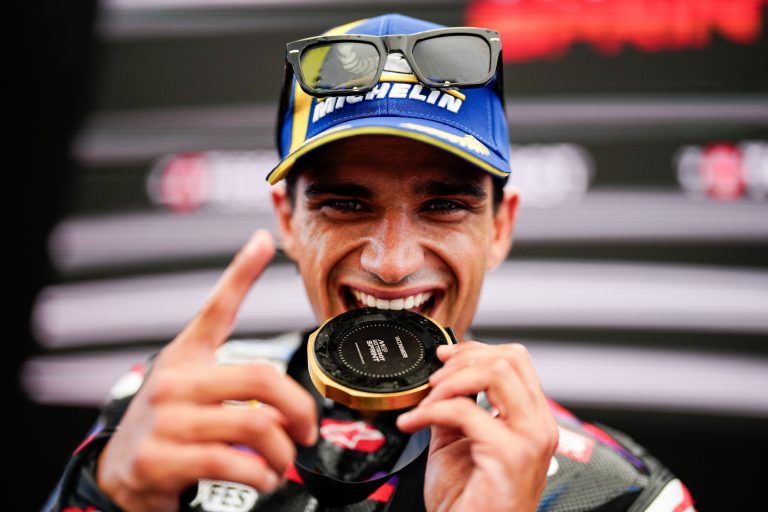
The challenge comes at an important point in the championship. Jorge Martín arrives with a 12-point advantage over Marc Márquez, making the ability to understand the circuit quickly another factor in the title fight heading into Motegi.
Why the old data cannot provide all the answers
The layout remains familiar, but the contact between tyre and track has changed. Michelin must establish how much grip the new surface offers, how aggressively it wears the rubber and how readily it generates temperature.
Motegi’s repeated heavy braking and acceleration already demand stability from the front tyre and traction from the rear. The resurfacing adds uncertainty to both requirements, making the opening sessions particularly valuable.
The practical consequence is that a familiar setup or successful tyre choice from a previous Japanese GP cannot automatically be treated as the best solution for 2026. Teams will need to compare immediate performance with consistency across longer runs.
What Michelin is bringing to Motegi
Michelin is retaining its three front options from 2025 while revising the rear allocation. Taramasso told Motorsport.com that the rear compounds are firmer than last year’s, with a reinforced rear construction available as a backup.
| Tyre | Construction and allocation |
|---|---|
| Front soft | Symmetrical compound; retained from the 2025 allocation |
| Front medium | Symmetrical compound; retained from the 2025 allocation |
| Front hard | Symmetrical compound with a reinforced construction |
| Rear soft | Standard construction |
| Rear medium | Standard construction |
| Rear hard | Reinforced construction also used in Austria |
The rear tyres are asymmetrical, with a firmer compound on the right. Importantly, the hard rear’s designation does not mean that every aspect of the tyre is harder than the other options: its reinforced construction is paired with the soft option’s compound.
“To compensate for the stiffer carcass, we have paired it with the same compound as the soft,” Taramasso explained, translated from his interview with Motorsport.com.
That distinction matters when interpreting tyre choices. The carcass concerns the tyre’s structure, while the compound is the rubber contacting the asphalt; Michelin is combining those characteristics to provide an additional option.
Why three front options matter
Michelin’s standard allocation at most 2026 grands prix has been reduced from three front specifications to two. The change increases the number available of each selected specification while reducing the overall variety manufactured and transported.
Motegi receives three front specifications to cover a wider range of conditions. That gives riders more alternatives while they establish how the new surface behaves under braking.
Pirelli faces the same unknown in Moto2 and Moto3
The uncertainty extends beyond the premier class. Pirelli confirmed that Motegi was resurfaced between late 2025 and early 2026, and says the lack of references is the main variable for its Moto2 and Moto3 preparations.
It has retained its previous allocation: supersoft SCX and soft SC0 rear options for Moto2, and soft SC1 and medium SC2 tyres for Moto3. Its engineers will also assess grip, wear and degradation from the opening sessions.
Those choices apply to the smaller categories. Michelin remains MotoGP’s tyre supplier for the 2026 Japanese Grand Prix.
The weekend runs from October 2–4. Friday’s practice will provide the first evidence of whether the renewed surface changes the competitive picture before Saturday’s Sprint and Sunday’s main race.
MotoGP today: FAQ
Who leads the 2026 MotoGP World Championship?
Jorge Martín leads with 306 points, 12 ahead of Marc Márquez. Marco Bezzecchi is third on 264.
Who won the 2026 Austrian MotoGP?
Pedro Acosta won at the Red Bull Ring, taking his maiden MotoGP victory ahead of Jorge Martín and Marco Bezzecchi.
When is the next MotoGP race?
The Japanese GP is next at Motegi from 2–4 October 2026, followed by the Indonesian GP at Mandalika one week later.
Has Motegi been resurfaced for MotoGP 2026?
Yes. The circuit was completely resurfaced between the end of 2025 and the beginning of 2026.