News Summary
- Lando Norris finished FP2 sixth and 1.484s behind George Russell
- McLaren’s floor problem and incomplete understanding of its upgrade distorted the gap—but cannot explain all of it
- Norris should remain a Q3 contender, although challenging Mercedes for pole would require a major overnight improvement
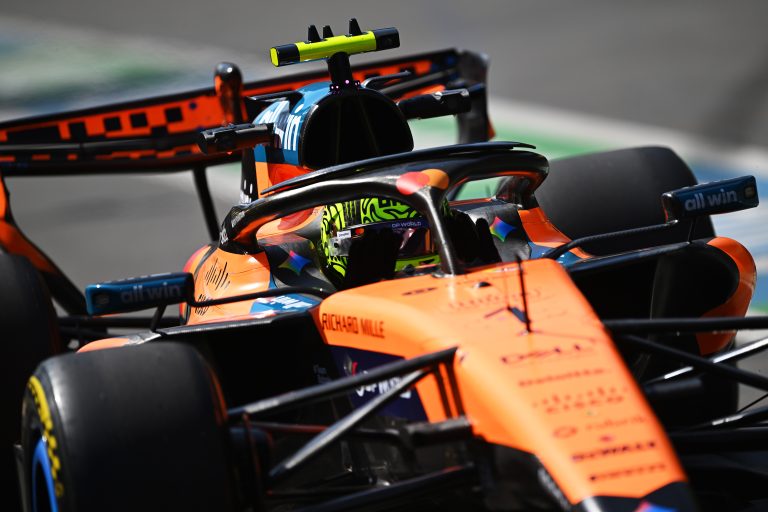
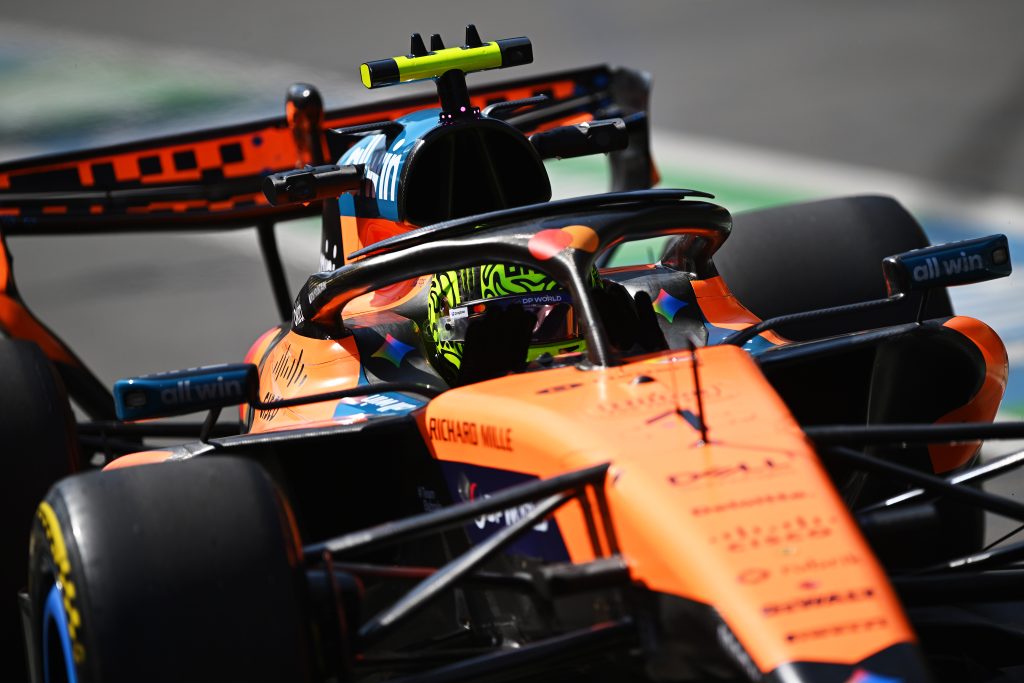
Lando Norris described McLaren’s 1.5-second deficit in Azerbaijan GP practice as “a little knife in the heart”. The number was dramatic, but its consequences for qualifying require a more careful interpretation.
Norris finished FP2 sixth with a 1:44.831, 1.484s behind George Russell’s Mercedes. Oscar Piastri placed eighth and was only 0.026s slower than his team-mate.
That internal comparison is significant. Norris did not simply produce a poor lap: both McLarens converged on almost identical performance and remained approximately 1.5s from the benchmark.
The gap should decrease in qualifying, particularly after McLaren repairs its floor and optimises its new aerodynamic package. However, Thursday’s evidence does not suggest the MCL40 can recover enough performance to challenge for pole without help from changing conditions or mistakes by its rivals.
Why the 1.5-second gap is not completely representative
Norris lost substantial running during FP1 after McLaren discovered a crack in a floor component. He completed only 14 laps and finished in the same position—14th—with a 1.594s deficit.
McLaren installed a temporary repair involving cable ties before completing a permanent solution. Technical director Rob Marshall described the damage as minor and said the car could potentially have continued without intervention.
The repair therefore affected McLaren’s programme, but the team does not believe the crack alone caused its lack of pace.
Norris also abandoned a promising lap during FP2. That suggests his final 1:44.831 did not represent the absolute limit of the car, although there is no evidence that completing the lap would have removed the entire deficit.
Russell’s 1:43.347 may also prove difficult to repeat. Mercedes’ apparent advantage was inflated by problems elsewhere, while Max Verstappen matched Russell’s pace earlier in FP2 when both used medium tyres.
The real gap should consequently be smaller than 1.484s—but McLaren still needs to find a substantial improvement.
McLaren’s upgrade is behaving correctly—but not producing enough lap time
McLaren introduced several aerodynamic components in Baku, increasing the amount of set-up work required during an already interrupted day.
Marshall said the aerodynamic map appeared to match the team’s expectations. That is encouraging because it indicates the upgrade is behaving similarly to McLaren’s simulations.
However, an upgrade working as predicted does not automatically mean the car is optimised.
“We put a lot of new parts on the car today,” Marshall said. “There is a lot to learn. When we install a new package, we need to learn how to set it up ideally, and I don’t think we have done that yet.”
The distinction matters for qualifying. McLaren is not attempting to repair a failed concept overnight; it is trying to extract performance from a package that appears aerodynamically consistent but remains outside its ideal operating window.
That process can produce a meaningful gain between FP2 and qualifying. Recovering more than one second against Mercedes is a considerably more difficult task.
What Piastri’s time reveals about Norris
Piastri’s 1:44.857 provides the strongest evidence that Norris’ deficit was not primarily caused by driver performance.
The McLaren drivers were separated by just 0.026s, despite following different programmes after both lost track time during FP1. Norris finished sixth and Piastri eighth only because Pierre Gasly separated them in the classification.
| Driver | Position | Time | Gap to Russell |
|---|---|---|---|
| Lando Norris | 6th | 1:44.831 | +1.484s |
| Oscar Piastri | 8th | 1:44.857 | +1.510s |
When both drivers reach almost the same lap time, the limitation is more likely to concern the car, tyre preparation or energy deployment than an isolated mistake.
Norris reinforced that conclusion by saying the car did not feel particularly bad. His frustration came from the stopwatch rather than unpredictable handling.
The world champion described McLaren’s deficit as “pretty pants” and admitted he did not know how much performance could be recovered overnight.
Can Norris reach Q3 in Azerbaijan?
Yes. Norris should still be considered a likely Q3 contender.
He finished sixth despite the interrupted programme and incomplete set-up work. McLaren also has sufficient margin over much of the midfield if it executes a clean qualifying session.
The more relevant question is whether Norris can qualify inside the first two rows. On Thursday’s evidence, that appears considerably less likely.
Mercedes, Verstappen and both Ferrari drivers finished ahead of him. Even if the gap to Russell contracts sharply, Norris must still overcome at least three teams to fight for pole.
A realistic target is therefore a position between fifth and eighth, with a front-row challenge dependent on McLaren finding a significant set-up breakthrough during FP3.
Why Friday’s wind creates an opportunity—and another risk
Strong wind gusts are forecast for qualifying and could reach approximately 70–80km/h. That introduces a variable capable of reducing the importance of Thursday’s established order.
Changing wind direction can affect braking stability, corner entry and the strength of the tow on Baku’s long final sector. A car that was balanced on Thursday may become difficult to predict, while McLaren could benefit if its revised set-up handles the conditions more effectively.
The same conditions can also punish the MCL40. If McLaren remains sensitive through the slow corners, sudden gusts may make tyre preparation and driver confidence even more difficult.
Traffic will provide another complication. Drivers require a tow along the main straight but cannot afford to compromise tyre temperature or become trapped behind slow cars before beginning their laps.
Is Norris a contender for Azerbaijan GP pole?
Based on Thursday, no. Norris is a Q3 contender, but Mercedes and Verstappen begin Friday with a clearer route to the front row.
McLaren should recover some of the 1.484s deficit through a permanent floor repair, improved set-up and a cleaner qualifying lap. The team’s stronger long-run performance also suggests its race prospects are healthier than the single-lap classification indicates.
Piastri described McLaren’s race simulations as solid and said the team made progress during FP2. That does not solve the qualifying weakness, but it means Norris’ weekend will not necessarily be defined by his starting position.
FP3 begins at 09:30 UK time on Friday, with qualifying following at 13:00. The Azerbaijan GP starts at 12:00 on Saturday.
GRANDE PRÊMIO follows every session of the Azerbaijan GP LIVE and in REAL TIME.
F1 today: FAQ
Why is the 2026 Azerbaijan Grand Prix on Saturday?
The race takes place on Saturday, September 26, because Sunday is Azerbaijan’s Remembrance Day. The entire programme was moved forward, with practice on Thursday and qualifying on Friday.
What time does the 2026 Azerbaijan Grand Prix start?
The Azerbaijan GP starts at 12:00 UK, 07:00 ET and 15:00 local time on Saturday. It will run for 51 laps around the 6.003km Baku City Circuit.
Can Kimi Antonelli win the 2026 F1 championship in Azerbaijan?
Yes. Antonelli arrives in Baku with an 81-point lead over George Russell, making him mathematically capable of securing the championship. To become champion, he must leave Azerbaijan at least 75 points ahead.
Why was Norris 1.5 seconds behind in Baku FP2?
McLaren lost running through a cracked floor component and had not optimised its new aerodynamic package. Norris also abandoned a potentially faster lap, although the problems do not fully explain the deficit.