

News Summary
- Lewis Hamilton was forced to stop his Ferrari during Mexican Grand Prix FP2 after reporting a problem with the power unit.
- The seven-time world champion had been running fourth when his session was interrupted, losing valuable preparation time ahead of qualifying.
- Charles Leclerc topped both Friday practice sessions, setting a 1:17.827 in FP2 as Ferrari emerged as a contender for pole position.
Lewis Hamilton suffered a setback in his preparations for the 2026 Mexico City Grand Prix after a Ferrari power unit problem forced him to stop on track during Friday’s (30) second practice session at the Autódromo Hermanos Rodríguez. The British driver was running fourth when the issue emerged, approximately 30 minutes before the end of FP2, while teammate Charles Leclerc went on to set the fastest lap of the afternoon.
The incident interrupted an otherwise encouraging day for Ferrari, which demonstrated competitive pace in both sessions. Leclerc’s performance reinforced the impression that the Italian team could challenge for pole position, although Hamilton’s mechanical problem left the team with additional work before Saturday’s qualifying.
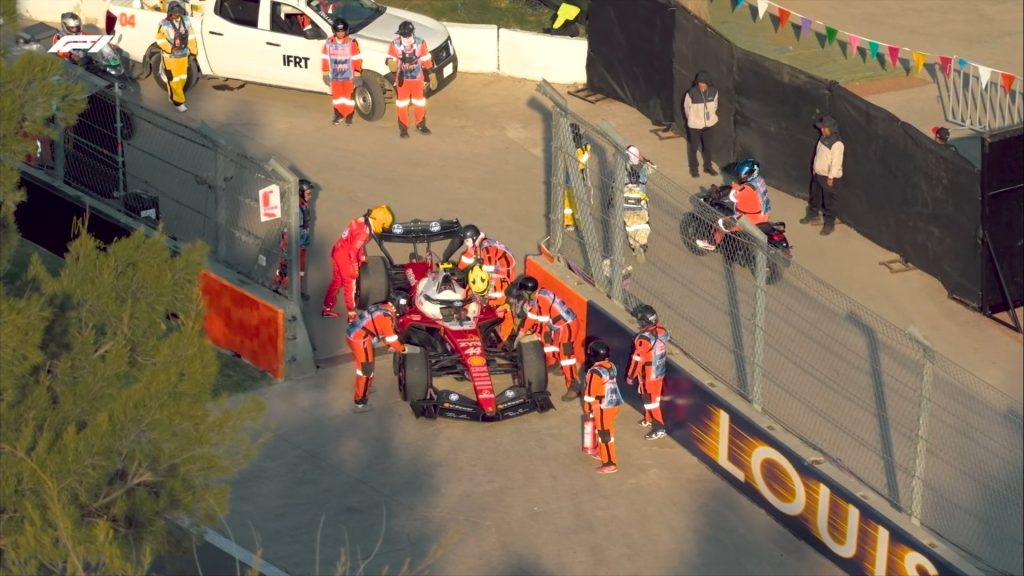
Hamilton reports power unit problem and stops Ferrari during FP2
Hamilton was completing his programme when he reported a problem to race engineer Carlo Santi over the radio. The seven-time world champion indicated that something was wrong with the power unit and was subsequently instructed to stop the car rather than attempt to return to the garage.
The Ferrari came to a halt on track, prompting Race Control to display the red flag while marshals recovered the stranded machine.
The interruption came at a particularly inconvenient moment for Hamilton. He had been running fourth in the classification and was preparing to continue the programme that would help Ferrari evaluate its qualifying and race performance.
Instead, the British driver was unable to complete the remaining planned running, leaving his engineers with less information than anticipated.
Hamilton eventually appeared 11th in the final classification, although the position did not fully reflect the competitiveness he had demonstrated before the problem.
The team must now investigate the cause of the failure and establish whether the issue can be resolved without replacing any power unit components.
Ferrari has not confirmed that an engine replacement or grid penalty will be necessary.
Leclerc leads both sessions as Ferrari shows encouraging pace
Hamilton’s reliability problem contrasted sharply with the performance of teammate Charles Leclerc, who finished Friday as the fastest driver in Mexico City.
The Monegasque led FP1 with a lap of 1:18.128, establishing an advantage of approximately six tenths over Andrea Kimi Antonelli.
Leclerc improved significantly during FP2, recording 1:17.827 to finish ahead of McLaren’s Lando Norris and Mercedes driver George Russell.
Norris was just 0.103s behind the Ferrari, with Russell another 0.003s adrift. Antonelli completed the top four, followed by Max Verstappen.
The narrow gaps indicated that Ferrari’s advantage was not as substantial as the opening session had suggested, particularly with McLaren and Mercedes improving their performance.
Leclerc also encountered difficulties during his qualifying simulations. Traffic affected one attempt, while a mistake prevented him from completing another clean lap before he eventually established the fastest time.
Nevertheless, Ferrari demonstrated that its car could deliver competitive performance even when the preparation of a flying lap was not ideal.
That consistency could become important during qualifying, particularly if changing track temperatures make tyre preparation more difficult.
Mexico City’s altitude adds pressure to Ferrari’s power unit
The mechanical issue also attracted attention because of the unusual demands imposed by the Autódromo Hermanos Rodríguez.
As GRANDE PRÊMIO explained in its analysis of Mexico’s high-altitude challenge, the circuit sits approximately 2,240 metres above sea level, where thinner air affects engine cooling, turbocharger operation and aerodynamic efficiency.
The 2026 power units introduce additional challenges because of their increased electrical contribution and the removal of the MGU-H.
Teams must manage the interaction between combustion-engine performance, electrical deployment and cooling requirements while maintaining sufficient aerodynamic efficiency.
The conditions are particularly demanding along Mexico City’s long main straight, where cars spend an extended period operating at high speed before braking for the opening sequence of corners.
However, there is no confirmed evidence that altitude caused Hamilton’s problem. Ferrari’s investigation will be necessary to establish the technical explanation.
The incident also affected Hamilton’s opportunity to evaluate the car over longer runs, which are important for understanding tyre degradation and race pace.
Ferrari faces close qualifying fight with McLaren and Mercedes
Leclerc’s fastest time established Ferrari as one of the leading contenders heading into Saturday, but the competitive picture remains open.
Norris finished within 0.103s of the benchmark, while Russell was only 0.106s behind Leclerc.
Antonelli, who won the United States Grand Prix at Austin the previous weekend, remained firmly in contention despite being unable to match the Ferrari’s outright pace.
Verstappen also featured among the leading drivers, although Red Bull still had work to do to improve its performance around the Mexican circuit.
Ferrari’s challenge will be to translate its Friday speed into a clean qualifying performance. At the United States Grand Prix, Leclerc and Hamilton showed strong practice pace before Andrea Kimi Antonelli secured pole position.
Hamilton’s interrupted session means the team will also have to recover some of the preparation time lost on Friday.
When is Mexican GP qualifying?
The final practice session takes place on Saturday (31), followed by qualifying later in the afternoon.
| Session | Mexico City | United Kingdom | US Eastern |
|---|---|---|---|
| FP3 — Saturday | 11:30 | 17:30 GMT | 13:30 EDT |
| Qualifying — Saturday | 15:00 | 21:00 GMT | 17:00 EDT |
| Race — Sunday | 14:00 | 20:00 GMT | 15:00 EST |
The United States switches from daylight saving time to standard time on Sunday, November 1.
GRANDE PRÊMIO is following every session of the Mexican Grand Prix this weekend, with breaking news, full coverage and real-time updates in its Formula 1 section.