News Summary
- Lewis Hamilton has accused Charles Leclerc of adopting a ‘do or die’ mentality, arguing that Ferrari lost a potential victory in Mexico because of its drivers’ opening-lap battle.
- Sebastian Vettel and Carlos Sainz also experienced significant disputes with Leclerc, including a qualifying agreement at Monza, a double retirement in Austria and accusations of excessive complaints in Spain.
- The incidents raise questions about Ferrari’s management of teammate rivalries, although the historical record does not establish Leclerc as solely responsible for every confrontation.
Lewis Hamilton’s fierce criticism of Charles Leclerc after the 2026 Mexico City Grand Prix has revived a question that has followed Ferrari through three different driver partnerships: why does the Italian team repeatedly struggle to prevent competition between its own drivers from becoming a problem? From Sebastian Vettel’s frustration in 2019 to Carlos Sainz’s public complaints in 2024, Ferrari has faced several confrontations involving Leclerc. Hamilton has now delivered perhaps the strongest criticism of all.
The seven-time world champion accused his teammate of approaching battles with a mentality that prioritises individual victory over the team’s result, after an opening-lap confrontation in Mexico helped Max Verstappen move into contention for the win.
Hamilton accuses Leclerc of putting himself before Ferrari
Hamilton started the Mexican Grand Prix from pole position, with Leclerc third. The two Ferrari drivers fought through the opening corners before both ran wide at Turn 4, where Leclerc completed an overtake outside the track limits.
The Monegasque received a five-second penalty, but Hamilton argued that the sanction did not compensate for the track position and clean air his teammate had gained.
After finishing second behind Verstappen, Hamilton questioned Leclerc’s approach.
“The guy is 28 years old, so I don’t think it’s an age thing. I think it’s a mentality thing,” Hamilton said. “It’s like, ‘Do or die. Either I win or none of us do,’ and it shouldn’t be that.”
Hamilton argued that Ferrari should have been fighting for a one-two finish rather than allowing Verstappen to benefit from its internal battle.
His criticism extended beyond Mexico.
The British driver recalled watching Leclerc race against Carlos Sainz while he was still at Mercedes, observing occasions when the Ferrari teammates fought so intensely that rivals escaped ahead.
For Hamilton, the consequences become more serious when the positions at stake are first and second rather than fourth and fifth.
He also contrasted Leclerc’s approach with his own restraint at Silverstone earlier in 2026, claiming he had avoided an unnecessarily aggressive attack because Ferrari was positioned for a strong collective result.
Hamilton warns Ferrari that the problem will continue without action
Hamilton’s strongest criticism concerned Ferrari’s response to previous disputes.
He argued that drivers have responsibilities extending beyond their individual results, particularly when thousands of employees have worked to make the car competitive.
“Working as a team is a part of our job and a part of our contract,” Hamilton said.
The seven-time champion insisted that the team needed a serious internal discussion and consequences if the same problems continued.
He also questioned the effectiveness of Ferrari’s previous attempts to resolve disagreements.
“Up until now nothing really has been done,” he said.
Hamilton acknowledged that he had experienced more severe teammate conflicts during his Mercedes years, particularly with Nico Rosberg, but suggested that those disputes had generally been managed effectively.
The Mexican Grand Prix was not the first time Hamilton and Leclerc had faced tension during 2026.
Disagreements over racing decisions and team instructions had surfaced during the season, including reports of friction at Zandvoort, Monza and Singapore.
However, Mexico represented a significant escalation because Hamilton publicly questioned Leclerc’s mentality rather than merely criticising a particular manoeuvre.
Vettel questioned Leclerc over broken Monza qualifying agreement in 2019
The first major Ferrari dispute involving Leclerc and a world champion teammate occurred during the 2019 Italian Grand Prix.
Sebastian Vettel believed Ferrari had established a clear plan for qualifying at Monza.
The German provided Leclerc with a slipstream during the first Q3 attempts, with the expectation that his teammate would return the favour during the final runs.
However, the second sequence became chaotic as drivers slowed to obtain a tow.
Leclerc eventually reached the timing line, while Vettel failed to begin another flying lap.
The four-time world champion was frustrated by the failure to execute the agreed strategy.
“I thought it was clear what we communicated beforehand,” Vettel said.
He also rejected the suggestion that he had deliberately participated in gamesmanship.
“Not from my side,” he replied when questioned about the situation.
Vettel’s complaint was directed at the failure to follow Ferrari’s qualifying plan, although the chaotic traffic situation also contributed to the outcome.
The incident became particularly sensitive because Leclerc secured pole position at Ferrari’s home race.

Brazil 2019 and Austria 2020 expose consequences of Ferrari collisions
The rivalry escalated later in 2019 at the Brazilian Grand Prix.
Vettel and Leclerc collided on the straight after a restart while fighting for position, damaging both cars and causing a double retirement.
Each driver offered a different interpretation of the incident, and responsibility remained disputed.
The following season produced a more straightforward example.
At the 2020 Styrian Grand Prix, Leclerc attempted an aggressive move at Turn 3 on the opening lap, rode over the kerbs and struck Vettel’s Ferrari.
Both drivers retired.
Leclerc accepted responsibility for the accident and apologised to Vettel.
The German subsequently confirmed that the two had discussed the collision and moved on.
The episode remains one of the clearest documented cases in which Leclerc acknowledged causing a damaging incident involving a Ferrari teammate.
However, it would be misleading to treat every confrontation during their partnership in the same way.
At the 2019 Russian Grand Prix, for example, Vettel himself became involved in a dispute over an agreed position exchange, with Leclerc questioning why the German had not returned the lead as planned.
Ferrari’s problems therefore involved not only individual driving decisions but also the way the team communicated and enforced agreements.
Sainz accused Leclerc of complaining too often in 2024
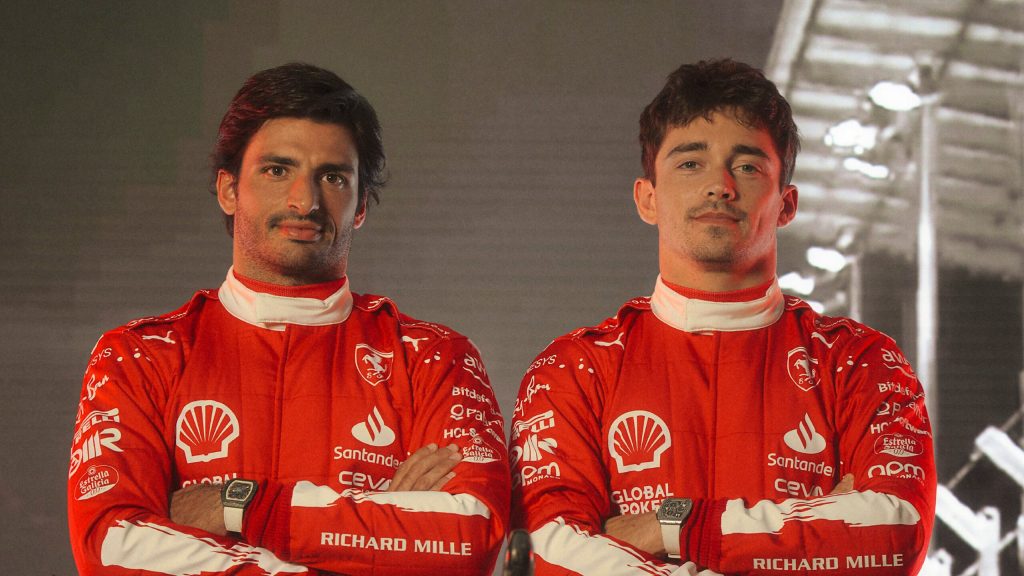
Carlos Sainz’s relationship with Leclerc was generally cooperative during their four seasons together, but it also produced public disagreements.
One of the strongest came at the 2024 Spanish Grand Prix.
Sainz overtook Leclerc early in the race, with the Ferrari drivers making contact during the manoeuvre.
Leclerc complained that his teammate had taken unnecessary risks and damaged his car.
Sainz responded by questioning the frequency of Leclerc’s complaints.
“Too many times after the race he complains about something,” Sainz told Sky Sports F1.
The Spaniard defended his decision to attack, arguing that he was attempting to maximise his own result.
Leclerc, meanwhile, maintained that the manoeuvre had been unnecessarily aggressive given their positions and the team’s strategy.
The exchange was significant because Sainz’s criticism concerned Leclerc’s reaction to a racing incident rather than an accusation that the Monegasque had deliberately compromised Ferrari.
Las Vegas dispute shows Ferrari’s problems were not one-sided
Another disagreement emerged at the 2024 Las Vegas Grand Prix.
Leclerc became frustrated when Sainz overtook him after a pit-stop sequence, believing the team had established expectations about how the drivers should manage their positions.
The Monegasque complained over the radio, while Ferrari team principal Frédéric Vasseur later acknowledged that the situation required discussion.
Unlike the Spanish Grand Prix, however, the principal public criticism came from Leclerc rather than Sainz.
The incident demonstrates why Ferrari’s history cannot be reduced to a succession of teammates accusing Leclerc of misconduct.
The team has repeatedly faced situations in which drivers understood instructions differently or disagreed over how racing priorities should be managed.
That distinction is important when assessing Hamilton’s latest accusations.
Leclerc admits Mexico penalty but disputes Hamilton’s interpretation
Leclerc has acknowledged that the five-second penalty imposed in Mexico was justified.
However, he rejected the suggestion that he alone was responsible for the incident, arguing that both Ferrari drivers failed to remain within the track limits at Turn 4.
“The penalty was deserved in a way,” Leclerc said after the race.
He explained that Verstappen’s move ahead of Hamilton complicated the possibility of immediately returning the position.
The Monegasque also suggested that he could have complained about Hamilton pushing him wide earlier in the opening sequence, but regarded the confrontation as part of racing for victory.
The FIA’s decision supported part of that interpretation.
Although the stewards determined that Leclerc gained an advantage outside the track limits, they reduced the standard ten-second penalty because Hamilton had also left the circuit.
Leclerc’s acceptance of the penalty therefore does not amount to accepting Hamilton’s broader criticism of his mentality.
Ferrari’s recurring challenge goes beyond Leclerc
Frédéric Vasseur has acknowledged the seriousness of Ferrari’s missed opportunity in Mexico.
The team principal described the lost victory as a lack of respect for the manufacturer, its sponsors and the approximately 2,000 employees involved in the Formula 1 operation.
However, he refused to single out Leclerc, pointing out that Hamilton had also run wide.
Ferrari’s history offers several examples of why the issue is complicated.
Vettel complained about an agreement that was not followed. Sainz criticised Leclerc’s tendency to complain after incidents. Hamilton has questioned whether his teammate places individual ambition ahead of the team’s interests.
Those complaints are related by their consequences for Ferrari, but they are not identical accusations.
Some incidents involved mistakes by Leclerc. Others involved disputed responsibility or poor communication from the pit wall.
The central question is whether Ferrari can establish rules that allow its drivers to compete without repeatedly compromising the team’s results.
Hamilton believes the situation requires action rather than another conversation that produces no lasting change.
With Ferrari showing improved performance and the São Paulo Grand Prix approaching, the team faces renewed pressure to demonstrate that it can manage its drivers as effectively as it develops its car.
GRANDE PRÊMIO is following the 2026 Formula 1 World Championship with breaking news, full coverage and real-time updates in its Formula 1 section.