News Summary
- Max Verstappen scored 116 points across the last five Grands Prix, ahead of Andrea Kimi Antonelli on 88 and Charles Leclerc on 70.
- Mercedes scored 219 points in the opening five rounds but only 114 in the latest five, while Red Bull improved from 57 to 152.
- George Russell’s dramatic decline and McLaren’s improving results suggest the competitive order could change significantly in 2027.
Mercedes has won both Formula 1 world championships in 2026, but the numbers from the first 20 Grands Prix suggest the team is no longer enjoying the dominance that defined the beginning of the season. Max Verstappen has emerged as the highest-scoring driver across the last five rounds, while Red Bull has overtaken Mercedes in recent team performance.
An analysis by GRANDE PRÊMIO divides the championship into four periods of five Grands Prix, measuring how many points each driver accumulated in each phase.
The comparison includes sprint points earned during the corresponding race weekends. It reveals a championship that began with overwhelming Mercedes superiority but has become considerably more competitive as the season progressed.
F1 2026: Points scored by every driver across four five-race periods
The table is ranked by points scored in the five most recent Grands Prix, from the Malaysian round to São Paulo, rather than by overall championship position.
| Driver | R1–5 | R6–10 | R11–15 | R16–20 | Total |
|---|---|---|---|---|---|
| M. VERSTAPPEN | 43 | 48 | 72 | 116 | 279 |
| K. ANTONELLI | 131 | 73 | 98 | 88 | 390 |
| C. LECLERC | 75 | 51 | 53 | 70 | 249 |
| L. HAMILTON | 72 | 87 | 40 | 62 | 261 |
| L. NORRIS | 58 | 45 | 83 | 60 | 246 |
| I. HADJAR | 14 | 49 | 23 | 36 | 122 |
| O. PIASTRI | 48 | 46 | 26 | 32 | 152 |
| L. LAWSON | 16 | 25 | 18 | 30 | 89 |
| G. RUSSELL | 88 | 66 | 82 | 26 | 262 |
| N. HÜLKENBERG | 0 | 0 | 7 | 7 | 14 |
| G. BORTOLETO | 2 | 8 | 0 | 4 | 14 |
| F. ALONSO | 0 | 1 | 2 | 4 | 7 |
| O. BEARMAN | 18 | 0 | 2 | 3 | 23 |
| P. GASLY | 20 | 13 | 8 | 1 | 42 |
| A. LINDBLAD | 5 | 19 | 13 | 1 | 38 |
| R. HIRAKAWA | 0 | 0 | 0 | 1 | 1 |
| F. COLAPINTO | 15 | 4 | 8 | 0 | 27 |
| E. OCON | 1 | 2 | 4 | 0 | 7 |
| C. SAINZ | 6 | 0 | 1 | 0 | 7 |
| A. ALBON | 1 | 4 | 0 | 0 | 5 |
| Y. TSUNODA | 0 | 0 | 1 | 0 | 1 |
| L. STROLL | 0 | 0 | 0 | 0 | 0 |
| V. BOTTAS | 0 | 0 | 0 | 0 | 0 |
| S. PÉREZ | 0 | 0 | 0 | 0 | 0 |
| R. CÂMARA | 0 | 0 | 0 | 0 | 0 |
The four periods cover Australia–Canada, Monaco–Belgium, Hungary–Azerbaijan and the five most recent rounds from the Malaysian event to São Paulo. Drivers who did not contest every race remain included, with zero points in rounds they missed.
The ranking highlights a remarkable reversal.
Verstappen has scored more than four times as many points as Russell during the latest five-race period. The Dutchman also outscored Antonelli by 28 points despite the Italian having already secured the world championship.
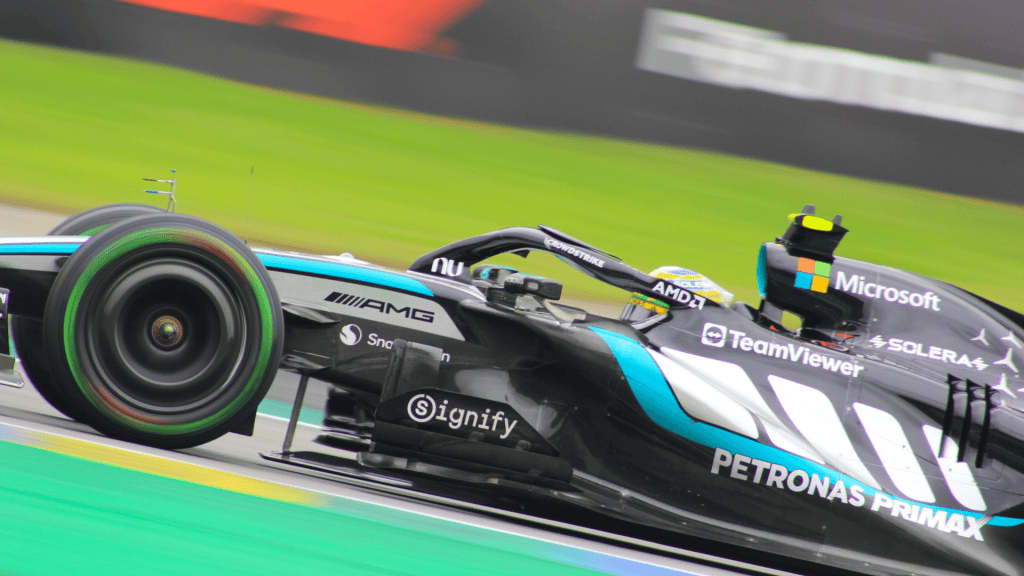
Mercedes built its titles early, but Red Bull now has the strongest results
The clearest evidence of the changing competitive order emerges when comparing team points across the same periods.
| Team | R1–5 | R6–10 | R11–15 | R16–20 | Total |
|---|---|---|---|---|---|
| Red Bull | 57 | 97 | 109 | 152 | 415 |
| Ferrari | 147 | 138 | 93 | 132 | 510 |
| Mercedes | 219 | 139 | 180 | 114 | 652 |
| McLaren | 106 | 91 | 109 | 92 | 398 |
| Racing Bulls | 21 | 44 | 18 | 31 | 114 |
| Audi | 2 | 8 | 7 | 11 | 28 |
| Haas | 19 | 2 | 6 | 4 | 31 |
| Aston Martin | 0 | 1 | 2 | 4 | 7 |
| Alpine | 35 | 17 | 16 | 1 | 69 |
| Williams | 7 | 4 | 1 | 0 | 12 |
| Cadillac | 0 | 0 | 0 | 0 | 0 |
Mercedes scored 219 points in the first five races, compared with just 57 for Red Bull. The difference was enormous: Mercedes collected almost four times as many points.
Across the last five races, however, Red Bull has scored 152 points, compared with Mercedes’ 114. The reversal amounts to a 38-point advantage for Red Bull during the most recent period.
Ferrari has also outscored Mercedes, collecting 132 points.
That does not establish that Red Bull possesses the fastest car at every circuit. Race results are influenced by reliability, driver performance, penalties, strategy and accidents.
Nevertheless, the trend suggests Mercedes’ early-season advantage has diminished considerably.
The team still secured the constructors’ championship at Interlagos, but its recent results no longer resemble those of an organisation consistently capable of dominating both qualifying and races.

Verstappen’s recovery exposes Russell’s dramatic decline
Verstappen’s progression is one of the most striking patterns in the championship.
The Red Bull driver scored 43 points in the opening five races, followed by 48 in the next five and 72 between Hungary and Azerbaijan. He then collected 116 points across the latest five rounds.
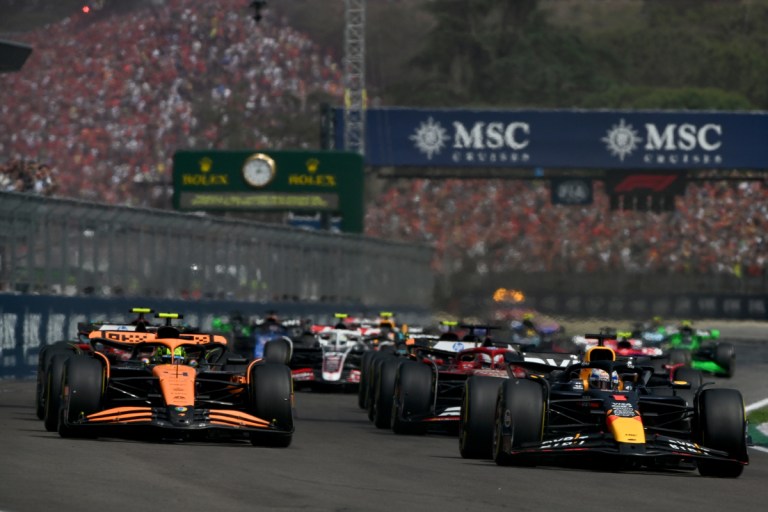
That final period included victories in the Malaysian round, Singapore and Mexico, followed by second place in São Paulo after starting 21st.
Russell’s trajectory moved in the opposite direction. The Mercedes driver scored 88 points in the opening five rounds, 66 in the next five and 82 between Hungary and Azerbaijan. His latest total is just 26.
The difference between Verstappen and Russell during those five races was therefore 90 points.
That reversal explains why Verstappen now holds a 17-point advantage in the fight for second place, despite Russell having spent much of the season ahead.
Mercedes team principal Toto Wolff has acknowledged that the team could consider ways to maximise Russell’s championship result, although no preferential treatment has been confirmed.
The situation is examined in GRANDE PRÊMIO’s analysis of Russell’s 90-point collapse against Verstappen.
Antonelli remains Mercedes’ strongest asset
Andrea Kimi Antonelli’s numbers tell a different story from Russell’s.
The newly crowned world champion scored 131 points in the opening five races, establishing the foundation of his championship campaign. His results subsequently fluctuated, but he remained competitive throughout the season.
Antonelli collected 73 points between Monaco and Belgium, 98 between Hungary and Azerbaijan and 88 across the latest five races. His most recent total is lower than Verstappen’s but remains the second-highest in the field.
The comparison suggests that Mercedes’ decline has not affected both drivers equally.
Russell has struggled badly, while Antonelli has continued delivering strong results despite the team’s reduced advantage.
That distinction matters when evaluating Mercedes’ prospects for 2027.
A championship-winning driver remains an important competitive asset, particularly if the team can address the handling and reliability problems that have compromised its recent weekends.
However, Antonelli’s continued competitiveness also makes it difficult to determine how much of Russell’s decline reflects the car and how much results from individual circumstances.
Ferrari and McLaren could complicate the 2027 battle
Ferrari’s results show a different pattern.
The Italian team scored 147 points in the opening five races, 138 in the second period, 93 in the third and 132 in the latest five. Its performance has been inconsistent rather than following a straightforward upward or downward trend.
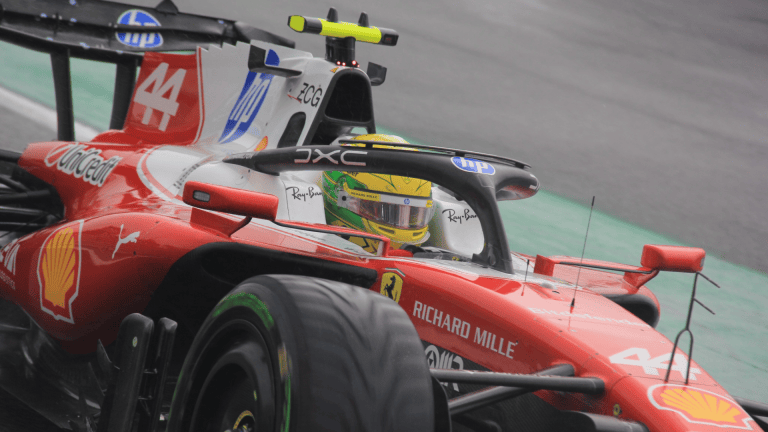
Lewis Hamilton collected 62 points across the last five races, while Charles Leclerc scored 70. Both outscored Russell during that period.
Ferrari therefore remains competitive enough to challenge Mercedes, although its difficulties with tyre management continue to limit consistency.
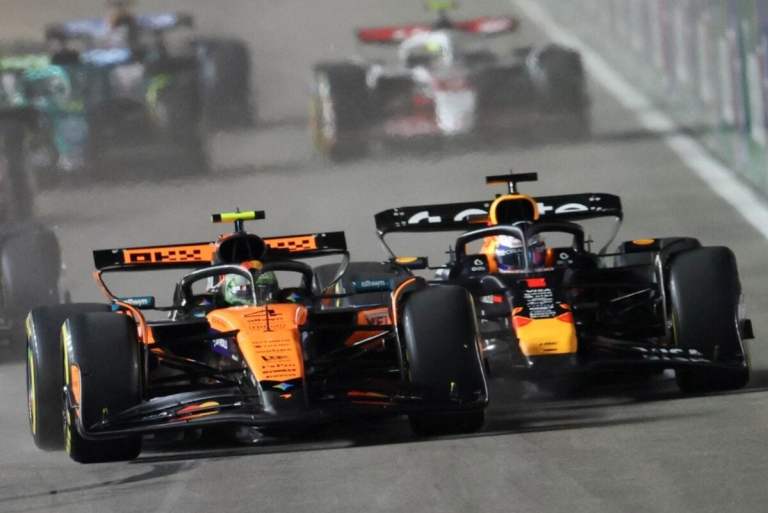
McLaren has also shown encouraging signs. Lando Norris scored 60 points in the latest five rounds, including victory in São Paulo, while Oscar Piastri collected 32.
Norris’ victory demonstrated the potential of McLaren’s recent aerodynamic improvements, but the team’s overall five-race total remained below Mercedes, Ferrari and Red Bull.
The distinction is important: McLaren may be improving, but the available points do not yet establish that it has overtaken the leading teams across a sustained period.
The contrasting performances of its drivers were evident in Brazil, where Piastri finished sixth despite Norris winning with the upgraded McLaren.
What the final five races suggest about 2027
The strongest conclusion is that Mercedes’ championship success should not be confused with continued technical superiority.
Its titles were built through exceptional results early in the season and Antonelli’s sustained competitiveness.
Red Bull, meanwhile, has made the largest improvement in championship points among the leading teams.
Ferrari has recovered from its weakest five-race period, while McLaren continues developing a car that has recently returned to winning races.
The latest results therefore suggest a more competitive 2027 championship than the opening months of 2026 might have indicated.
However, points alone cannot establish which team will possess the strongest car next year.
Development programmes, regulation changes, power-unit performance and driver line-ups could alter the competitive order.
There is also an important distinction between current form and future performance.
Verstappen’s 116 points demonstrate that Red Bull has become extremely effective at converting opportunities into results. They do not guarantee that the team will maintain that advantage when the next season begins.
Likewise, Mercedes’ recent decline does not mean its technical programme has stopped progressing.
The team has already secured both championships and may have different development priorities from rivals still fighting for positions.
For 2027, the most significant warning is that the field appears to be converging.
Red Bull, Ferrari and McLaren have all demonstrated the ability to challenge Mercedes, while the German manufacturer’s two drivers have produced increasingly different results.
With Las Vegas, Qatar and Abu Dhabi remaining, the final three races will provide another opportunity to determine whether Red Bull’s current advantage is sustainable or whether Mercedes can recover its earlier performance.
GRANDE PRÊMIO is following every session of the 2026 Formula 1 championship as teams prepare for the final rounds and the 2027 season.