News Summary
- Oscar Piastri finished sixth at the São Paulo Grand Prix while McLaren teammate Lando Norris claimed victory.
- McLaren said Piastri showed encouraging pace on soft tyres, but time lost in traffic limited his progress.
- Piastri believes the upgraded MCL40 improved in Brazil but still needs greater speed and more predictable handling to challenge Mercedes and Red Bull.
Oscar Piastri believes McLaren made genuine progress with its upgraded Formula 1 car in Brazil, but the Australian’s sixth-place finish exposed the difficulty of converting improved pace into results when strategy and traffic work against a driver.
While Lando Norris celebrated his third victory of the season at Interlagos, Piastri finished more than 56 seconds behind his teammate after a complicated race in changing weather conditions.
The difference was striking because both drivers had access to McLaren’s latest aerodynamic developments. However, their starting positions, track position and ability to exploit the drying circuit created very different races.

McLaren upgrades help Norris but cannot rescue Piastri
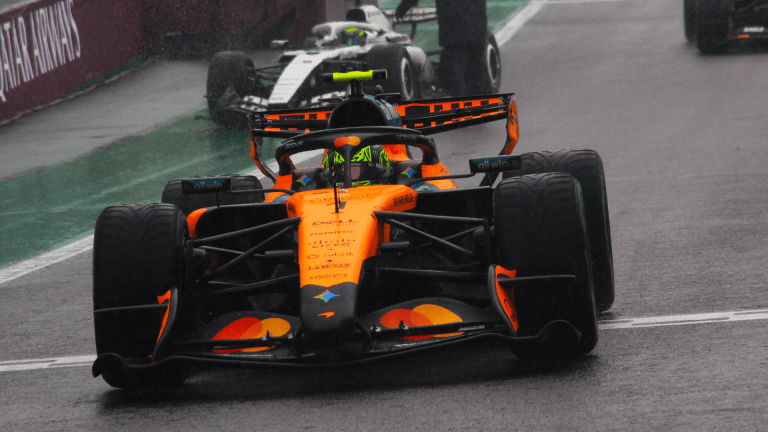
McLaren introduced an updated front wing and aerodynamic package for the São Paulo weekend, seeking to improve the MCL40’s performance and gather information for its 2027 development programme.
Norris qualified at the front and recovered from a difficult start to win, benefiting from strong pace on intermediate and slick tyres.
Piastri started tenth and initially struggled to establish a rhythm in the slippery conditions.
The Australian gradually recovered positions, moving into seventh by lap nine before the field began switching from intermediates to slicks.
McLaren brought both drivers into the pits on lap 16, completing a double pit stop as the circuit continued to dry.
The strategy helped Norris close the gap to race leader Andrea Kimi Antonelli, while Piastri emerged in sixth.
The two drivers were therefore following similar strategic plans, but Norris was already much closer to the leaders.
Traffic prevents Piastri from exploiting improved pace
Piastri’s race became more promising once the soft tyres reached their ideal operating temperature.
He overtook Liam Lawson on lap 23 to move into fifth and began demonstrating the speed that McLaren believed its upgraded car could deliver.
However, the Australian spent considerable time behind other cars, limiting his ability to exploit the available pace.
McLaren later explained that traffic had been one of the main reasons Piastri failed to convert his improved speed into a stronger finishing position.
When the team decided to fit another set of soft tyres during the second half of the race, Norris stopped on lap 49 while Piastri remained out until lap 51.
The later stop left Piastri sixth, behind George Russell, who had chosen a different strategy.
Although the fresh tyres provided more grip, the Australian could not recover enough ground before rain returned.
The leading drivers switched back to intermediates on lap 62, leaving Piastri with limited opportunities to improve his position.
Piastri admits sixth was below McLaren’s potential
Piastri acknowledged that the weekend had been difficult, particularly during the opening stages when the track remained slippery.
“A good result in the end today after a challenging weekend with tricky conditions, especially at the beginning when the conditions were slippery and it took me a while to get into a rhythm,” he said.
“Once I did, the pace was strong, particularly on the Soft tyres, and that’s a real positive.”
The Australian nevertheless believed his finishing position failed to reflect the competitiveness he had demonstrated during parts of the race.
“I’m pleased with how competitive we were at points, although sixth feels a little lower than the performance deserved.”
His assessment is consistent with McLaren’s race analysis, which identified improved pace on slick tyres but acknowledged that traffic had compromised his progress.
Norris, by contrast, benefited from being able to control the race once he inherited the lead following Antonelli’s spin.
The British driver then built enough of an advantage to manage the remaining tyre changes without losing control of the Grand Prix.
Piastri says McLaren still needs a faster, easier car
Piastri welcomed the improvement delivered by McLaren’s updates but insisted the team still has work to do.
“The car felt like it took a step forward this weekend, but we still need to make it quicker and easier to drive and close the gap to Red Bull and Mercedes,” he said.
The Australian’s comments reflect a concern he had already raised about the MCL40’s handling characteristics earlier in the season.
Despite the improvements in Brazil, the car remains difficult to drive consistently, particularly when conditions change rapidly.
McLaren has already confirmed further aerodynamic developments for Las Vegas, where the team hopes to build on the progress demonstrated at Interlagos.
However, the São Paulo weekend illustrated that upgrades alone cannot eliminate the influence of starting position, tyre management and traffic.
Norris converted McLaren’s improved performance into victory. Piastri demonstrated competitive speed but spent too much of the race trying to recover lost ground.
The Australian now has three races remaining to improve his results and help McLaren close the gap to the championship’s leading teams.
GRANDE PRÊMIO is following Piastri, Norris and McLaren’s preparations for the Las Vegas Grand Prix in its Formula 1 section.