News Summary
- Cadillac admits Valtteri Bottas struggled with race pace during parts of the 2026 season, explaining why the team waited before confirming his 2027 contract.
- Marcin Budkowski acknowledges Colton Herta’s Formula 2 campaign was more difficult than expected, despite the American completing six FP1 appearances and obtaining his FIA superlicence.
- Cadillac is discussing a longer-term arrangement with Herta and maintains its ambition to field an American Formula 1 driver, although no timetable has been established.
Cadillac team principal Marcin Budkowski has admitted that Valtteri Bottas’s lack of race pace at several Grands Prix was one of the reasons the American manufacturer delayed confirming his Formula 1 seat for 2027, despite the Finn already holding a multi-year contract.
Speaking to Sky Sports F1 during the Las Vegas Grand Prix weekend, Budkowski also acknowledged that Colton Herta’s first Formula 2 season had been substantially more difficult than anticipated, but insisted the team had achieved important objectives through the American’s extensive practice programme.
The comments offer the clearest explanation yet of Cadillac’s decision to retain Bottas alongside Sergio Pérez, even after investing considerable time and resources in preparing Herta for a possible Formula 1 promotion.
As GRANDE PRÊMIO reported when the announcement was made, the decision left Herta without a race seat for next season despite finally obtaining the necessary superlicence points.
Cadillac admits Bottas’s race pace delayed contract decision
Bottas joined Cadillac for the manufacturer’s inaugural Formula 1 campaign on a multi-year agreement, but the team still had to confirm whether it would retain him for the second season.
Budkowski explained that the uncertainty was partly related to the Finn’s performances, which had fallen below expectations at certain events.
“Valtteri was on a multi-year contract. There was a date where we had to reconfirm [him] for next season,” Budkowski said.
“There were a few races, a few events, where Valtteri was lacking a bit of race pace and that’s something we wanted to take the time to look into as a team, together with Valtteri.”
The admission is particularly significant because Cadillac had consistently maintained that the experience of Bottas and Pérez was essential to developing its new Formula 1 operation.
Pérez has generally been the stronger of the two drivers during the team’s difficult debut season, while Bottas has experienced a succession of reliability problems and weekends in which his race performance could not match that of his teammate.
Budkowski had previously acknowledged that the team was struggling to identify the precise reasons for the differences in pace, raising questions about both the car’s characteristics and Cadillac’s ability to provide its drivers with consistently competitive equipment.
The manager’s latest comments confirm that those concerns were substantial enough to influence the timing of the contractual decision, even though the team ultimately chose continuity.
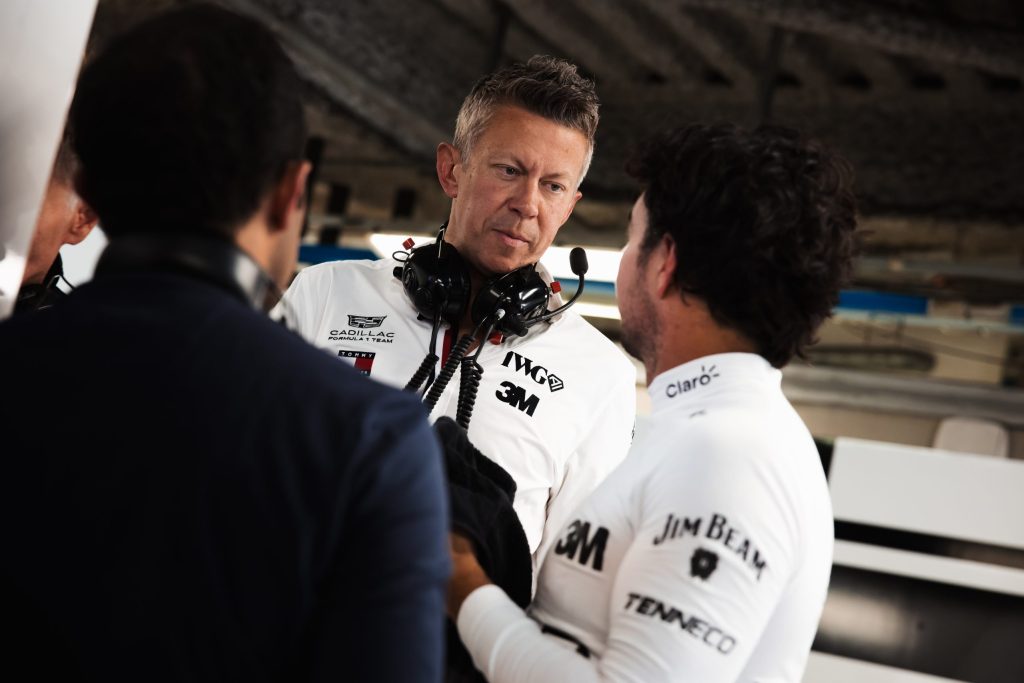
Why Cadillac announced Pérez in Mexico and Bottas in Las Vegas
Budkowski also explained why Cadillac separated the two contract announcements rather than confirming its 2027 lineup at the same time.
Pérez’s extension was announced around the Mexican Grand Prix, where the former Red Bull driver celebrated his 300th Formula 1 appearance in front of his home crowd.
Bottas’s continuation was confirmed several weeks later, ahead of the Las Vegas Grand Prix.
“Calendar-wise. Mexico was Checo’s big race, 300th race, big event and a great opportunity to announce he was staying with us,” Budkowski explained.
“And here, a third home race of the season, it’s a good opportunity to confirm Valtteri.”
Cadillac views Las Vegas as another home event following Miami and Austin, reinforcing the manufacturer’s American identity during its first year on the Formula 1 grid.
The timing therefore reflected both the team’s assessment of Bottas’s performances and its decision to make the announcement during an important commercial and promotional weekend.
The confirmation ended speculation about the Finn’s future and formally removed the remaining opening in Cadillac’s 2027 race lineup.
In a separate appearance during the FIA’s official press conference in Las Vegas, Bottas described the speculation over his future as unnecessary, stressing that obtaining a superlicence for Herta had never automatically meant promoting him to a race seat.
Budkowski admits Herta’s Formula 2 campaign was worse than expected
The second major subject of Budkowski’s interview concerned Colton Herta, whose move from IndyCar to Formula 2 was intended to accelerate his preparation for a potential Cadillac race seat.
Although the American arrived with an established record of IndyCar victories, his performances in the junior category have fallen well short of expectations.
Budkowski openly acknowledged the difficulty of the campaign.
“He had a difficult season in Formula 2 this year. Probably more difficult than he, or everyone anticipated.”
The assessment represents an important admission from the organisation that supported Herta’s decision to leave IndyCar and pursue a different route towards Formula 1.
Herta entered the campaign as one of the most experienced professional racing drivers on the Formula 2 grid but has struggled to consistently compete with younger rivals.
His difficulties have been particularly notable because Cadillac was evaluating whether the American could replace Bottas as early as 2027.
The Formula 2 results, however, did not deliver the clear sporting argument for promotion that Herta and the team would have wanted.
Budkowski nevertheless argued that those results should not overshadow the progress achieved through Herta’s Formula 1 development programme.

Cadillac says Herta achieved its FP1 and superlicence objectives
With Herta struggling to collect superlicence points through his Formula 2 results, Cadillac expanded his opportunities to participate in official Formula 1 practice sessions.
The American completed six FP1 appearances during the season, although a technical problem compromised one of them.
“There are a lot of factors there. We gave him six FP1 sessions but one of them was compromised by reliability issues. It gave him some mileage in the car and experience of circuits he hasn’t raced before and he got a super licence,” Budkowski said.
“There are some objectives we gave ourselves. He’s race ready in terms of mileage and in terms of the super licence. We are looking at our future with him.”
Herta secured the final point needed for his FIA superlicence at the São Paulo Grand Prix, removing a regulatory barrier that had previously prevented him from competing in Formula 1.
Cadillac’s practice programme therefore succeeded in making the American eligible for a race seat, even though his Formula 2 championship results had been disappointing.
The distinction is important. Budkowski considers Herta sufficiently prepared in terms of mileage and superlicence eligibility, but that does not mean the team believes he should immediately replace one of its established drivers.
Cadillac has instead chosen to retain Bottas and Pérez while continuing to evaluate Herta’s longer-term prospects.
Cadillac continues talks with Herta over future F1 role
Despite overlooking Herta for 2027, Budkowski insisted that the American remains part of Cadillac’s plans.
The team has not yet finalised its reserve-driver arrangements for next season, and discussions are continuing with Herta and his representatives.
“We are discussing that. First we needed to confirm our race drivers and we have done that,” Budkowski said.
“We are looking at the plan now in terms of our reserve drivers but also the longer plan for the drivers.”
“We are talking to Colton and his management for next year and the following years.”
The statements suggest that Herta could remain involved in Cadillac’s testing, simulator and reserve programmes, although Budkowski did not confirm a particular position or contract.
His comments also leave open the possibility of a race opportunity beyond 2027.
Bottas has been confirmed for next season, but the announcement does not guarantee that Cadillac will retain the same lineup indefinitely.
Herta’s superlicence and accumulated Formula 1 experience now give the manufacturer more flexibility should it decide to change its drivers in the future.
For the American, however, the immediate uncertainty remains significant. Having left IndyCar to pursue a Formula 1 career, he now faces another year without a guaranteed Grand Prix debut.
Cadillac still wants an American Formula 1 driver
Budkowski closed his assessment by reaffirming that Cadillac remains committed to the idea of eventually fielding an American race driver.
The manufacturer entered Formula 1 seeking to build a distinctly American identity, and Herta’s recruitment was one of the most visible parts of that strategy.
However, the team principal stressed that nationality alone cannot determine the selection of a driver.
“The ambition for the team is to have an American driver at some point in the car. It needs to be the right driver, the right timing and the right combination.”
That final qualification explains the central contradiction of Cadillac’s 2026 driver programme.
The team invested in Herta’s superlicence, provided six FP1 opportunities and believes he has achieved the mileage needed to be ready for Formula 1. Yet it has decided that the appropriate moment to give him a race seat has not arrived.
Budkowski has also acknowledged that Bottas struggled with race pace, confirming that the decision to keep him was taken only after the team spent time reviewing those difficulties.
The result is a 2027 lineup built around the experience of Bottas and Pérez, while Cadillac continues to search for the right circumstances to fulfil its ambition of racing with an American driver.
The decision and its implications for Herta were also examined in GRANDE PRÊMIO’s analysis of Cadillac’s choice to retain Bottas.
GRANDE PRÊMIO is following every session of the Las Vegas Grand Prix and the latest developments in Formula 1.
FAQ
Why did Cadillac delay confirming Valtteri Bottas for 2027?
Marcin Budkowski said Bottas had struggled with race pace at several events, prompting Cadillac to review his performances before reconfirming his contract.
Will Colton Herta remain with Cadillac in 2027?
His role has not yet been announced. Cadillac is discussing reserve-driver arrangements and longer-term opportunities with Herta and his management.
Does Cadillac still want an American Formula 1 driver?
Yes. Budkowski reaffirmed that the team wants an American race driver in the future, but said the decision depends on finding the right driver and timing.