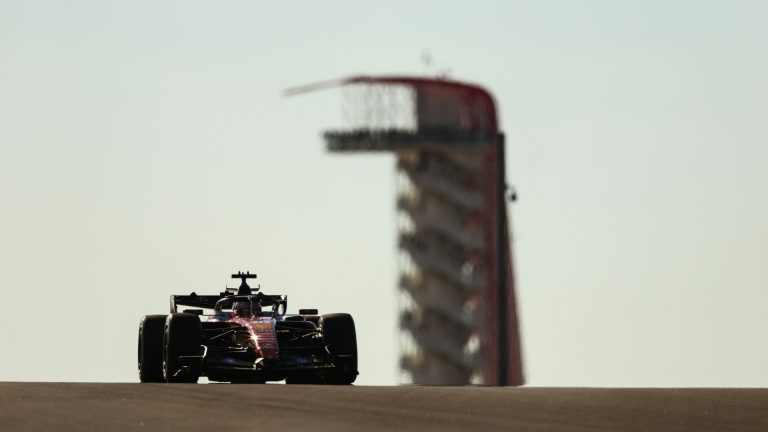
Charles Leclerc topped both Friday practice sessions at Circuit of The Americas, but the United States Grand Prix appears considerably closer than Ferrari’s results suggest. Race simulations placed Ferrari and Red Bull almost level, Mercedes showed competitive pace on a different tyre compound, and McLaren believes its one-lap performance concealed the true potential of the MCL40.
Ferrari finished Friday (October 23) at the top of the Formula 1 timing screens in Austin, but the opening two practice sessions suggested that the fight for victory at the United States Grand Prix remains open. Charles Leclerc led both FP1 and FP2, yet Mercedes, Red Bull and McLaren all demonstrated signs of competitiveness during a day heavily influenced by tyre behaviour, track limits and the difficult surface of Circuit of The Americas.
Leclerc set a 1:36.052 in FP1 before improving to 1:35.291 in the second session. The Monegasque finished only 0.042s ahead of championship leader Kimi Antonelli in the afternoon, with Max Verstappen another 0.147s behind.
Lewis Hamilton completed the top four for Ferrari, while George Russell was fifth and Liam Lawson sixth. McLaren finished seventh and eighth with Lando Norris and Oscar Piastri, respectively.
However, the qualifying simulations revealed only part of the picture. The longer runs that followed suggested a particularly close contest between Ferrari, Red Bull and Mercedes, while McLaren reported that it had not extracted the maximum performance from its soft-tyre laps.
The results leave several questions unanswered before Saturday’s final practice session and qualifying, particularly regarding which team can combine single-lap performance, race pace and tyre management most effectively.
Ferrari leads on single-lap pace, but Verstappen and Antonelli remain close
Leclerc was the reference point throughout Friday.
The Ferrari driver led FP1 despite Verstappen briefly setting an even faster lap, which was subsequently deleted for exceeding track limits at Turn 19.
In FP2, Leclerc again moved to the top during the qualifying simulations on soft tyres. His 1:35.291 proved sufficient to keep Ferrari ahead, but the margins were considerably smaller than the final classification initially suggested.
Antonelli finished only 42 thousandths behind, while Verstappen was 0.189s away.
The leading trio also showed different strengths around the 5.513km circuit.
Verstappen was particularly competitive in the fast opening sector, while Antonelli demonstrated strong performance through the middle section, including the long back straight.
Leclerc combined a competitive opening sector with particularly effective performance in the technical final part of the lap.
Those differences suggest that the cars are achieving their lap times in different ways rather than relying on identical aerodynamic characteristics.
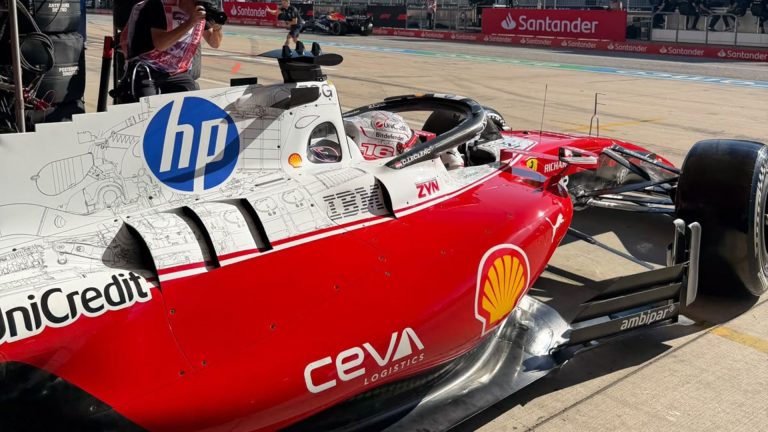
Ferrari’s latest development package includes changes intended to improve the SF-26’s overall efficiency and aerodynamic balance. The initial results have been encouraging, but Leclerc warned that the team cannot assume Friday’s advantage will continue into qualifying.
“Our upgrades worked as expected, but we must not get carried away by too high expectations ahead of tomorrow,” the Ferrari driver said.
The Monegasque also identified the two rivals who appeared particularly threatening.
“Kimi and Max already look very strong, and they’ll definitely be up there in qualifying,” he added.
Ferrari’s Friday advantage therefore provides encouragement without establishing the Italian team as the definitive favourite for pole position.
Ferrari and Red Bull separated by 0.002s in race simulations
The longer runs provided further evidence of the close contest at the front.
According to the stint analysis, Leclerc averaged 1:41.479 over 12 laps on soft tyres, while Verstappen recorded 1:41.481 over the same number of laps and on the same compound.
Only 0.002s separated the Ferrari and Red Bull averages.
Antonelli was similarly competitive, averaging 1:41.521 over 13 laps. However, the Mercedes driver completed his stint on medium tyres, preventing a direct comparison with the soft-tyre runs of Leclerc and Verstappen.
Piastri produced McLaren’s representative long run, averaging 1:41.872 over seven laps on soft tyres.
| Team / Driver | Average lap | Laps | Tyre |
|---|---|---|---|
| Ferrari — Leclerc | 1:41.479 | 12 | Soft |
| Red Bull — Verstappen | 1:41.481 | 12 | Soft |
| Mercedes — Antonelli | 1:41.521 | 13 | Medium |
| McLaren — Piastri | 1:41.872 | 7 | Soft |
Long-run averages from Friday’s FP2 data. Fuel loads are unknown, and differences in tyres and stint lengths prevent a direct performance ranking.
The comparison is particularly significant because Ferrari’s advantage on a single lap did not translate into a substantial margin over Verstappen during the longer simulations.
Mercedes also remained within 0.042s of Ferrari’s average, despite using a different compound.
The figures do not prove that Mercedes would have been faster or slower on soft tyres. They do, however, confirm that Antonelli remained competitive during an extended run with a different tyre strategy.
McLaren’s shorter sample requires additional caution, especially because tyre age, fuel load and track evolution can influence averages.
The available evidence points towards a close race rather than a clear Ferrari advantage.
Mercedes improves W17 balance after difficult opening session
Mercedes experienced one of the clearest changes in performance between FP1 and FP2.
Antonelli finished fifth in the opening session, while Russell placed fourth. Both drivers struggled with balance and braking difficulties as the team continued learning how to operate its latest aerodynamic package.
The developments had been introduced earlier in the season, but Mercedes had not consistently extracted the expected performance.
The team used different specifications at Singapore to improve its understanding of the changes before returning both drivers to the latest configuration in Austin.
During Friday’s break, Mercedes adjusted the cars, improving their balance and reducing some of the braking problems experienced in FP1.
Antonelli responded by finishing second in FP2, while Russell placed fifth despite failing to complete his strongest possible qualifying simulation.
“We were able to improve that for FP2 though and we took a good step forward,” Antonelli said.
The Italian also acknowledged that Mercedes still needed further improvement to challenge for victory.
“We will now pick through the data overnight and see if we can take another step. We will likely need that if we are to be confident of fighting for victory on Sunday.”
Russell experienced a more complicated qualifying simulation. One of his laps was deleted for exceeding track limits, and another was compromised by a significant loss of control through the opening sector.
That means his fifth place, 0.744s behind Leclerc, may not fully represent his potential over a clean qualifying lap.
Mercedes trackside engineering director Andrew Shovlin believes the fight remains particularly open.
“You wouldn’t rule out any of the top four teams having the pace for pole position tomorrow,” Shovlin said.
The German manufacturer will use FP3 to continue refining the W17 before the final qualifying session.
Verstappen combines qualifying speed with strong long-run performance
Red Bull’s improvement during the second half of the championship continued to be evident in Austin.
Verstappen arrived in Texas following consecutive victories in Malaysia and Singapore and immediately established himself among Ferrari’s principal rivals.
The Dutchman finished second in FP1 and third in FP2, remaining within two-tenths of Leclerc during the afternoon.
His longer run was even closer to Ferrari’s benchmark.
Verstappen’s average of 1:41.481 on soft tyres was virtually identical to Leclerc’s 1:41.479, with both stints covering 12 laps.
The result suggests that Red Bull has a competitive foundation for Sunday’s race, although additional information will be required before drawing conclusions about tyre degradation and fuel-corrected performance.
Verstappen acknowledged that Circuit of The Americas presented particular difficulties in finding a satisfactory balance.
“This track is never easy when it comes to finding the right compromise between the low and high-speed corners,” he said.
The four-time champion identified the bumps as another factor complicating the process.
“The bumps make it even more difficult, so you’re trying to find a good balance in the car and get into a rhythm.”
While Verstappen demonstrated competitive pace, teammate Isack Hadjar experienced a more difficult afternoon.
The Frenchman struggled with the balance of his RB22 and had several laps deleted for exceeding track limits, finishing ninth in FP2.
That contrast indicates that Red Bull’s performance cannot necessarily be assessed solely through Verstappen’s results.
The team will continue evaluating the balance of the car during FP3, particularly in the high-speed corners that have caused difficulties for Hadjar.
McLaren struggles over one lap but sees encouraging race pace
McLaren was the most difficult of the leading four teams to assess after Friday’s sessions.
Norris finished third in FP1, only 0.245s behind Leclerc, but dropped to seventh in FP2 with a 1:36.373. Piastri finished eighth, just 0.014s behind his teammate. Both were more than a second slower than Ferrari’s benchmark in the afternoon.
However, McLaren reported that the final positions did not reflect its complete performance potential.
The drivers struggled to combine their strongest sectors into clean laps on soft tyres. Track limits and changing grip also affected their qualifying simulations.
The team nevertheless collected encouraging information from its race preparation, with the MCL40 performing more competitively over longer runs than the headline FP2 classification suggested.
Chief technical officer and chief designer Rob Marshall acknowledged that McLaren had not extracted everything from the car.
“The balance of power amongst the top four teams is quite close — closer than the FP2 standings suggest,” Marshall said.
He also highlighted the importance of the team’s small developments introduced for Austin.
“The long runs were quite positive, and the series of minor updates we’ve brought to this track seem to be delivering the expected results in terms of performance.”
The changes include work around the suspension and brake ducts, with McLaren continuing to address limitations in slower corners.
The team’s performance through medium- and high-speed sections remained encouraging, but Norris and Piastri struggled with grip and consistency during the qualifying simulations.
Marshall believes McLaren can reduce its deficit after studying the information collected on Friday.
For Norris and Piastri, Saturday’s challenge will be to convert that underlying performance into competitive qualifying laps.
Track limits become major problem before qualifying
One of the defining characteristics of Friday’s sessions was the large number of lap times deleted for exceeding track limits.
The FIA recorded 79 deleted laps during FP1 and another 128 in FP2, a combined total of 207 deleted laps.
The principal problem areas included Turns 12, 19 and 20, with drivers frequently running beyond the white lines while attempting to extract more speed.
The incidents complicated the final classification because several drivers lost laps that would otherwise have improved their positions.
Verstappen was among those affected in FP1, while Russell and both McLaren drivers also struggled to complete clean laps.
The limits are expected to remain a significant factor during qualifying, when a deleted time can determine whether a driver progresses through Q1 or Q2.
The track’s bumps further complicate matters because they can destabilise the cars and affect braking consistency.
Norris and Verstappen had already criticised the uneven surface before Friday’s running, with the McLaren driver explaining that the physical impacts at particularly rough circuits can cause headaches.
Their comments are detailed in Norris’s warning about the bumps at Circuit of The Americas.
The combination of strict track limits, changing grip and a physically demanding surface gives teams another variable to manage during qualifying.
Tyre strategy could be decisive in Sunday’s United States GP
The race simulations also raised questions about tyre selection for Sunday.
Pirelli brought the C2, C3 and C4 compounds to Austin, with teams spending Friday evaluating their performance and degradation.
The preliminary data suggests that the medium and soft compounds will play the principal roles in race strategy.
Pirelli motorsport director Dario Marrafuschi explained that the hardest compound may have relatively limited importance.
“So far, the C2 appears likely to play only a limited role in defining race strategies,” he said.
The tyre supplier also identified a one-stop strategy as the most likely approach based on Friday’s information.
“Given the level of degradation observed and the rapid evolution of track grip, a one-stop race currently appears to be the most likely scenario.”
Pirelli estimated the performance difference between the medium and soft compounds at approximately half a second per lap.
However, those figures can change with track temperature, fuel load, tyre age and the evolving surface conditions.
The longer stints completed by Leclerc, Verstappen and Antonelli therefore provide useful evidence but do not establish a definitive race hierarchy.
Ferrari and Red Bull ran their representative stints on soft tyres, while Mercedes collected its main comparative data with Antonelli on mediums.
The differing approaches may influence how the teams plan their strategies for Sunday’s race.
What Friday’s practice tells us about the fight for pole
The two sessions produced a clear fastest driver but not an equally clear favourite for qualifying.
Leclerc demonstrated consistent single-lap speed and Ferrari showed encouraging performance with its latest aerodynamic package.
Antonelli improved substantially after Mercedes changed its set-up between sessions, while Russell still had performance to recover from a disrupted qualifying simulation.
Verstappen combined competitive single-lap pace with an almost identical long-run average to Leclerc, strengthening Red Bull’s position after its recent victories.
McLaren has more work to do on qualifying performance, although its technical staff believe the car is significantly closer to the front than Friday’s final classification suggests.
The differences among the leading teams are also influenced by tyre choice, fuel loads, circuit characteristics and the ability to produce clean laps within the track limits.
Saturday’s FP3 will give Ferrari, Mercedes, Red Bull and McLaren one final opportunity to refine their cars before qualifying.
When is United States GP qualifying at Austin?
The United States Grand Prix continues on Saturday, October 24, with FP3 beginning at 12:30 local time in Austin, followed by qualifying at 16:00.
| Session | Austin (CDT) | UK (BST) | India (IST) | Brazil (BRT) |
|---|---|---|---|---|
| FP3 | 12:30 | 18:30 | 23:00 | 14:30 |
| Qualifying | 16:00 | 22:00 | 02:30 Sunday | 18:00 |
The full United States Grand Prix qualifying guide provides the complete international schedule.
GRANDE PRÊMIO is following every session of the United States Grand Prix at Circuit of The Americas this weekend, with breaking news, full coverage and real-time updates in its Formula 1 section.