
News Summary
- Mercedes tested an exhaust arrangement inspired by Ferrari’s SF-26 during practice at the Spanish GP
- Ferrari uses the exhaust flow to influence the air leaving the diffuser and reaching the rear wing
- Mercedes removed its version after Friday, suggesting that the expected aerodynamic benefit was not reproduced consistently
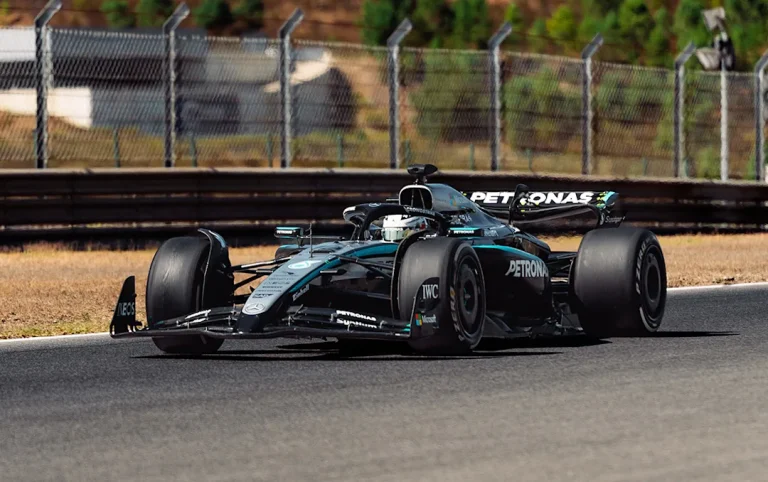
Mercedes tested an exhaust configuration inspired by Ferrari’s SF-26 during the Spanish GP weekend but abandoned the system before the competitive sessions at the Madring.
The modification appeared on the W17 during practice and represented Mercedes’ interpretation of Ferrari’s so-called FTM — or flick tail mode — exhaust concept. The team subsequently returned to the arrangement previously used at Monza for qualifying and the race.
Neither Mercedes nor the FIA has indicated that the component raised a legality concern. Its removal therefore points towards a performance decision after the team compared both specifications on track.
The experiment also revealed that Mercedes has been studying one of Ferrari’s most interesting aerodynamic solutions as the Formula 1 development contest approaches its final phase of 2026.
How Ferrari’s exhaust system works
Ferrari has used the FTM arrangement since pre-season testing. Its purpose is not to produce additional engine power but to make the exhaust gases interact more effectively with the airflow around the rear of the car.
The system partially obstructs the exhaust outlet, increasing the force of the gas flow and directing it upwards. That accelerated flow can then assist the air leaving the diffuser and energise the airflow travelling towards the underside of the rear wing.
In simplified terms, Ferrari is using energy that would otherwise leave the car without serving an aerodynamic function. The exhaust flow becomes another tool for managing the turbulent air around the diffuser, beam wing and rear wing.
This can improve the consistency of the rear aerodynamic load, particularly during acceleration. However, it also creates a complicated relationship between engine operation, throttle position, temperatures and the airflow produced by the floor.
Ferrari’s solution has been refined around the SF-26 since the beginning of the season. Mercedes attempted to introduce a similar principle to a car developed around a different rear-end architecture.
Why did Mercedes abandon its version?
Mercedes has not provided a detailed explanation, meaning any definitive conclusion would be premature. The most likely interpretation is that the component failed to deliver a sufficiently reliable performance gain during Friday’s comparison.
A modification can produce promising figures in computational fluid dynamics or the wind tunnel but behave differently once exposed to changing ride heights, crosswinds, exhaust temperatures and the movement of a real car.
The W17’s aerodynamic platform may also have responded differently from Ferrari’s. Copying the visible component does not reproduce the network of surfaces and airflow structures that allow it to work on the original car.
Mercedes could also have encountered an undesirable balance change. Increasing rear load is valuable only if the improvement is predictable and does not compromise the behaviour of the diffuser or rear wing through different cornering phases.
Cooling and thermal management represent another consideration. Redirecting hot exhaust gases requires careful control of nearby bodywork and suspension components, especially across a full race distance.
The decision to remove the part does not necessarily mean Mercedes has abandoned the concept permanently. Practice experiments are frequently used to collect correlation data before a revised version is introduced at a later event.
Ferrari offers Mercedes another development reference
The Madrid test was significant because Mercedes began 2026 with the championship’s benchmark car. Rivals have reduced that advantage through a more aggressive development cycle, forcing the German manufacturer to investigate solutions already proven elsewhere.
Ferrari’s exhaust concept is different from copying a conventional wing element. Its effectiveness depends on the interaction between the power unit and the aerodynamic package, making it considerably harder to reproduce through external observation alone.
Mercedes has simultaneously transferred resources towards its 2027 programme, although the team is preparing one final major W17 upgrade. That package is expected to arrive in Malaysia rather than at the Azerbaijan GP.
The team will therefore continue with its established exhaust specification in Baku. Practice begins on Thursday, with qualifying taking place on Friday and the Grand Prix moving to Saturday because of Azerbaijan’s Remembrance Day.
F1 today: FAQ
When is the next Formula 1 race?
The next race is the 2026 Azerbaijan Grand Prix at the Baku City Circuit on Saturday, 26 September.
Why is the 2026 Azerbaijan Grand Prix being held on Saturday?
The race was moved forward to avoid Azerbaijan’s national Remembrance Day on Sunday, 27 September. Practice begins on Thursday, with qualifying on Friday and the Grand Prix on Saturday.
Who leads the 2026 Formula 1 championship?
Kimi Antonelli leads the Drivers’ Championship with 292 points. Mercedes teammate George Russell is second on 211, leaving Antonelli 81 points ahead with nine rounds remaining.
What is Ferrari’s FTM exhaust system?
FTM stands for flick tail mode. Ferrari’s arrangement redirects the exhaust flow upwards to influence the air leaving the diffuser and travelling towards the rear wing.