
News Summary
- Hamilton recovered from more than a minute behind to finish third after Ferrari started on slicks.
- He agreed that a different tyre choice could have given him a winning opportunity, while acknowledging the importance of the late Safety Car.
- Vasseur admitted Ferrari chose the wrong side of the strategy split, but said the decision remained difficult even with hindsight.
Lewis Hamilton’s recovery at Sepang leaves Ferrari with a question more uncomfortable than whether third place represented a good result: did its starting tyre decision prevent him from fighting for victory? Starting alongside Max Verstappen and recovering from more than a minute behind provided enough evidence to raise that possibility. Establishing that Ferrari actually surrendered a win requires considerably more.
Hamilton himself entertained the idea. Asked after the Bahrain Grand Prix in Malaysia whether his pace suggested he could have won with a different starting tyre, the seven-time Formula 1 champion answered affirmatively. His subsequent explanation, however, also identified how much his recovery owed to circumstances Ferrari could not control.
The distinction matters. Ferrari compromised Hamilton’s opening phase with its slick tyre gamble. Whether the alternative would have produced victory remains an unresolved counterfactual.
Ferrari’s gamble removed Hamilton from the early fight
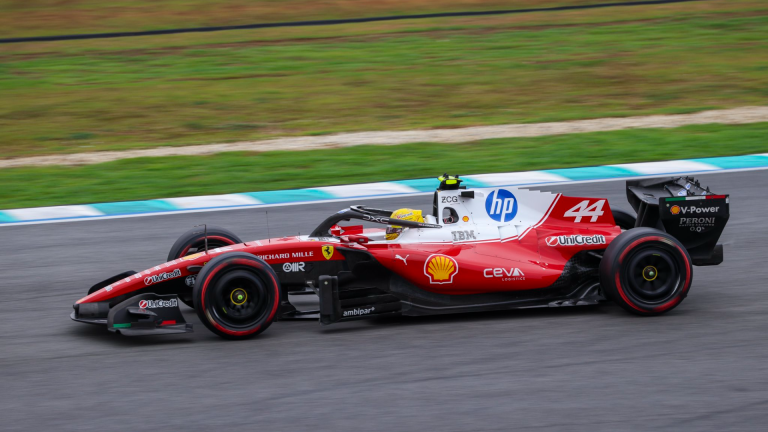
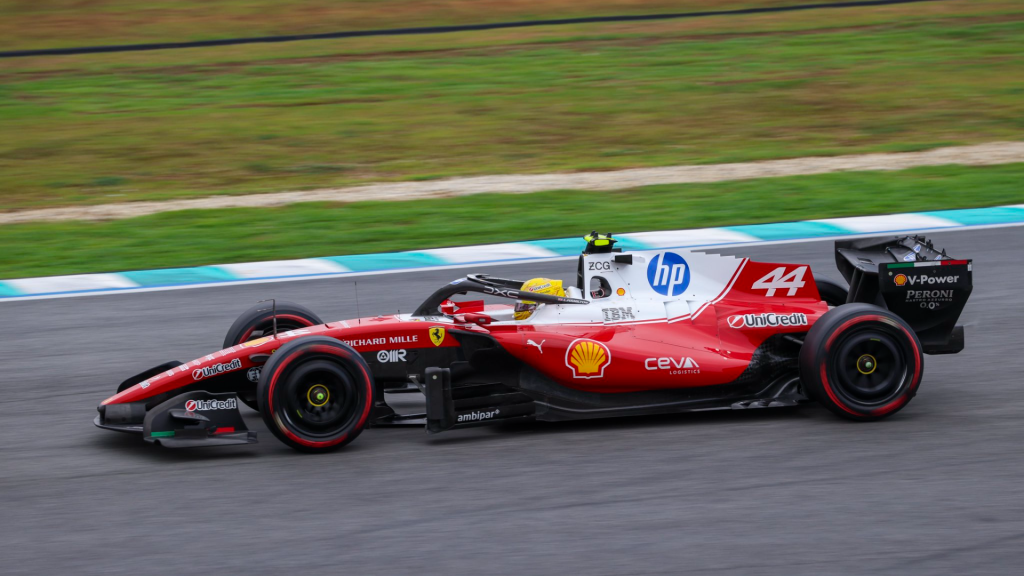
Hamilton started second, with the opportunity to contest the race directly against Verstappen. Instead, Ferrari’s decision to use slicks on the wet surface left him struggling for grip while the drivers on intermediates established an advantage.
The reasoning depended on the circuit drying quickly enough to reward avoiding an early tyre change. Hamilton’s account made clear that the transition took much longer than expected, turning a potentially useful strategic shortcut into a substantial loss.
“Yeah. Yeah, I mean it’s a mixed emotion. On one side I’m really, really grateful to have got back to the podium. And then on the other side, obviously with the debates that we were having in the background, to then see the covers come off the car ahead and slicks and the one behind, sorry on wets and us on slicks and the track being so tricky and dangerous at that beginning, it was definitely, yeah, my heart sank and I was kind of like that’s the race over,” Hamilton said in his post-race interview with Sky Sports F1.
Ferrari subsequently considered reversing the decision. Hamilton opted to continue, accepting the immediate loss rather than making another stop before the surface became suitable for his tyres.
“But then they were like, should we stop? And I was like, no, we’ve already made the decision, we have to live with it and we’ll stay out here until this bloody place dries. And I eventually did. And then I just kept my head down, just kept pushing, just didn’t give up,” he continued.
That exchange establishes two separate decisions: the initial choice of slicks and the subsequent commitment to stay on them. Hamilton supported continuing with the gamble after its consequences became apparent. His refusal to stop does not establish who originally advocated the starting tyre or how Ferrari divided responsibility for choosing it.
The full account of Hamilton’s decision to remain on slicks captures that tension: the driver believed the race had slipped away, then committed to finding a route back without immediately abandoning the strategy.
A recovery of more than a minute does not measure the lost winning chance
Hamilton’s comeback demonstrated competitive pace, persistence and Ferrari’s ability to execute the later stages of the race. It did not provide a clean comparison with Verstappen over an uninterrupted Grand Prix.
“And I definitely didn’t expect to get back to P3. It’s crazy to think we were over a minute down. And the track took so long to dry, which was, normally it’s been spitting and it dries straight away because it’s so hot here. But unfortunately that didn’t happen for quite some time. But the team did a good job on the pit stops,” Hamilton explained.
“And yeah, I wish we had longer and more opportunities to get further ahead. But that safety car at the end was a blessing enabling me to get to the podium,” he added.
The late Safety Car is central to interpreting the result. Hamilton finished only 4.919 seconds behind Verstappen, but that margin followed a neutralisation that compressed the field. It cannot be treated as proof that Ferrari needed to recover only another five seconds through a better starting decision.
Nor can the minute Hamilton lost simply be deducted from his eventual race time. Starting on intermediates would have changed his position, traffic, pit-stop requirements and tyre usage. Verstappen would also have faced a different opponent and potentially responded with different decisions.
The Sepang race report shows the other side of that comparison: Verstappen converted his race into victory ahead of Kimi Antonelli, while Hamilton needed the closing opportunity to reach third.
Ferrari’s pace supports the argument that Hamilton could have remained a contender with a better opening phase. It does not establish that he would have beaten Verstappen.
Vasseur admits the wrong choice, but not an obvious alternative
Frédéric Vasseur acknowledged that Ferrari had landed on the wrong side of the tyre split. His assessment nevertheless resisted presenting the original decision as straightforward.
“It’s a strong performance, if you consider that we were 21 or 22 seconds off after lap 1, or something like this. It’s a very good comeback, very strong pace. Very well managed by the two guys, and we can be pleased with this,” Vasseur said.
“For sure, the tyre choice is another story, but at the end of the day. I think 50% of the cars took one direction, and the others 50 took the other one, and we were on the wrong side. Difficult.”
“Honestly, if I have to do it again, I’m not sure which choice I’d make now that I know. It is like it is, it’s a difficult choice in these conditions,” he continued.
“You are in the pitlane, you can just see the tarmac in the pitlane, but I am very pleased with the performance over the weekend. We had a very strong comeback. The pace was there and I am pleased for everybody.”
Vasseur’s observation about the field being divided explains the uncertainty teams faced. It does not, by itself, validate Ferrari’s process. Several teams making the same unsuccessful choice would still leave Ferrari needing to examine its own information, assumptions and assessment of the risk.
His post-race defence of Ferrari’s recovery therefore leaves a specific operational question: how confidently did the team expect the entire circuit to become suitable for slicks, and what evidence supported that expectation?
Hamilton’s experience suggests that expectation was decisive. The surface eventually improved, but the delay had already removed him from the early battle.
Ferrari lost the opportunity to test its winning pace
The strongest criticism Ferrari faces is that its strategy prevented a direct assessment of what Hamilton could achieve from the front row. He spent the opening phase surviving the conditions and the remainder recovering ground, rather than applying sustained pressure to Verstappen.
Third and fourth for Hamilton and Charles Leclerc demonstrated that Ferrari could salvage a substantial result. Those positions also leave room to question whether the team extracted everything available from its weekend.
Ferrari compromised a potential winning opportunity; the available evidence does not prove it threw away a certain victory. Hamilton’s belief deserves weight, but confirming it would require a comparison of stint pace, tyre condition, traffic and the time recovered through Safety Car periods.
Formula 1 returns this weekend, from 9–11 October, for the Singapore Grand Prix, featuring a Sprint weekend. GRANDE PRÊMIO will cover all the action at Marina Bay.
F1 today: FAQ
What time is the 2026 Singapore GP?
The Singapore GP starts at 20:00 local time on Sunday, October 11. That is 13:00 in the UK, 08:00 ET in the US and Canada and 17:30 in India. Singapore is a sprint weekend, with sprint qualifying on Friday and the sprint on Saturday.
Why does George Russell have a grid penalty in Singapore?
Russell has exhausted his permitted allocation of four engines after suffering a power-unit failure at Sepang. Mercedes must introduce another unit, triggering a grid penalty for Sunday’s Grand Prix. The penalty does not apply to Saturday’s sprint.
Can Kimi Antonelli win the F1 championship in Singapore?
No. Antonelli leads Russell by 84 points, 320 to 236, but cannot mathematically secure the 2026 title in Singapore. His first opportunity to become world champion comes at the United States GP in Austin.