News Summary
- Liam Lawson qualified eighth for the Las Vegas Grand Prix and moves to seventh on the starting grid after power-unit penalties.
- Racing Bulls exceeded its expectations by placing both Lawson and Arvid Lindblad in Q3, with the rookie securing fifth place on the grid.
- Lawson praised the car’s cornering performance but admitted the team must investigate its lack of speed on the straights.
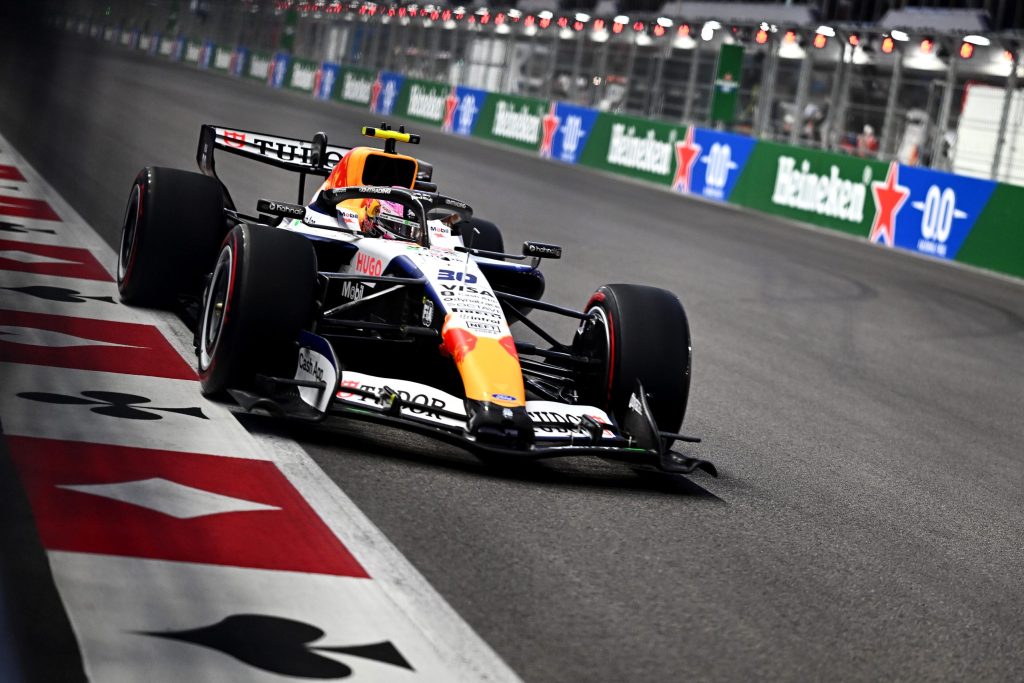
Liam Lawson has admitted Racing Bulls exceeded its expectations during qualifying for the 2026 Las Vegas Grand Prix, although the New Zealander warned that the team’s lack of straight-line speed could become a significant challenge during Saturday night’s race.
Lawson qualified eighth with a 1:35.090, reaching Q3 alongside teammate Arvid Lindblad, who produced an impressive 1:34.668 to finish sixth. Following the penalties imposed on other drivers, the Racing Bulls pair will start seventh and fifth respectively.
The result represented a substantial improvement after a difficult opening day, when heavy rain restricted running and left Racing Bulls unable to gather representative dry-weather data.
Both cars reached Q3 despite the team arriving in Las Vegas without expecting to be particularly competitive, giving Racing Bulls an encouraging starting position for the 50-lap Grand Prix.
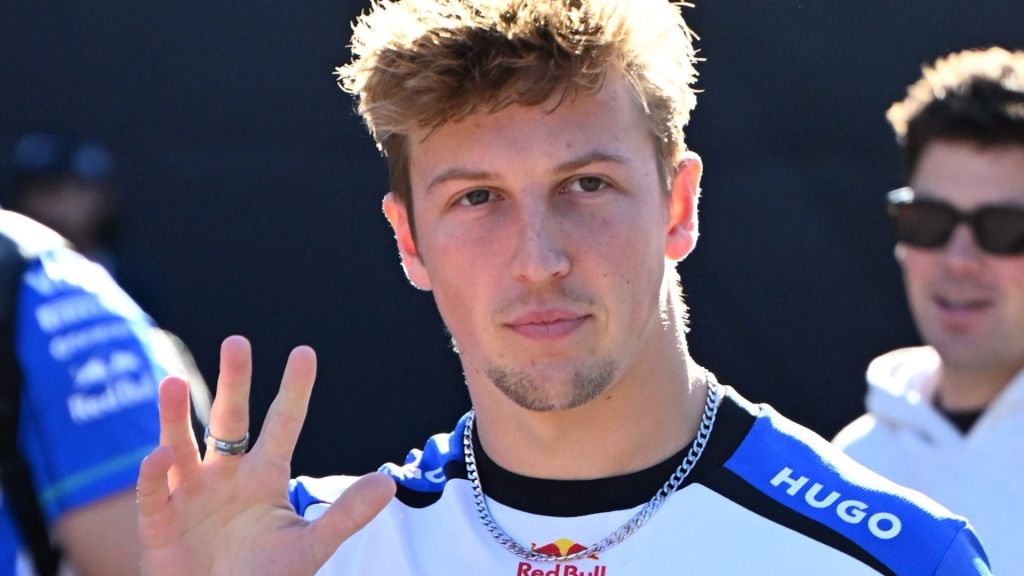
Lawson admits Racing Bulls was stronger than expected
Lawson was pleased with the balance of his car throughout Friday’s running, particularly after the difficult conditions experienced during the opening practice sessions.
“The car has been great all day, which is a really positive sign, especially as we weren’t expecting to be quite this strong here,” Lawson said after qualifying.
“Getting both cars into Q3 is another great result for the team.”
Racing Bulls had endured a disrupted Thursday, with neither driver recording a time during FP1 and both completing relatively limited running in FP2.
The conditions improved considerably for FP3 and qualifying, allowing the team to find a more suitable setup for the demands of the Las Vegas Strip Circuit.
Lawson nevertheless emphasised that extracting performance required careful management of the car and driving conditions.
“You need everything to come together around this track as it’s quite tricky,” he explained.
The circuit combines lengthy straights with heavy braking zones and slower corners, creating a difficult aerodynamic compromise between maximum speed and cornering grip.
For Racing Bulls, the balance has been particularly challenging because its strong performance through the corners has not been matched by equivalent speed along the straights.
Racing Bulls struggles on straights despite strong cornering performance
Lawson identified straight-line speed as the team’s principal area for improvement ahead of the race.
“We’ve been really strong through the corners, but we’re lacking a bit of pace on the straights, so that’s something we’ll need to review and understand.”
The assessment reveals an important limitation despite Racing Bulls’ strong qualifying performance. The team appears competitive in the more technical sections, but the long acceleration zones could leave its drivers vulnerable when attempting to defend positions or complete overtakes.
The issue is particularly relevant at Las Vegas, where slipstreaming played a decisive role during qualifying.
Kimi Antonelli used the aerodynamic tow from another car to record the fastest lap, while several drivers acknowledged that track positioning had a substantial influence on their results.
Lawson’s comments also echo concerns expressed by Lando Norris, who admitted McLaren was losing considerably more time on the straights than it could recover through the corners.
However, Racing Bulls and McLaren have not established that they are suffering from the same technical problem. Lawson described a modest straight-line deficit, while Norris was far more critical of McLaren’s aerodynamic compromise.
The difference could become important when the field begins fighting for positions during the race.
Red Bull driver Isack Hadjar, who starts fourth, has already identified straight-line performance as a potential advantage over Norris. Racing Bulls, meanwhile, must ensure its stronger cornering pace is sufficient to compensate for the speed it lacks elsewhere.
Lindblad gives Racing Bulls two cars in strong starting positions
Lawson’s performance was complemented by an impressive qualifying session from Lindblad.
The British rookie reached Q3 and finished sixth in the classification, more than four tenths faster than his experienced teammate.
After Kimi Antonelli’s five-place penalty, Lindblad moves into fifth, placing him behind Max Verstappen, George Russell, Norris and Hadjar.
Lawson starts seventh, directly behind Antonelli and ahead of Pierre Gasly.
The result gives Racing Bulls two cars inside the first seven positions, creating an opportunity to challenge for a valuable double points finish.
It is also particularly important for Lawson, whose performances during the closing stages of the season have helped strengthen Racing Bulls’ position in the Constructors’ Championship.
The New Zealander had previously identified Alpine as a threat because of its straight-line speed, making the competitive picture in Las Vegas especially interesting.
Gasly and Franco Colapinto qualified ninth and tenth respectively, with both moving forward following the penalties affecting other drivers.
The midfield competition therefore remains closely contested, with Racing Bulls needing to convert its strong qualifying performance into race points.
Lawson sees overtaking opportunities despite speed concerns
Although Lawson acknowledged the car’s weaknesses, he remained optimistic about the race.
“We’re starting from a good position for tomorrow’s race, and with this track offering plenty of overtaking opportunities, let’s see what we can do.”
The circuit’s long straights and heavy braking areas provide several opportunities to attack, although successful overtaking also depends on tyre grip, energy deployment and the ability to remain close through the preceding corners.
Lawson will have to manage those factors while attempting to take advantage of his seventh-place start.
Tyre behaviour could also influence his race. Pirelli expects a one-stop strategy to be the fastest option, but cold track conditions and the possibility of graining create additional uncertainty.
As GRANDE PRÊMIO explained in its Las Vegas tyre strategy guide, newly fitted tyres may initially struggle to generate sufficient temperature, making the timing of pit stops particularly important.
Racing Bulls will therefore need to combine its encouraging qualifying pace with effective tyre management and race strategy.
The complete Las Vegas starting grid confirms Lawson in seventh and Lindblad fifth.
The Las Vegas Grand Prix begins at 8:00 PM local time on Saturday, November 21, equivalent to 11:00 PM Eastern Time and 4:00 AM GMT on Sunday, November 22.
GRANDE PRÊMIO is following every session of the Las Vegas Grand Prix and the latest developments in Formula 1.
FAQ
Where will Liam Lawson start the 2026 Las Vegas Grand Prix?
Lawson qualified eighth but moves to seventh after the application of grid penalties. Teammate Arvid Lindblad starts fifth.
What problem did Lawson identify with Racing Bulls in Las Vegas?
Lawson said the car was performing strongly through the corners but lacked some straight-line speed, an area the team wants to investigate before the race.
Did both Racing Bulls drivers reach Q3 in Las Vegas?
Yes. Lindblad qualified sixth and Lawson eighth, giving Racing Bulls two cars inside the top ten. Both gain positions following grid penalties.