News Summary
- Max Verstappen admitted that Red Bull continued struggling with problems already experienced during the São Paulo Grand Prix.
- The Dutchman qualified second in Las Vegas, 0.258 seconds behind Kimi Antonelli, but inherited pole position because of the Mercedes driver’s five-place grid penalty.
- Verstappen praised Red Bull’s qualifying execution and highlighted low track temperatures and slipstream positioning as the main challenges.
Max Verstappen has revealed that Red Bull is still struggling with problems that first affected the team at the São Paulo Grand Prix, despite securing pole position for the 2026 Las Vegas Grand Prix following Kimi Antonelli’s grid penalty.
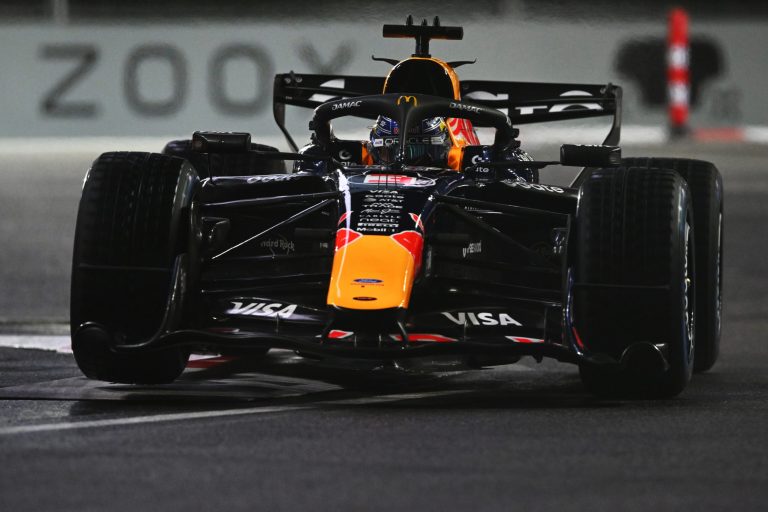
The Dutchman qualified second on Friday night, recording 1:34.151, 0.258 seconds behind Antonelli’s fastest lap. However, the Mercedes driver’s five-place penalty for exceeding his internal combustion engine allocation promoted Verstappen to first on the starting grid.
The result represented a significant recovery for Red Bull after a difficult practice programme, but Verstappen admitted that the team had not entirely resolved the problems affecting its car.
“Just struggling with some things that also were in the car in Brazil. Just trying to get my head around to it to try to make the best out of it this weekend again,” Verstappen said when interviewed by James Hinchcliffe after qualifying.
His comments suggest that the difficulties experienced in Las Vegas were not entirely specific to the cold and wet conditions that disrupted the opening practice sessions.

Verstappen reveals problems carried over from São Paulo
Red Bull endured a difficult start to the Las Vegas weekend, with Verstappen finishing 13th in FP2 after completing only eight laps.
The team had initially kept him in the garage while the circuit remained extremely wet, before an interruption caused by plastic debris compromised his later programme.
Technical director Pierre Waché subsequently explained that Verstappen had experienced energy-management difficulties, but identified the car’s balance as the more significant concern.
As GRANDE PRÊMIO reported, Waché said the team needed to understand and correct the handling problems before the final practice session.
Verstappen’s comments following qualifying added another dimension to that explanation. The Dutchman acknowledged that some of the same difficulties had been present at Interlagos, suggesting Red Bull was still searching for a satisfactory solution across different circuits.
The team had nevertheless shown significant improvement in qualifying, with Verstappen fighting near the front throughout the session.
Isack Hadjar also demonstrated competitive pace, qualifying fifth with a 1:34.592 before moving to fourth on the starting grid following Antonelli’s penalty.
Verstappen praises Red Bull’s qualifying execution
Despite the remaining technical concerns, Verstappen was pleased with the way Red Bull managed the session.
“I think we had a solid qualifying. We executed well. My first lap in Q3 was pretty much as good as it can be, just with the tow effect as well around the lap,” he explained.
“I think to be on the front row is very good for us.”
The Dutchman initially established the Q3 benchmark with his 1:34.151, using the slipstream to improve his performance on the Las Vegas Strip Circuit.
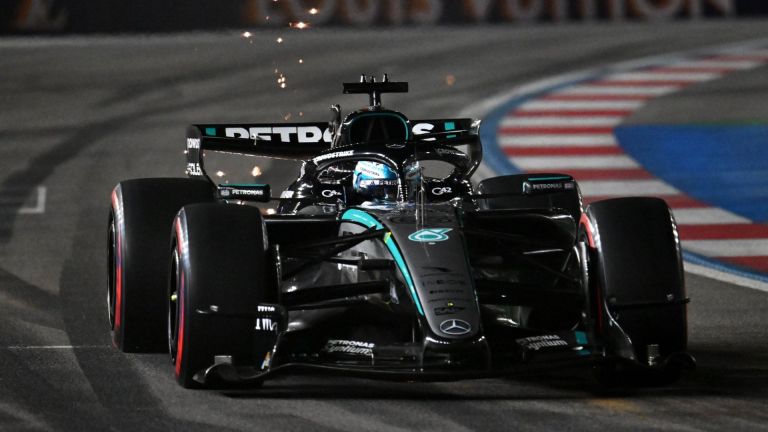
Antonelli subsequently completed a faster lap to lead the qualifying classification, but the Italian was already facing a five-place grid penalty.
Verstappen therefore secured the most favourable starting position without setting the fastest qualifying time, while George Russell moved onto the front row alongside him.
Lando Norris will start third for McLaren, with Hadjar fourth and Arvid Lindblad fifth. Antonelli drops to sixth.
The complete classification and the consequences of the engine penalty are detailed in GRANDE PRÊMIO’s Las Vegas qualifying report.
Track temperatures and slipstreams complicate Las Vegas qualifying
Verstappen also identified the difficulty of managing track position as one of the defining characteristics of qualifying.
The Las Vegas circuit features several long straights, making slipstreams especially important for drivers seeking an advantage on their flying laps.
However, the same characteristics can complicate preparations, particularly when several cars are attempting to find the right position on track simultaneously.
Low temperatures added another challenge, with teams needing to generate sufficient tyre heat without compromising performance before the start of a timed lap.
“Track temp, being in the right position – it’s incredibly hard when you have so many straights around here,” Verstappen explained.
“But I think we executed well, so we can be very happy with that.”
The combination of a favourable slipstream and an effective lap allowed Verstappen to secure second place in qualifying, despite the problems he had described.
His pole position gives Red Bull an opportunity to challenge for victory on Saturday night, although the team’s remaining balance concerns could become relevant over longer race stints.
The Las Vegas Grand Prix starts at 8:00 PM local time on Saturday, November 21, equivalent to 11:00 PM Eastern Time and 4:00 AM GMT on Sunday, November 22.
GRANDE PRÊMIO is following every session of the Las Vegas Grand Prix and the latest developments in Formula 1.
FAQ
What problems did Max Verstappen report after Las Vegas qualifying?
Verstappen said Red Bull was still struggling with problems that had also affected the car in São Paulo. Technical director Pierre Waché had previously identified car balance as the team’s principal difficulty in Las Vegas.
Did Verstappen set the fastest qualifying lap in Las Vegas?
No. Kimi Antonelli was fastest with a 1:33.893, while Verstappen finished second with a 1:34.151. The Red Bull driver inherited pole position after Antonelli received a five-place grid penalty.
What did Verstappen identify as the biggest qualifying challenges?
Verstappen highlighted low track temperatures and the difficulty of positioning his car to benefit from a slipstream on a circuit featuring several long straights.