Key Takeaways:
- Legal Action Pending: Neighborhood action group ‘Stop F1 Madrid’ is preparing a lawsuit against the Madrid Grand Prix organization, targeting health impacts caused by excessive noise pollution.
- Extreme Noise Levels: Circuit noise impact studies predict engine sound levels reaching 95 decibels, significantly surpassing WHO residential recommendations of 40–53 dB.
- Bernabéu Precedent: Residents plan to collect real-time acoustic evidence during the September 11–13 event weekend, mirroring legal strategy recently used against noise pollution at Real Madrid’s Santiago Bernabéu stadium.
Scheduled for September 11–13, 2026, the inaugural Spanish GP in Madrid faces mounting local opposition as residents in the Valdebebas district prepare formal legal action following the event. Organized under the advocacy group ‘Stop F1 Madrid,’ residents contend that hosting a street circuit within a residential zone poses severe health risks and violates urban noise regulations.
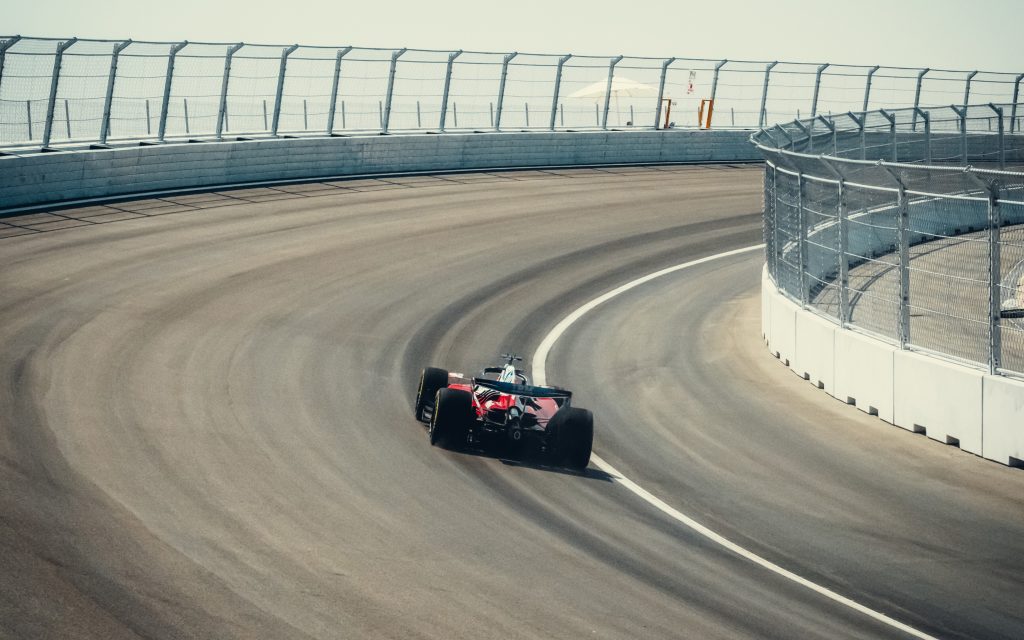
The 5.4 km ‘Madring’ circuit weaves through the IFEMA exhibition center grounds and surrounding municipal roads. Valdebebas was originally developed under eco-friendly and green-urbanism guidelines, making the integration of a Formula 1 circuit a point of friction for neighboring communities.
An official acoustic impact study commissioned for the circuit projected noise levels reaching 95 decibels (dB) during sessions. By contrast, World Health Organization (WHO) guidelines recommend residential noise exposure remain between 40 and 53 dB during waking hours, and below 35 dB inside living quarters.
Constantino Blanco, spokesperson for ‘Stop F1 Madrid,’ outlined the group’s legal stance during an interview with Spanish daily El País.
“Inside a residence, noise levels should not exceed 35 decibels during the day and 30 at night. The neighborhood will suffer the consequences, because a noisy neighborhood directly impacts public health,” Blanco stated. “We oppose the construction of a circuit in a residential neighborhood—this one or any other—because it is illegal. Those responsible for the circuit will ultimately pay the price for subjecting us to this noise in our homes.”

The group’s legal strategy mirrors the successful campaign launched by residents surrounding Real Madrid’s Santiago Bernabéu stadium, where concert events were suspended due to acoustic violations. Opposition members plan to measure and record sound emissions during the race weekend to submit as primary evidence.
“As our lawyer noted, no offense has been committed yet because the evidence will be generated during the race in September,” explained local resident Inma Gallego. “It is terrible that a neighborhood lacking a health center, sports center, or high school gets an F1 circuit before basic public infrastructure.”
The Madrid Grand Prix controversy unfolds as Formula 1 prepares for Round 12 at Zandvoort, following headlines including Carlos Sainz’s multi-year contract extension at Williams.
Formula 1 resumes track action August 21–23, 2026, at Circuit Zandvoort for the Dutch Grand Prix. GRANDE PRÊMIO is covering all activities live on-site with reporter Leonid Kliuev.
2026 Dutch Grand Prix — Session Schedule (Local Time / CEST)
| Day | Session | Local Time (CEST) |
| Friday, August 21 | Free Practice 1 | 12:30 – 13:30 |
| Friday, August 21 | Sprint Qualifying | 16:30 – 17:14 |
| Saturday, August 22 | Sprint Race | 12:00 – 12:30 |
| Saturday, August 22 | Grand Prix Qualifying | 16:00 – 17:00 |
| Sunday, August 23 | Grand Prix (72 Laps) | 15:00 |
Frequently Asked Questions (FAQ)
What is ‘Stop F1 Madrid’?
‘Stop F1 Madrid’ is a resident action committee in the Valdebebas district formed to oppose the Madrid Grand Prix street circuit due to noise pollution, health concerns, and urban planning issues.
What are the predicted noise levels for the Madrid Grand Prix?
Official impact studies estimate noise levels reaching 95 decibels, significantly higher than World Health Organization recommendations of 40–53 dB for residential areas.
When is the inaugural Madrid Grand Prix scheduled to take place?
The Madrid Grand Prix is scheduled to take place from September 11–13, 2026, around the IFEMA exhibition complex.