News Summary
- George Russell starts from pole after beating Charles Leclerc by 0.837s
- Mercedes’ estimated race-pace advantage over McLaren is only 0.05s per lap
- Just three of nine Formula 1 races in Baku have been won from pole position
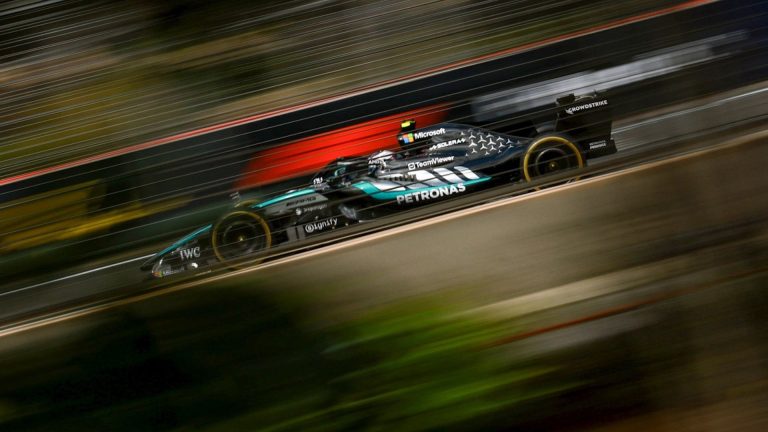
George Russell produced one of Formula 1’s most dominant dry qualifying performances in decades, but converting that 0.837s advantage into Azerbaijan Grand Prix victory will require considerably more than repeating Friday’s speed.
The Mercedes driver starts ahead of Charles Leclerc and Oscar Piastri, who were separated by only 0.001s. Isack Hadjar occupies fourth, with Lando Norris, Lewis Hamilton, Pierre Gasly and Max Verstappen completing a group capable of applying strategic pressure.
Russell has the quickest car and the best starting position. Baku’s history, however, shows why neither guarantees victory.
Baku has rarely rewarded pole position
Only three of the nine Formula 1 races previously held at the Baku City Circuit have been won from pole.
| Year | Polesitter | Race winner | Won from pole? |
|---|---|---|---|
| 2016 | N. ROSBERG | N. ROSBERG | Yes |
| 2017 | L. HAMILTON | D. RICCIARDO | No |
| 2018 | S. VETTEL | L. HAMILTON | No |
| 2019 | V. BOTTAS | V. BOTTAS | Yes |
| 2021 | C. LECLERC | S. PÉREZ | No |
| 2022 | C. LECLERC | M. VERSTAPPEN | No |
| 2023 | C. LECLERC | S. PÉREZ | No |
| 2024 | C. LECLERC | O. PIASTRI | No |
| 2025 | M. VERSTAPPEN | M. VERSTAPPEN | Yes |
That represents a pole conversion rate of only 33.3%. Four winners started from the front row, but Baku has repeatedly allowed strategy, safety cars and straight-line overtaking to overturn the qualifying order.
Russell therefore cannot approach the race as though his qualifying margin reflects a guaranteed performance advantage.
Mercedes’ race advantage is much smaller
Friday’s qualifying simulation already suggested that Mercedes’ apparent 1.5s practice advantage was misleading. Race simulations subsequently reduced the gap further.
| Team | Estimated race-pace gap |
|---|---|
| Mercedes | Benchmark |
| McLaren | +0.05s |
| Red Bull | +0.30s |
| Ferrari | +0.34s |
| Alpine | +0.99s |
A 0.05s advantage over McLaren is effectively negligible once tyre condition, traffic, wind and energy management are considered. Over 51 laps, it corresponds to only 2.55s before pit stops or interruptions are taken into account.
Ferrari’s estimated deficit of 0.34s is more substantial, but Leclerc starts alongside Russell and needs only a strong launch or an early strategic opportunity to take control.
Russell must control the opening lap
Russell’s first task is to retain the lead through Turns 1 and 2. The initial run from the grid is not especially long, but Leclerc can attack directly while Piastri may benefit if the front-row pair compromise each other.
The greater danger arrives after the opening lap. Baku contains a 2.2km flat-out section from the exit of Turn 16 to the braking zone for Turn 1, making the slipstream particularly powerful.
Russell must create a gap before DRS becomes available. If Leclerc remains within one second, the Ferrari driver can use both the tow and DRS to compensate for Mercedes’ superior straight-line performance.
Piastri represents an equally serious threat. He starts on the cleaner side of any fight between Russell and Leclerc and has the McLaren race pace to remain attached to the leaders.
Energy deployment could decide the defence
The 2026 power units place greater emphasis on electrical energy, and Baku’s extended full-throttle section creates one of the championship’s most demanding deployment challenges.
Russell cannot use maximum electrical power on every lap without compromising energy availability elsewhere. Mercedes must decide when to deploy aggressively for defence and when to harvest for the next attack.
That creates a potential vulnerability. A following driver can save energy inside the slipstream before launching an attack, while the leader encounters undisturbed air and carries the full aerodynamic resistance.
Russell’s advantage is that Mercedes has been exceptionally quick through the speed measurements. Lewis Hamilton and Verstappen both identified the Mercedes-powered cars’ straight-line performance as a decisive factor after qualifying.
Mercedes cannot rely on Antonelli strategically
Kimi Antonelli’s accident left the championship leader 16th, removing Mercedes’ second car from the immediate fight at the front.
Russell is consequently exposed to teams with two strategic options. Ferrari has Leclerc in second and Hamilton in sixth, while McLaren has Piastri third and Norris fifth.
Those teams can attempt an early undercut with one driver while extending the other. Mercedes must cover the most dangerous move without sacrificing Russell’s preferred strategy.
Antonelli could eventually recover into the leading group, but he is unlikely to reach a position where Mercedes can use him to protect Russell during the opening phase.
Safety-car timing remains the largest variable
A conventional Baku pit stop costs approximately 19.27s, including an estimated 2.5s stationary. A stop under the safety car can reduce that loss significantly.
That makes pit timing dangerous for the leader. Stopping immediately protects Russell from an undercut but leaves him vulnerable if a safety car appears one lap later. Extending the stint carries the opposite risk.
Baku had an estimated 57% safety-car probability before the 2025 race. Incidents are particularly difficult to clear through the castle section, where recovery vehicles have limited access and damaged cars can block much of the circuit.
Russell must therefore maintain enough tyre life to respond if Leclerc or Piastri pits, while avoiding a strategy that depends on a neutralisation arriving at precisely the right moment.
Wind and tyre temperature remain threats
Saturday should remain dry, with an air temperature of approximately 26°C and a maximum track temperature near 43°C. Northerly gusts could still reach 43.2km/h.
The wind is less severe than during qualifying, but it can change braking performance and aerodynamic balance without warning. A mistake into Turn 1 or the castle section could immediately erase Russell’s advantage.
Tyre temperature will become especially important after a safety-car restart. Russell needs to generate enough grip to protect himself at Turn 1 without overheating the tyres before the long final sector.
Russell’s route to victory
Russell does not need to reproduce his qualifying advantage. He needs to complete five specific tasks:
- Retain the lead through the opening two corners
- Move beyond DRS range before Leclerc can use the tow
- Preserve enough electrical energy to defend on the main straight
- Avoid committing too early to a pit stop
- Control tyre temperature during any safety-car restart
If Russell completes those steps, Mercedes has enough underlying performance to dictate the race. If Leclerc or Piastri remains within one second, however, the pole advantage could disappear quickly.
Russell’s 0.837s qualifying margin was the largest recorded in completely dry conditions since 1992. The race challenge is different: his genuine advantage appears to be measured in hundredths, not tenths.
The Azerbaijan GP begins at 12:00 UK time on Saturday. GRANDE PRÊMIO follows the race LIVE and in REAL TIME.
F1 today: FAQ
When is the next F1 race after the Azerbaijan Grand Prix?
The Bahrain Grand Prix in Malaysia takes place at Sepang on Sunday, 4 October 2026. The race starts at 08:00 BST, 03:00 US Eastern time and 15:00 in Malaysia.
Who leads the 2026 F1 championship after Baku?
Kimi Antonelli leads with 302 points, 66 ahead of Mercedes teammate George Russell, who has 236. Russell reduced the gap by 15 points with his Azerbaijan GP victory.
What penalty will Franco Colapinto serve at the next F1 race?
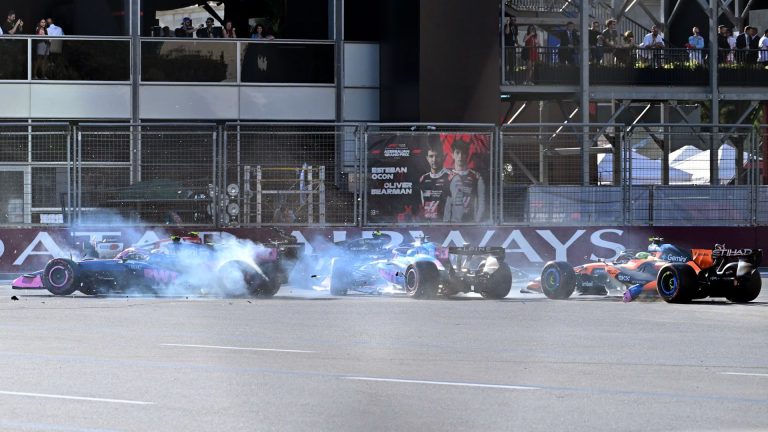
Colapinto has a five-place grid penalty for the Bahrain Grand Prix in Malaysia after causing the Baku collision involving Pierre Gasly and Lando Norris.
How many Azerbaijan GPs have been won from pole?
Three of the nine Formula 1 races previously held in Baku were won from pole position.