Summary
- FP1 starts at 12:30 in Malaysia on Friday, 2 October, followed by FP2 at 16:00.
- UK viewers can follow the sessions at 05:30 and 09:00 BST; India’s start times are 10:00 and 13:30 IST.
- On the US and Canadian West Coast, FP1 begins on Thursday evening, 1 October, at 21:30 PDT.
F1 practice at Sepang begins on Friday, 2 October, at 12:30 local time, with the opening session of the Bahrain Grand Prix in Malaysia. FP2 follows at 16:00, with both sessions scheduled to last one hour.
For viewers in the United Kingdom, that means an early start: FP1 begins at 05:30 BST and FP2 at 09:00 BST. In India, the sessions start at 10:00 IST and 13:30 IST, respectively.
Fans in the United States and Canada need to pay particular attention to the date. First practice starts just after midnight on Friday on the East Coast, while viewers on the West Coast can watch it on Thursday evening.
Friday F1 practice times at Sepang
| Country / city | Time zone | FP1 | FP2 |
|---|---|---|---|
| Malaysia — Sepang | MYT | Friday 2, 12:30 | Friday 2, 16:00 |
| United Kingdom — London | BST | Friday 2, 05:30 | Friday 2, 09:00 |
| United States — New York | EDT | Friday 2, 00:30 | Friday 2, 04:00 |
| United States — Los Angeles | PDT | Thursday 1, 21:30 | Friday 2, 01:00 |
| Canada — Toronto / Montreal | EDT | Friday 2, 00:30 | Friday 2, 04:00 |
| Canada — Vancouver | PDT | Thursday 1, 21:30 | Friday 2, 01:00 |
| India — New Delhi / Mumbai | IST | Friday 2, 10:00 | Friday 2, 13:30 |
| Australia — Sydney / Melbourne / Brisbane | AEST | Friday 2, 14:30 | Friday 2, 18:00 |
| Australia — Adelaide | ACST | Friday 2, 14:00 | Friday 2, 17:30 |
| Australia — Perth | AWST | Friday 2, 12:30 | Friday 2, 16:00 |
Dates correspond to the local time in each location. Session times remain subject to changes by the organisers.
FP1 is scheduled to run from 12:30 to 13:30 MYT, while FP2 takes place from 16:00 to 17:00 MYT. There are two hours and 30 minutes between the end of the first session and the beginning of the second.
The Friday timetable gives teams two opportunities to assess their cars before final practice and qualifying on Saturday. Readers can find the remaining session times in the complete Bahrain Grand Prix in Malaysia schedule.
Is there a Sprint at Sepang?
There is no Sprint at the 2026 Bahrain Grand Prix in Malaysia. The weekend follows the traditional format, with FP1 and FP2 on Friday, followed by FP3 and qualifying on Saturday.
Third practice begins on Saturday, 3 October, at 12:30 MYT, and qualifying starts at 16:00 MYT. Those sessions therefore repeat Friday’s start times in the UK, North America, India and Australia.
The race starts on Sunday, 4 October, at 15:00 in Malaysia. That corresponds to 08:00 BST, 03:00 EDT and 12:30 IST.
Australia’s clocks change before the race
Australian viewers should distinguish Friday’s practice times from Sunday’s race conversion. Sydney, Melbourne and Adelaide begin daylight saving time on Sunday, 4 October, while Brisbane and Perth keep their existing offsets.
Friday’s sessions therefore take place at 14:30 and 18:00 AEST in Sydney, Melbourne and Brisbane. On Sunday, the race starts at 18:00 AEDT in Sydney and Melbourne, but 17:00 AEST in Brisbane.
Why is the Bahrain Grand Prix being held at Sepang?
The event retains the Bahrain Grand Prix name while taking place at Sepang International Circuit in Malaysia. The background to the relocation is explained in why the 2026 Bahrain Grand Prix is taking place in Malaysia.
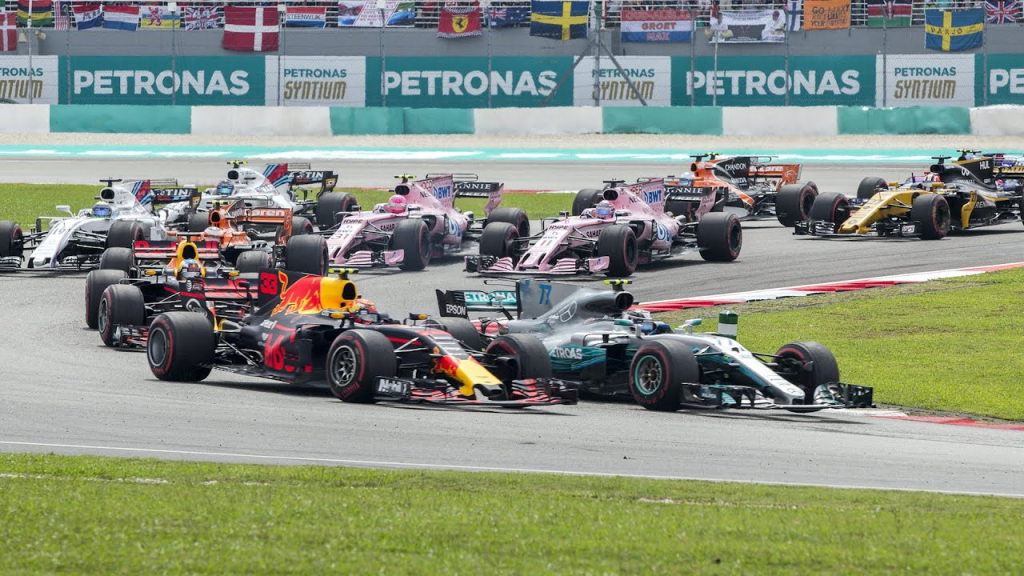
The weekend also marks Formula 1’s first race at Sepang since 2017. Friday’s practice sessions will provide the first competitive indication of how the current cars perform at a circuit returning after nine years, as explored in what has changed since F1 last raced at Sepang.
The Bahrain Grand Prix in Malaysia runs from 2–4 October, with the race scheduled for 56 laps on Sunday. GRANDE PRÊMIO will cover the practice sessions, qualifying and race throughout the weekend.
F1 today: FAQ
What time is F1 qualifying at Sepang?
Qualifying starts on Saturday, 3 October, at 16:00 Malaysia time. That is 09:00 BST in the UK, 04:00 EDT in New York and Toronto, 01:00 PDT in Los Angeles and Vancouver, 13:30 IST in India and 18:00 AEST in Sydney.
Did Lewis Hamilton receive a grid penalty for the Bortoleto incident?
No. Hamilton received a warning after impeding Gabriel Bortoleto during FP2 at Sepang. Ferrari was fined €10,000, but Hamilton will not lose grid positions over the incident.
Why were F1 lap times at Sepang over four seconds slower than expected?
Pirelli identified low grip, dust and an abrasive surface that increased tyre sliding and degradation. Friday’s benchmark was more than four seconds slower than its qualifying simulation reference, rather than four seconds slower than the 2017 race weekend.