News summary
- Formula 2 unveiled its new car for the 2027, 2028 and 2029 seasons at Monza on Saturday.
- The championship will retain the current Dallara chassis and 3.4-liter Mecachrome turbo engine, while introducing redesigned front and rear wings to improve the ability to follow cars closely.
- An integrated starter is another major change, allowing drivers to restart the car after a spin or stop on track, while the DRS system remains in place.
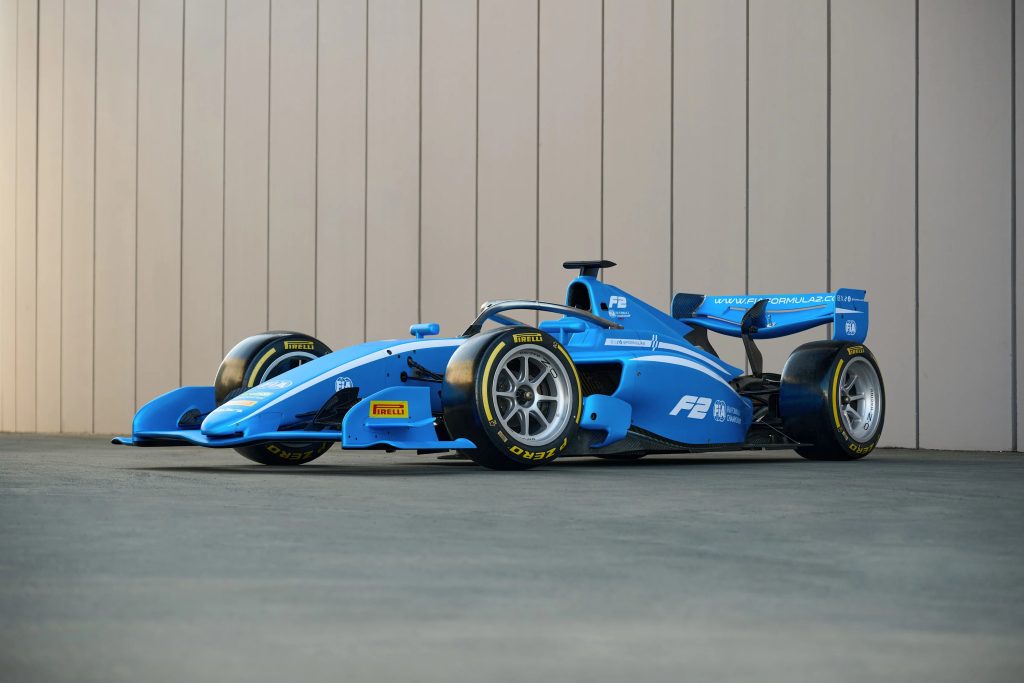
Formula 2 unveiled its new-generation car on Saturday (5), with the model set to compete in the championship from 2027 through 2029. The presentation took place in the Formula 1 paddock at Monza, where the FIA and F2 highlighted a development philosophy focused on improving racing without significantly increasing costs.
To keep expenses under control, F2 has retained the current Dallara chassis and Mecachrome power unit, concentrating the main aerodynamic changes on the front and rear wings. The objective is to allow drivers to follow the car ahead more closely and reduce the performance loss caused by turbulent air.
The most visible change is at the front. The new wing features additional aerodynamic elements and small winglets, giving it an appearance somewhat closer to modern Formula 1 designs.

The rear wing has also been redesigned as part of the effort to improve the quality of racing. Rather than creating an entirely new car, F2 opted for a targeted aerodynamic update intended to make it easier for drivers to remain within striking distance of their rivals.

Another new feature is the integrated starter. Hewland developed a new gearbox to accommodate the system, simplifying operations for teams and allowing drivers to restart their cars after a spin or after coming to a stop on track.
The 2027 F2 car will continue to use the Dallara chassis introduced for the current generation, together with the 3.4-liter turbocharged Mecachrome engine producing 620 hp. The power unit will continue to run on sustainable fuel.
F2 is also maintaining the specifications for braking performance, steering effort and cockpit ergonomics, as well as the existing electronic and hydraulic systems. The approach is designed to avoid a costly overhaul while preserving the championship’s role as the final major step in the FIA single-seater pyramid before Formula 1.
The DRS will also remain in Formula 2. The system allows the driver to open the rear-wing flap on designated straights when passing the detection point less than 1 second behind the car ahead.
That represents a notable difference from Formula 1, which abandoned traditional DRS in 2026 and introduced active front and rear aerodynamics instead. In F2, the conventional DRS system will therefore continue to be part of the overtaking package.
The new car is intended to preserve F2’s role as a training ground for drivers targeting Formula 1 while improving the racing product.
“When working on this new car, our first objective was to ensure that it remained the perfect tool to prepare drivers for F1. Together with the FIA, we chose to retain the current chassis and focused on redesigning the front and rear wings. This allows us to keep costs under control, while bringing the design closer to the look of an F1 car and enhancing the F2 car’s ability to produce close racing,” said Bruno Michel, CEO of Formula 2.
“Our fans expect F2 races to be extremely entertaining and safe, and this new kit will provide exactly that,” Michel added.
The new car completed its first track test in June at the Circuit de Barcelona-Catalunya. Since then, the development program has included extensive work with Dallara, including wind-tunnel and aerodynamic testing before the car enters competition in 2027.
The new generation will remain in competition for 3 seasons, meaning the same basic package will be used through the 2029 F2 season.
FAQ
1. What is changing on the F2 car for 2027?
The biggest changes are the redesigned front and rear wings and the introduction of an integrated starter. The chassis, engine and most of the existing systems will remain unchanged to control costs.
2. Will F2 still use DRS in 2027?
Yes. F2 will retain DRS for the 2027 season. The system will continue to allow drivers to open the rear-wing flap on designated straights when within the required distance of the car ahead.
3. How is the 2027 F2 car different from the 2026 F1 car?
The categories will use different aerodynamic concepts. F2 retains conventional DRS, while Formula 1 moved to active front and rear wings in 2026, with drivers switching between different aerodynamic modes.