News Summary
- Six verified grands prix offer a combined hypothetical gain of 45 points for Martín if he had inherited the best Aprilia finishing position.
- Indonesia and the Netherlands each account for nine potential points, with other Aprilia riders finishing first and second ahead of Martín.
- The figures represent mathematical scenarios, not points demonstrably lost through team decisions, and exclude sprint results and other rounds pending a complete audit.
Aprilia’s growing dominance of the 2026 MotoGP season has created an unusual problem for Jorge Martín: the manufacturer has repeatedly demonstrated the speed to win races, but its championship leader has not always been the rider collecting the maximum points.
Martín leads Marc Márquez by just two points after 17 rounds, with 355 against the Ducati rider’s 353. Yet Marco Bezzecchi, Raúl Fernández and Ai Ogura have all delivered results that raise questions about how Aprilia might manage its riders during the closing stages of the championship.
An investigation by GRANDE PRÊMIO identifies six grands prix in which another Aprilia rider finished ahead of Martín. Across those races, the difference between Martín’s actual points and those awarded to the highest-placed Aprilia rider totals 45 points.
That figure is not a calculation of points officially lost or a claim that team orders would necessarily have produced those results. It is a counterfactual measurement of what Martín could have gained if the manufacturer had been able to exchange his finishing position with its leading rider in each of the six races.
The distinction is especially important because Bezzecchi remains mathematically in contention for the championship, while Fernández and Ogura compete for the independent Trackhouse team.
How many points could Aprilia have transferred to Martín?
The six verified results show that Martín finished behind another Aprilia rider in Thailand, Brazil, Italy, the Netherlands, Great Britain and Indonesia.
| Grand Prix | Leading Aprilia rider | Martín’s finish | Martín’s points | Potential points as leading Aprilia | Hypothetical gain |
|---|---|---|---|---|---|
| Thailand | Bezzecchi — 1st | 4th | 13 | 25 | +12 |
| Brazil | Bezzecchi — 1st | 2nd | 20 | 25 | +5 |
| Italy | Bezzecchi — 1st | 2nd | 20 | 25 | +5 |
| Netherlands | Ogura — 1st | 3rd | 16 | 25 | +9 |
| Great Britain | Fernández — 1st | 2nd | 20 | 25 | +5 |
| Indonesia | Bezzecchi — 1st | 3rd | 16 | 25 | +9 |
| Total | 105 | 150 | +45 |
Methodology: verified Sunday grand prix results only. The calculation subtracts Martín’s actual race points from those awarded to the best-finishing Aprilia rider. It excludes sprints, unverified rounds and any changes to race results that might have followed hypothetical team orders.
The six races produced 105 points for Martín, compared with the 150 that would have been available through six victories.
The resulting 45-point difference is more than 22 times his current two-point championship advantage over Márquez, illustrating why Aprilia’s internal finishing order has become such a sensitive issue.
However, these calculations do not establish that Aprilia could realistically have transferred all 45 points. The manufacturer would have needed different instructions, potentially different race circumstances and cooperation from riders with their own championship ambitions.
Indonesia: Aprilia’s strongest weekend exposed its dilemma
The Indonesian Grand Prix provides the clearest recent example.
Aprilia achieved an unprecedented sweep of the first four positions, with Bezzecchi winning ahead of Fernández, Martín and Ogura. Márquez finished sixth, collecting ten points.
Martín earned 16 points for third place, six more than his championship rival. However, had he finished first instead, he would have collected 25 points — nine more than his actual result.
| Rider | Actual Indonesian GP result | Points |
|---|---|---|
| Marco Bezzecchi | 1st | 25 |
| Raúl Fernández | 2nd | 20 |
| Jorge Martín | 3rd | 16 |
| Ai Ogura | 4th | 13 |
| Marc Márquez | 6th | 10 |
If Martín and Bezzecchi had exchanged their finishing positions, Martín would have gained nine points, while Bezzecchi would have lost nine. Fernández would have remained second.
Under that simplified scenario, Márquez’s sixth place would have remained unchanged, meaning Martín would have extended his championship advantage by another nine points.
The reality was more complicated. Bezzecchi was fighting for his own championship position, while Fernández was competing for victory despite racing with fractured fingers sustained during Saturday’s sprint.
The result nevertheless intensified the debate about whether Aprilia should begin prioritising Martín as the championship approaches its conclusion.
The manufacturer has already acknowledged discussions about possible team orders, while the role of Trackhouse in Aprilia’s title strategy has become increasingly significant.
The Netherlands: another nine-point opportunity
The Dutch Grand Prix at Assen produced a remarkably similar mathematical scenario.
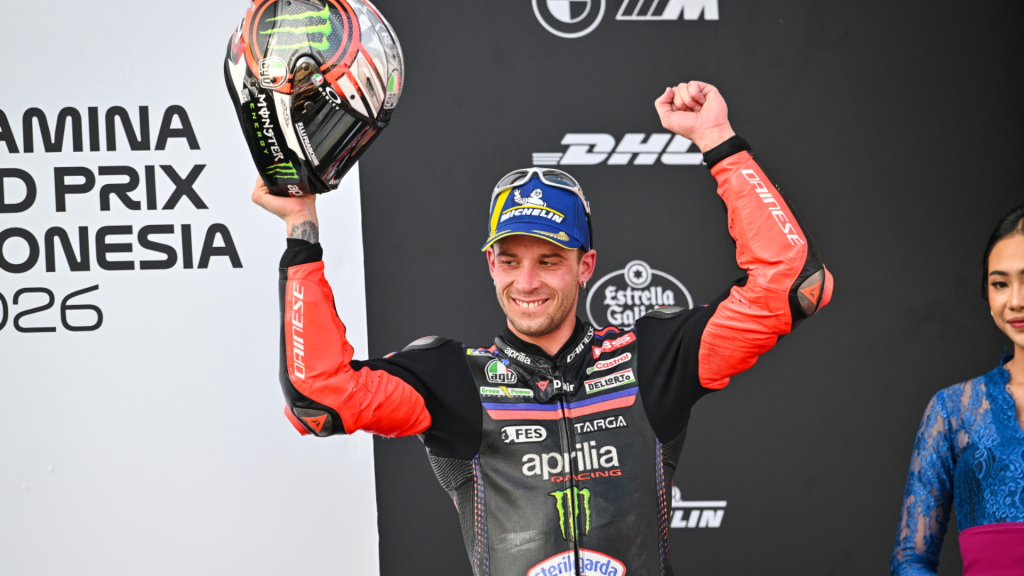
Ogura won the race for Trackhouse, Fernández finished second and Martín completed the podium in third. It was another example of Aprilia’s competitive depth, with its independent riders finishing ahead of the factory team’s championship contender.
Martín scored 16 points, while Ogura collected 25. The difference was again nine points.
If Martín had inherited Ogura’s victory, he would have collected 25 points instead of 16. That hypothetical result would have increased his championship total without requiring a change to Márquez’s finishing position, provided the Ducati rider’s result remained unaffected.
However, the scenario would also have required Trackhouse to surrender a race victory. Unlike a simple instruction between factory team-mates, such an arrangement would involve a separate team with its own sporting and commercial interests.
The distinction is central to the team orders debate. Aprilia supplies motorcycles to four competitive riders, but it does not follow that all four share the same individual championship priorities.
Thailand, Brazil and Italy: Bezzecchi’s victories created another 22-point difference
The largest single hypothetical gain in the verified sample occurred at the opening round in Thailand.
Bezzecchi won the grand prix, collecting 25 points, while Martín finished fourth and scored 13. The difference between their results was 12 points, the largest of the six races analysed.
Brazil and Italy produced smaller but still significant differences. Bezzecchi won both races, with Martín finishing second on each occasion. Those results created a five-point gap at each event.
Across Thailand, Brazil and Italy, Bezzecchi’s victories placed 22 more points in the hands of Aprilia’s leading finisher than Martín actually collected.
These races also demonstrate why applying team orders retrospectively is problematic. During the early part of the season, Bezzecchi was leading the championship and had every reason to pursue victories.
At that stage, prioritising Martín would not necessarily have reflected the strongest championship position within Aprilia.
The manufacturer’s current dilemma has emerged because the standings have changed, with Martín now leading Márquez while Bezzecchi sits 46 points behind his team-mate.
Silverstone shows why Trackhouse matters
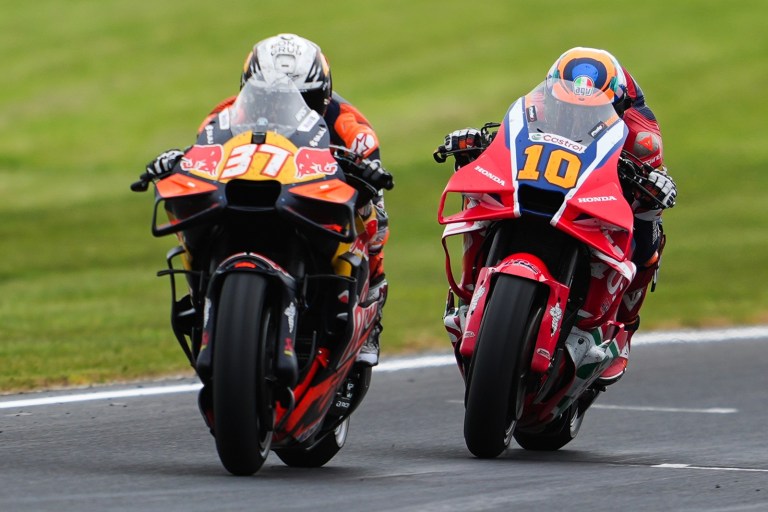
The British Grand Prix offers another example of the complications created by Aprilia’s satellite operation.
Fernández won at Silverstone, while Martín finished second and Bezzecchi third. The difference between victory and second place was five points, representing another potential gain for Martín under a hypothetical position swap.
Unlike the Indonesian and Dutch races, Martín needed to exchange positions with only one Aprilia rider to inherit the victory.
Even so, the sporting implications would have been substantial. Fernández’s victory was an important achievement for Trackhouse, and there is no evidence that the independent team was prepared to surrender it to support Martín’s championship campaign.
This is why manufacturer-wide coordination cannot be treated as equivalent to an automatic obligation to exchange positions.
The debate involves the factory team’s championship objectives, Trackhouse’s independence and the ambitions of four riders competing on Aprilia machinery.
What would Martín’s championship lead look like with 45 extra points?
The simplest mathematical scenario adds the 45-point hypothetical gain to Martín’s actual championship total while leaving Márquez’s results unchanged.
| Championship scenario | Martín | Márquez | Martín’s advantage |
|---|---|---|---|
| Actual standings after Indonesia | 355 | 353 | +2 |
| Six verified Sunday swaps | 400 | 353 | +47 |
Under that model, Martín would hold a 47-point advantage instead of two.
However, the scenario assumes that the same races could have unfolded with identical results for all non-Aprilia riders. It also assumes that the relevant Aprilia riders would have accepted the exchanges and that no further incidents or strategic consequences would have occurred.
Those assumptions are not established facts.
The 47-point figure should therefore be interpreted as a mathematical illustration of the potential effect of team orders, not as an alternative championship classification that Aprilia could necessarily have achieved.
There is also an important timing issue: the six races took place at different stages of the championship, when Aprilia’s priorities were not necessarily the same.

Why sprint results require a separate calculation
MotoGP’s sprint format adds another dimension to the analysis.
Saturday races award up to 12 points, compared with 25 for a grand prix. That creates additional opportunities for riders on the same manufacturer to influence the championship standings.
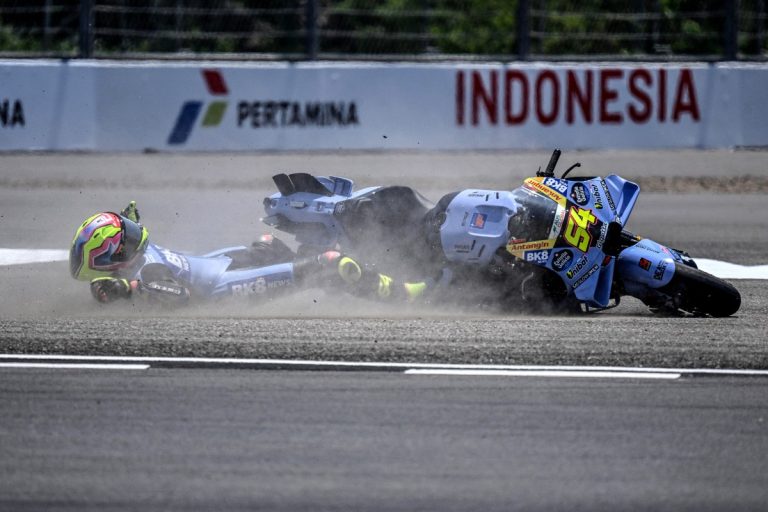
The Indonesian sprint demonstrated the importance of those points when Márquez won after Bezzecchi and Fernández collided at the opening corner.
Martín finished fourth and collected six points, allowing Márquez to gain six points on him and temporarily move into the championship lead.
However, that incident cannot be classified as a simple example of Aprilia failing to transfer points through team orders. The two riders who collided were removed from contention, and no position exchange could have restored the points they lost.
A complete season-long estimate would need to examine all 17 sprints individually, identifying where an Aprilia rider finished ahead of Martín and whether a position exchange was mathematically possible.
The 45-point figure in this investigation therefore applies only to six verified Sunday races. It is not presented as an exhaustive total for all 17 weekends.
Could team orders have prevented Márquez’s comeback?
Márquez has produced an extraordinary recovery during the second half of the season, overcoming a deficit of 102 points to Bezzecchi after the Italian Grand Prix and briefly taking the championship lead during the Indonesian sprint.
His recovery has been driven by race victories, strong sprint results and improved Ducati performance, while Aprilia has continued placing several riders near the front.
The manufacturer has consequently faced a difficult strategic choice: allowing its riders to compete freely maximises their individual opportunities, but does not always maximise the points collected by the rider best positioned to defeat Márquez.
That tension has become more significant as the championship gap has narrowed.
The mathematical scenarios for Márquez to reclaim the MotoGP lead at Phillip Island show how even small differences in finishing positions can affect the standings.
Aprilia’s technical director Fabiano Sterlacchini has acknowledged that the manufacturer may reconsider its approach during the remaining rounds, although no formal instructions requiring riders to surrender positions have been confirmed.
What the numbers reveal about Aprilia’s title strategy
The six verified grands prix demonstrate that Aprilia’s competitive strength has not always translated into the maximum possible points for Martín.
The largest hypothetical opportunities came in Thailand, where the difference was 12 points, and the Netherlands and Indonesia, where the difference was nine points each.
Together, those three races account for 30 of the 45 potential points identified in the analysis.
However, the calculations also expose the limitations of treating team orders as a simple mathematical solution. Bezzecchi has been a championship contender throughout the season, while Trackhouse has legitimate reasons to pursue its own victories.
The difference between actual points and hypothetical transfers is therefore not a measure of managerial failure. It measures the size of a strategic opportunity that would have required decisions affecting several riders and teams.
How much could Aprilia’s decisions matter in the final five rounds?
The 45-point hypothetical gain identified across six grands prix illustrates how influential Aprilia’s internal finishing order could become, particularly with Martín and Márquez separated by only two points.
But the most important lesson is not that Aprilia should necessarily have imposed team orders earlier. It is that the sporting value of a position exchange changes as the championship develops.
With Bezzecchi still mathematically in contention and Trackhouse competing for its own results, Aprilia must determine when, if ever, the interests of one title contender should take priority over the ambitions of the others.
The next round takes place at Phillip Island from October 23 to 25. The Australian MotoGP schedule and international start times are available on GRANDE PRÊMIO.