News Summary
- The FIA’s reluctance to decide the fate of Qatar and Abu Dhabi could create logistical and sporting uncertainty for the Formula 2 championship.
- Four F2 rounds remain, with 152 points still available if Madrid, Baku, Qatar and Abu Dhabi all go ahead; losing the final two rounds would cut that figure to 76.
- Nikola Tsolov leads Rafael Câmara by 11 points, but the number of races remaining could significantly influence how the title contenders approach the final weeks of the season.
The FIA’s decision to wait before determining the fate of the Qatar and Abu Dhabi Grands Prix could have consequences far beyond Formula 1. Formula 2, which is scheduled to support both events, is potentially the category most affected by the uncertainty as its championship enters the final stages of the 2026 season.
FIA president Mohammed Ben Sulayem said the governing body is in no rush to decide whether the two Middle Eastern rounds can take place, stressing that safety and discussions with local governments and promoters remain the priorities.
The situation is particularly important for F2 because the category already had to react earlier this year after the Bahrain and Saudi Arabian rounds were cancelled amid the security situation in the Middle East. Miami and Montreal were added to the calendar as replacements, allowing the championship to maintain its planned number of rounds.
The final two rounds in Qatar and Abu Dhabi, however, remain on the schedule for November 27-29 and December 4-6 respectively. The current F2 calendar has 14 rounds, with Madrid next on September 11-13 and Baku following on September 24-26.
The FIA says there is no rush to decide the fate of Qatar and Abu Dhabi, while Formula 1 has previously identified European alternatives if the Middle Eastern races become impossible. Imola has been mentioned among the possible options, with Stefano Domenicali previously indicating that a decision would not come before mid-September.
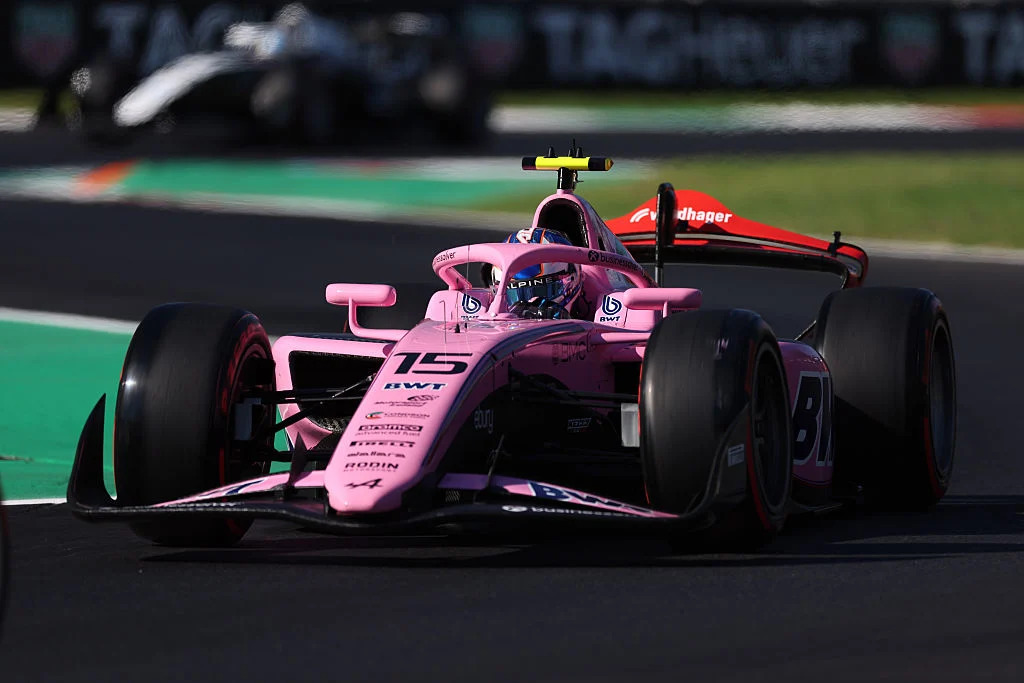
F2 faces a different problem from F1
For Formula 1, replacing or relocating the final two Grands Prix is already a complex logistical challenge. For F2, the problem is even more delicate because the category is approaching the end of its championship and has far less room to absorb changes.
After Monza, four F2 rounds remain: Madrid, Baku, Qatar and Abu Dhabi. The first two are already scheduled, while the final two depend on the eventual decision over the Middle East.
That means teams and drivers need to know not only where they will race, but also how many opportunities remain to score points.
If all four rounds take place, a maximum of 156 points is still available to each driver. Under the current F2 scoring system, a driver can score up to 39 points over a weekend: 25 for winning the Feature Race, 10 for winning the Sprint Race, two for pole position and one fastest-lap point in each race.
That leaves the championship mathematically open to the first 11 drivers in the standings after Monza: Nikola Tsolov has 177 points, followed by Rafael Câmara on 166, Gabriele Minì on 147, Alex Dunne on 118, Noel León on 114, Kush Maini on 88, Dino Beganovic on 79, Joshua Dürksen on 78, Laurens van Hoepen on 66, Tasanapol Inthraphuvasak on 63 and Martinius Stenshorne on 62. The official F2 standings confirm Tsolov’s 177-point lead over Câmara’s 166.
But if Qatar and Abu Dhabi were both removed without replacement, only 78 points would remain. In that scenario, the title fight would effectively be reduced to the top five.
Maini, currently sixth on 88 points, could score a maximum of 78 points from Madrid and Baku and therefore reach only 166. Even a perfect two-weekend finish would leave him 11 points behind Tsolov’s current total of 177.
The difference is enormous — and it could influence how the championship contenders race.
The uncertainty can change how drivers approach the title fight
With four rounds guaranteed, the logical approach for the drivers is to think about consistency as much as outright victories. There is enough time remaining for a championship to change hands, meaning a driver does not necessarily need to take maximum risks at every opportunity.
The situation would be completely different if the season were suddenly reduced to 12 rounds.
In that case, Minì, Dunne and León in particular would have a much smaller window to close the gap to Tsolov. That could encourage more aggressive strategies and greater risk-taking, because simply collecting solid points every weekend might not be enough to overturn the deficit.
Tsolov and Câmara would be in a more comfortable position. The Bulgarian leads the championship by 11 points, while Câmara has made significant progress during the second half of the season.
A four-round finale therefore gives Câmara more time to attack the championship lead. A shortened season would favor Tsolov because his advantage would become proportionally more difficult to overcome.
Câmara’s lost points show how quickly the picture can change
The Brazilian’s campaign also illustrates why the number of remaining rounds matters so much.
Câmara lost valuable points earlier in the season after errors in the Feature Races in Canada and Monaco. Those incidents cost him opportunities to score major points and have kept the championship closer than it might otherwise have been.
Those lost points were costly at the time, but Câmara has recovered strongly since then. He is now only 11 points behind Tsolov and has turned what once looked like a difficult championship situation into a genuine title fight.
That history also highlights the importance of knowing how many races remain. If there are four rounds left, one mistake can be recovered from. If there are only two, the same error could effectively end a driver’s championship hopes.
The same applies to Minì, Dunne and León. Each still has a mathematical route to the title under the current 14-round calendar, but the margin for error would shrink dramatically if the final two rounds disappeared.
FIA decision affects more than Formula 1
From a financial perspective, keeping Qatar and Abu Dhabi on the F1 calendar is clearly important for Formula 1 and the FIA. But the consequences of the decision extend to the support categories as well.
F2 is not simply waiting to discover whether its final races will be held in the Middle East or elsewhere. Teams need time to organize freight, personnel, travel and budgets, while drivers need certainty about how many opportunities they have left to fight for the championship.
The FIA has already demonstrated earlier this year that it can react to major calendar disruptions. The replacement of the cancelled Middle Eastern rounds with Miami and Montreal showed that alternatives can be found, but those decisions also require planning and coordination.
Now, however, the championship is approaching its conclusion. Any replacement for Qatar or Abu Dhabi would therefore need to be arranged while the title battle is already underway and with considerably less room for logistical flexibility.
The question is no longer simply whether the final F1 races will take place in the Middle East. It is also whether the F2 championship will have enough time and certainty to prepare for whatever comes next.
For Tsolov, Câmara and the other title contenders, knowing whether they have two, three or four weekends left could change the way they approach every race from Madrid onward.
Formula 2 returns to action from September 11-13 with the Madrid round at the new Madring circuit. GRANDE PRÊMIO will provide full coverage of the weekend and the remainder of the 2026 F2 season.