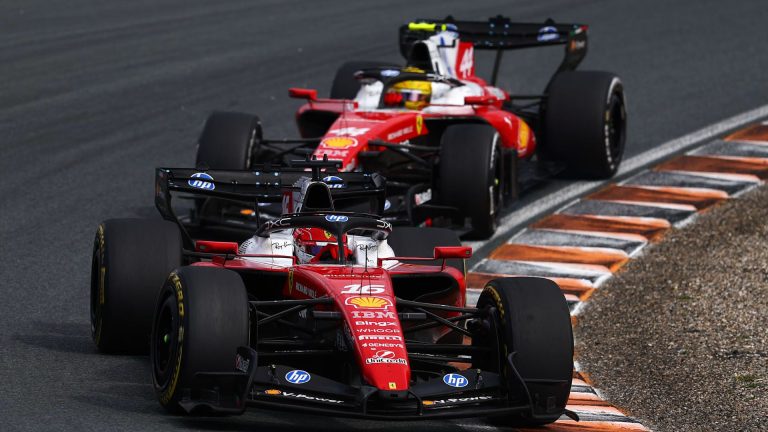
As one of the teams pushing hardest on development during the 2026 Formula 1 season, Ferrari drew inspiration from McLaren for one of its key upgrades brought to this weekend’s Hungarian Grand Prix. The Italian squad incorporated an aerodynamic appendage into its Macarena rear wing, similar to the solution seen on the papaya cars in Monaco.
The Budapest circuit layout is one of the most technical on the calendar, featuring a sequence of medium- and low-speed corners that demand high levels of downforce, much like Monte Carlo. The key difference, however, is that the FIA disabled Straight-Line Mode for that event, prompting top teams to install dedicated aerodynamic devices attached to the center of the rear wing to maximize downforce.
In Monaco, while McLaren, Red Bull, and Mercedes introduced new iterations, Ferrari was the sole front-runner to forego rear wing modifications. The same cannot be said for Hungary, a track whose characteristics align closely with the strengths of the red car. For this reason, the team saved its updated version of the Macarena wing for this weekend.
Ferrari opted to fit a triple deflector to the center of the wing, anchored to the primary flap, mirroring McLaren’s Monaco setup. The team expects this modification to generate additional downforce in conjunction with the active aerodynamics package, which will remain active in Budapest.

Further teams are expected to introduce rear wing revisions given the paramount importance of optimizing aerodynamic load around the Hungarian venue. Red Bull, for instance, is anticipated to bring back its version of the Macarena wing after shelving it at Spa-Francorchamps. Technical Director Pierre Waché confirmed in an interview that the wing defect responsible for Max Verstappen’s crashes in Austria and Great Britain has been resolved.
Formula 1 returns July 24–26 in Budapest, host of the Hungarian GP, Round 11 of the 2026 season.
F1 Hungarian GP: when to watch in US ET, London (UK), New Delhi (India), Shanghai (China) and Sydney (Australia)
US Eastern Time (ET)
- Free Practice 1: 07:30 AM
- Free Practice 2: 11:00 PM
- Free Practice 3: 06:30 AM
- Qualifying: 10:00 AM
- Race: 09:00 AM
London Time (BST)
- Free Practice 1: 12:30 PM
- Free Practice 2: 04:00 PM
- Free Practice 3: 11:30 AM
- Qualifying: 03:00 PM
- Race: 02:00 PM
New Delhi Time (IST)
- Free Practice 1: 05:00 PM
- Free Practice 2: 08:30 PM
- Free Practice 3: 04:00 PM
- Qualifying: 07:30 PM
- Race: 06:30 PM
Shanghai Time (CST)
- Free Practice 1: 07:30 PM
- Free Practice 2: 11:00 PM
- Free Practice 3: 06:30 PM
- Qualifying: 10:00 PM
- Race: 09:00 PM
Sydney Time (AEST)
- Free Practice 1: 09:30 PM
- Free Practice 2: 01:00 AM (overnight)
- Free Practice 3: 08:30 PM
- Qualifying: 12:00 AM (midnight)
- Race: 11:00 PM