News Summary
- Bezzecchi has won five grands prix in 2026, but sits third in the championship with 309 points, 46 behind Jorge Martín.
- Four consecutive weekends after Mugello produced just 13 points from a possible 148, with no points scored in the main races.
- The Italian subsequently collected 123 points across six rounds, recovering much of his competitiveness but failing to regain the championship lead.
Marco Bezzecchi’s 2026 MotoGP campaign presents one of the championship’s most striking statistical contradictions. The Aprilia rider has won five grands prix and demonstrated race-winning speed across different circuits, yet arrives at the Australian Grand Prix 46 points behind championship leader Jorge Martín and 44 behind Marc Márquez.
The difference is not explained by a simple lack of competitiveness. Bezzecchi led the championship after the Italian Grand Prix at Mugello, when he had accumulated 173 points and established himself as one of the leading candidates for the title. However, the four rounds that followed produced a dramatic reversal, with the Italian collecting only 13 of the 148 points available across sprint races and grands prix.
An examination by GRANDE PRÊMIO of Bezzecchi’s championship progression reveals that four consecutive weekends accounted for much of the damage to his title challenge. His subsequent recovery demonstrated that Aprilia retained the performance required to win, but also exposed how difficult it is to recover from an extended period of minimal scoring in a championship that awards points twice per weekend.
Bezzecchi’s 2026 MotoGP season in numbers
| Statistic | Marco Bezzecchi |
|---|---|
| Championship position | 3rd |
| Championship points | 309 |
| Grand prix victories | 5 |
| Rounds completed | 17 |
| Average points per weekend | 18.18 |
| Gap to Jorge Martín | −46 |
| Gap to Marc Márquez | −44 |
| Points after Italian GP | 173 |
| Points across next four rounds | 13 |
| Points across following six rounds | 123 |
Statistics cover the 17 completed rounds through the Indonesian Grand Prix on October 11, 2026. Weekend totals combine sprint and grand prix points.
Bezzecchi has collected an average of 18.18 points per weekend, compared with Martín’s 20.88 and Márquez’s 20.76. Although the difference appears relatively small when averaged across the entire championship, its distribution reveals a much more uneven campaign.
The Italian’s five grand prix victories represent 29.4% of the races contested. However, his championship position demonstrates that winning frequently is not enough when strong weekends are interrupted by a prolonged sequence of poor results.
The four MotoGP weekends that changed Bezzecchi’s season
The decisive period came immediately after Mugello. Bezzecchi left the Italian Grand Prix leading the championship with 173 points, but the subsequent races in Hungary, Czechia, the Netherlands and Germany produced only 13 additional points.
Across those four rounds, a maximum of 148 points was available: 100 from the grands prix and 48 from the sprints. Bezzecchi collected just 8.8% of that total, an exceptionally low return for a rider who had entered the sequence leading the standings.
| Championship period | Points scored | Maximum available | Scoring efficiency |
|---|---|---|---|
| Four rounds after Mugello | 13 | 148 | 8.8% |
| Following six rounds | 123 | 222 | 55.4% |
| Full season through Indonesia | 309 | 629 | 49.1% |
Scoring efficiency is calculated against the maximum 37 points available per race weekend, not against the points theoretically achievable after considering each rider’s actual starting position or race circumstances.
The most damaging detail is that Bezzecchi failed to score in all four Sunday races during that sequence. His entire 13-point return came from Saturday’s sprints, leaving him unable to defend his championship position against rivals who were regularly finishing on the podium.
MotoGP’s official championship analysis described the period as a combination of mistakes and misfortune. Whatever the individual circumstances, the effect on the standings was substantial: Bezzecchi fell from first place to outside the top three as Martín and other contenders continued accumulating points.
Why zero-point grands prix hurt more than poor sprint results
MotoGP’s current points system creates a substantial difference between a disappointing sprint and a grand prix without points. A sprint victory awards 12 points, while a grand prix victory is worth 25, meaning Sunday’s race accounts for more than two-thirds of the maximum championship points available during a weekend.
Bezzecchi’s four consecutive Sunday failures therefore carried an enormous cost. Even a series of modest top-ten finishes would have produced a substantially larger return than the zero points he actually collected.
For example, four tenth-place finishes would have yielded 24 grand prix points, almost twice the 13 points Bezzecchi earned across the entire four-weekend period. Four fifth-place finishes would have produced 44 points, illustrating the importance of consistently reaching the finish in competitive positions.
These are illustrative scoring scenarios, not points that Aprilia can legitimately claim were lost. They demonstrate the mathematical effect of poor results without assuming Bezzecchi would necessarily have achieved those positions in different circumstances.
The comparison becomes especially relevant when examining Martín’s campaign. The championship leader has relied on regular points finishes rather than a large number of victories, allowing him to protect his position while other riders experience more extreme fluctuations.
Bezzecchi’s recovery produced 123 points in six rounds
Bezzecchi’s response after the difficult four-race sequence was substantial. Across the following six rounds, culminating in his Indonesian Grand Prix victory, the Italian scored 123 points from a possible 222, averaging 20.5 per weekend.
That represents an improvement of more than six times his scoring rate during the preceding four rounds. His average increased from 3.25 points per weekend to 20.5, reflecting a return to regular front-running performances.
The recovery also demonstrated that Aprilia’s competitiveness had not disappeared during the earlier difficulties. Bezzecchi was once again capable of challenging for victories, particularly as the RS-GP26 became increasingly competitive against Ducati.
However, his recovery was not enough to reverse the championship damage. Martín and Márquez continued scoring heavily, with the Ducati rider producing his own extraordinary comeback after falling 102 points behind Bezzecchi at Mugello.
The analysis of Márquez’s 102-point recovery during the 2026 MotoGP season provides an important comparison: while Bezzecchi struggled, Márquez transformed a substantial deficit into a direct championship challenge.
Indonesia showed Bezzecchi’s speed — and his inconsistency
The Indonesian Grand Prix provided an unusually clear illustration of both sides of Bezzecchi’s season.
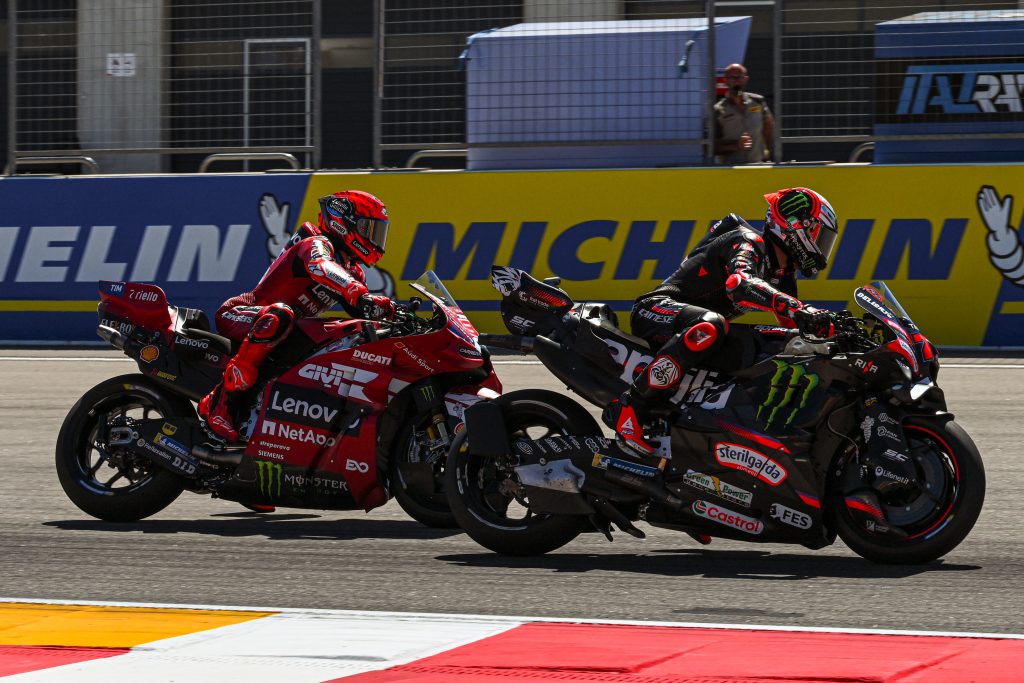
The Italian was among the strongest riders throughout the Mandalika weekend, but Saturday’s sprint ended almost immediately. Starting from the front row, Bezzecchi collided with Trackhouse rider Raúl Fernández at the opening corner, eliminating both Aprilias from contention.
The incident was particularly damaging because Márquez capitalised on the opportunity to win the sprint and temporarily move ahead of Martín in the championship. Bezzecchi, meanwhile, collected no points despite possessing one of the most competitive motorcycles on the grid.
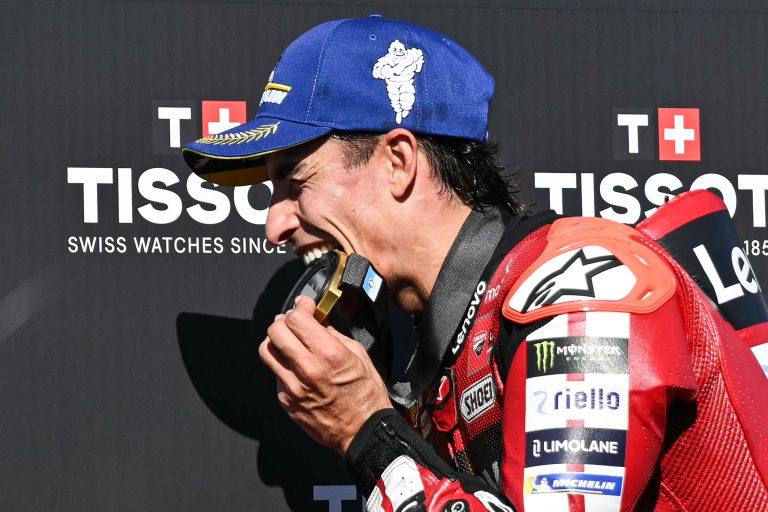
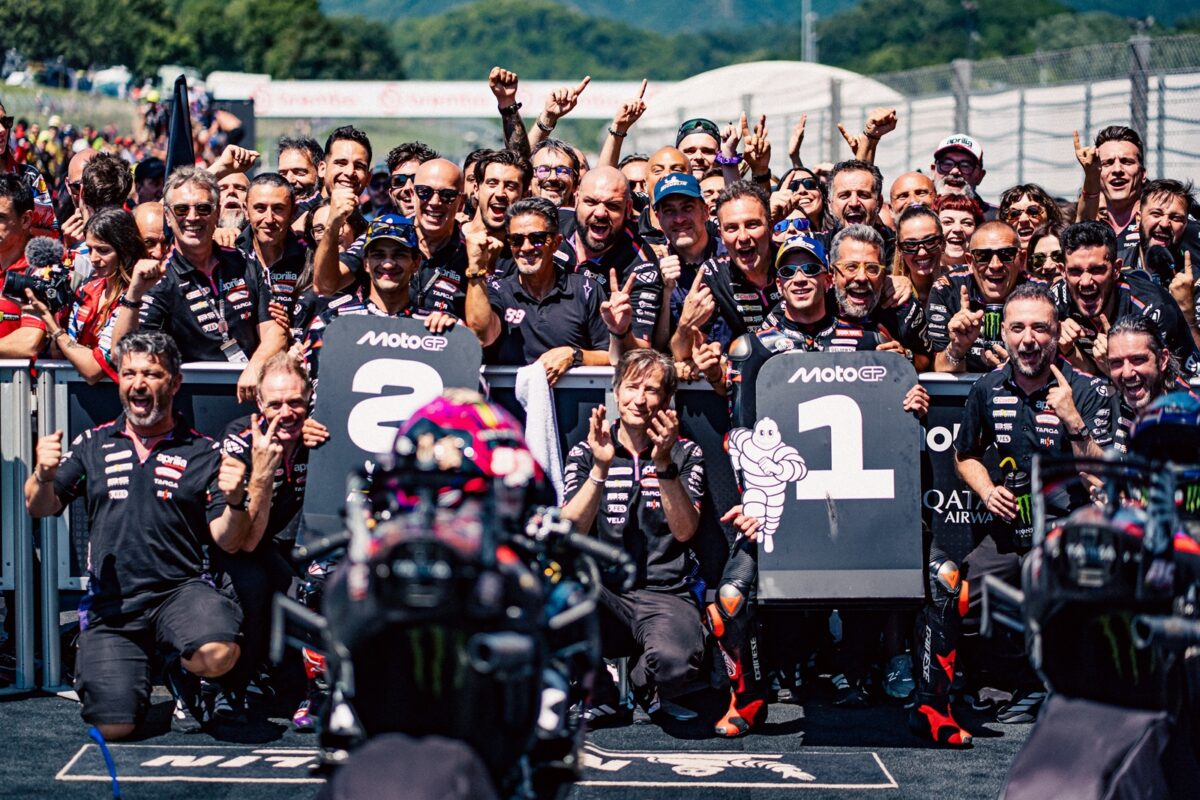
Sunday produced a completely different result. Bezzecchi recovered from a difficult opening phase to chase down Fernández, taking the lead with nine laps remaining and securing his fifth grand prix victory of the season.
He finished 4.260 seconds ahead of Fernández, while Martín completed the podium and Ai Ogura finished fourth, delivering Aprilia’s historic sweep of the first four positions.
Bezzecchi scored 25 points across the Indonesian weekend, but all of them came from Sunday’s race. His victory demonstrated the performance available from the RS-GP26, while the sprint retirement highlighted the continuing risk of losing points even on weekends when the motorcycle is capable of winning.
How Bezzecchi compares with Martín and Márquez
The championship’s leading three riders have accumulated their points in markedly different ways.
| Rider | Championship points | GP victories | Average points per weekend |
|---|---|---|---|
| Jorge Martín | 355 | 1 | 20.88 |
| Marc Márquez | 353 | 6 | 20.76 |
| Marco Bezzecchi | 309 | 5 | 18.18 |
The comparison reveals that Bezzecchi has won almost as many grands prix as Márquez and considerably more than Martín, yet remains substantially behind both riders in the standings.
Bezzecchi and Márquez have combined for 11 grand prix victories, while Martín leads the championship with just one. The contrast illustrates how MotoGP’s combined sprint and grand prix points system rewards consistency alongside outright race-winning ability.
Martín has maintained a more regular scoring pattern, while Márquez has compensated for early-season difficulties with a remarkable concentration of victories. Bezzecchi has experienced both extremes: periods of exceptional performance and a four-round sequence that yielded almost no points.
The analysis of Bezzecchi’s remaining championship chances examines the mathematical implications of his current deficit.
Is Bezzecchi MotoGP’s fastest rider in 2026?
Bezzecchi’s five victories establish him as one of the championship’s most successful riders, but they do not prove that he is the fastest.
Márquez leads the grand prix victory count with six, while Martín has demonstrated greater consistency in scoring. Establishing which rider possesses the strongest outright pace would require a more detailed comparison of qualifying laps, representative race stints, tyre degradation and performance across different circuit characteristics.
A rider may win because of superior race pace, but also through strategy, tyre management, mistakes by rivals or favourable race circumstances. Similarly, a rider who fails to finish may have demonstrated competitive speed before the incident.
For that reason, victory totals should not be treated as a direct measurement of average motorcycle or rider performance. Bezzecchi’s results demonstrate race-winning capability, while his championship position reveals the consequences of inconsistent scoring.
The same distinction applies to qualifying. Pole positions and front-row starts indicate one-lap competitiveness, but do not automatically establish which rider is fastest over a full grand prix distance.
How much did Bezzecchi’s four bad weekends cost?
The simplest way to measure the impact is to compare his actual scoring rate during the four difficult rounds with his average across the following six.
Bezzecchi scored 13 points during the poor sequence. Had he matched his subsequent average of 20.5 points per weekend, he would have collected 82 points over the same period — 69 more than he actually scored.
| Scenario across four rounds | Points |
|---|---|
| Actual points scored | 13 |
| At his subsequent six-round average | 82 |
| Hypothetical difference | +69 |
This is a retrospective scoring comparison, not a reconstruction of the race results. It assumes that Bezzecchi could have maintained his later scoring average during four different events.
The hypothetical 69-point difference is greater than his current 46-point deficit to Martín. That does not mean Bezzecchi would necessarily be leading the championship without those difficult weekends, because alternative results could also have changed the points collected by his rivals.
Nevertheless, the comparison demonstrates how concentrated the damage was. Bezzecchi did not lose his championship position because he was incapable of winning; he lost ground because he endured four consecutive rounds with almost no points.
Aprilia’s team orders dilemma complicates the final rounds
Bezzecchi’s championship position has also created a strategic problem for Aprilia.
Martín leads the standings by two points over Márquez, while Bezzecchi remains 46 points behind his team-mate. With five rounds remaining, the Italian retains a mathematical chance of winning the title, but the manufacturer is considering whether team orders may become necessary to strengthen Martín’s position.
Technical director Fabiano Sterlacchini has acknowledged discussions about possible guidelines, although no formal instructions requiring riders to surrender positions have been announced.
The situation is particularly sensitive because Bezzecchi has been one of Aprilia’s strongest race performers, winning five grands prix and helping establish the RS-GP26 as a leading motorcycle.
The role of Trackhouse in Aprilia’s team orders debate adds another complication, with Fernández and Ogura also capable of finishing ahead of the factory riders.
Any decision to prioritise Martín would therefore involve balancing the manufacturer’s championship ambitions against Bezzecchi’s continuing mathematical chances and the sporting objectives of its other riders.
What Bezzecchi’s 2026 numbers reveal
The central finding is that Bezzecchi’s championship deficit has been shaped more by the concentration of his poor results than by a lack of winning performance.
His five grand prix victories demonstrate that he can compete with the strongest riders, while his recovery of 123 points across six rounds confirms that his difficult mid-season sequence was not representative of his entire campaign.
However, the four weekends after Mugello produced just 13 points from 148 available, creating a deficit that even a return to regular victories has not erased.
The difference between Bezzecchi and his championship rivals is therefore not simply the number of races won, but the ability to avoid extended periods of minimal scoring.
Can Bezzecchi still turn speed into a championship?
Bezzecchi remains mathematically in contention with 185 points available across the final five rounds. However, he must recover 46 points against Martín and 44 against Márquez while maintaining the strong scoring rate he has demonstrated during the second half of the season.
The Italian’s five victories show that Aprilia has the performance to compete for the championship, but his four-round collapse illustrates why consistent points finishes are as important as outright victories.
The Australian Grand Prix at Phillip Island, scheduled for October 23–25, provides his next opportunity to reduce the deficit. The full Australian MotoGP schedule and international start times are available on GRANDE PRÊMIO.