News Summary
- Two Ford Hypercars covered more than 7,300km during testing in Spain.
- An overnight cooling issue forced an engine replacement, but the endurance car completed more than 24 hours of running.
- Ford introduced an improved 5.4-litre naturally aspirated V8 and is preparing to present the car officially on November 26.
Ford Racing has completed its first extended endurance simulation with the prototype it will enter in the 2027 World Endurance Championship, overcoming technical problems during a demanding test at MotorLand Aragón.
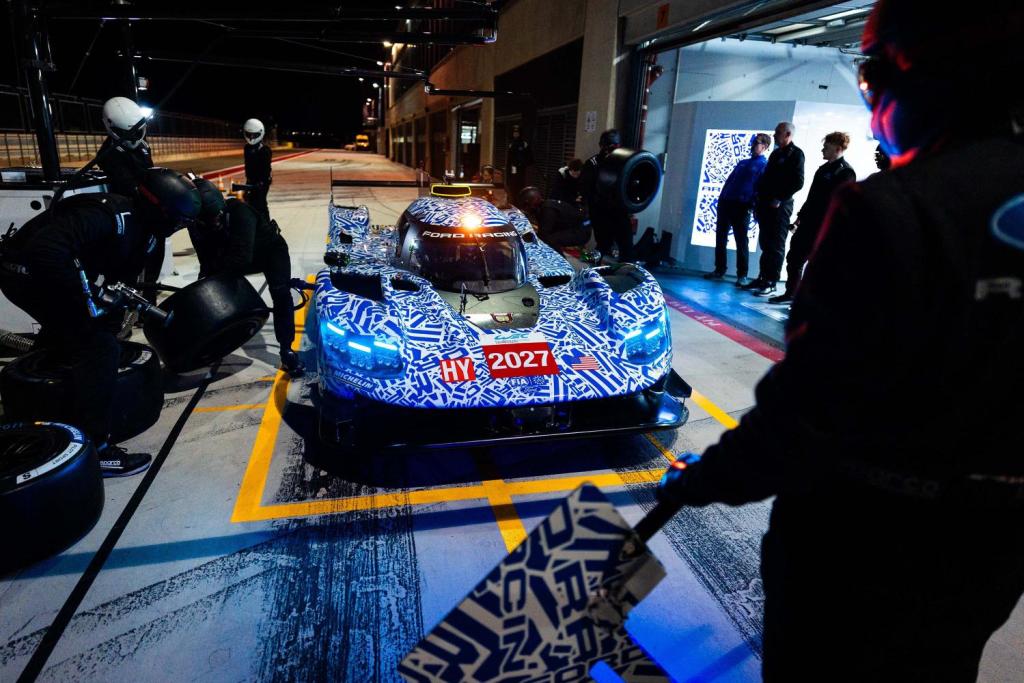
The manufacturer used two cars during the programme. One focused on endurance running, while the second concentrated on vehicle controls and performance development.
The prototypes covered a combined distance exceeding 7,300km, with the endurance car running for more than 24 hours of the planned 30-hour programme.
“Despite the engine change, we did actually run for over 24 hours of the 30 scheduled. Overall, it was what I would call a very successful first endurance test. There were no failures that we’re concerned about,” programme manager Dan Sayers told the official 24 Hours of Le Mans website.
Ford replaces engine after overnight cooling problem
The test represented a substantial increase in mileage for the new Hypercar, which had previously completed relatively short running periods.
Ford intended to reproduce some of the mechanical and operational demands of a major endurance event, including extended night running.
The programme included scheduled inspections, but an issue involving the cooling system caused several unexpected interruptions.
Engineers eventually replaced the engine at approximately 02h30 before returning to the test.
The setback provided an opportunity to examine components that had not previously been subjected to such lengthy running.
“Could we reasonably expect to run for 30 hours without a hitch? Obviously not. Nobody really expected that,” Sayers said.
The team identified a relatively simple solution to the cooling problem and will incorporate the findings into its next development phase.
New V8 delivers greater power with reduced weight
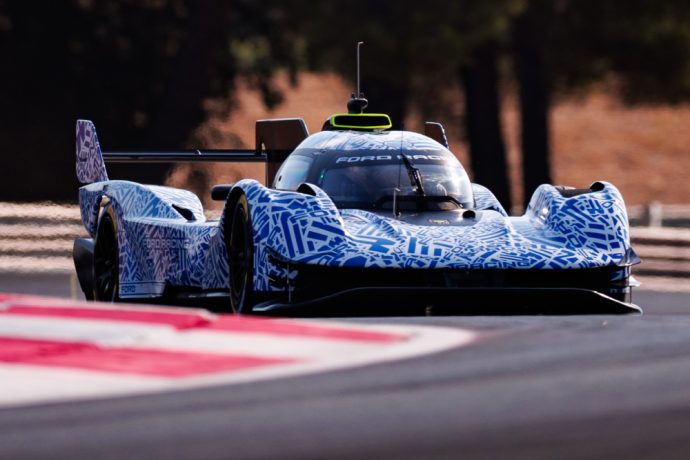
Ford introduced an updated specification of its naturally aspirated 5.4-litre V8 during the Aragón test.
The power unit has been developed by Ford’s engineering operation and is based on the manufacturer’s established V8 architecture.
Its latest version produces more power while weighing less than the previous specification.
The engine had already completed 30 hours of dynamometer running, but Aragón was its first extended evaluation in the complete prototype.
“It was a slight risk,” Sayers acknowledged, discussing the decision to test the revised engine at such an early stage.
The Hypercar uses an ORECA-based LMDh chassis, combined with Ford’s own bodywork, powertrain integration and vehicle systems.
The American manufacturer has also drawn on experience acquired through its Formula 1 partnership with Red Bull, particularly in understanding hybrid systems and the integration of electrical components.
Ford prepares homologation and further American testing
The manufacturer will now continue its programme at Sebring, where the circuit’s uneven surface and demanding conditions will place considerable stress on suspension and mechanical components.
Further running is planned before another extended endurance simulation in January.
Ford estimates that the technical specification of the Hypercar is approximately 95% complete, with homologation work forming a central part of its preparations.
The team is entering a competitive category that includes Ferrari, Toyota, Cadillac, BMW, Aston Martin and other major manufacturers.
Its previous test at Silverstone provided valuable running in changing weather conditions, while Aragón focused on longer-distance reliability.
Ford is scheduled to reveal the completed Hypercar on Thursday, November 26, Thanksgiving Day in the United States.
FAQ
How far did Ford’s Hypercar run at Aragón?
The two prototypes completed a combined distance exceeding 7,300km.
Why did Ford replace the engine?
A cooling-system issue required an engine replacement during overnight testing.
When will Ford introduce its 2027 Hypercar?
The official presentation is scheduled for November 26, 2026.