News Summary
- Medium-to-hard is the fastest conventional strategy, with stops expected around laps 18–24.
- Starting on hard tyres opens a longer window, potentially extending the first stint beyond lap 30.
- A Safety Car could completely reshape the race, with a normal pit stop costing approximately 19 seconds.
Formula 1 teams are expected to favour a one-stop tyre strategy during Saturday’s 51-lap Azerbaijan GP, with the medium and hard compounds providing sufficient durability to complete the race.
Pirelli selected its softest available 2026 range for Baku: C3 as the hard, C4 as the medium and C5 as the soft. Despite that choice, degradation remained low during the long runs, while track evolution partly compensated for tyre wear.
That makes the timing of the stop—and the possibility of a Safety Car—more important than outright tyre preservation.
Predicted Azerbaijan GP strategies
| Starting tyre | Second tyre | Predicted pit window | Strategic purpose |
|---|---|---|---|
| Medium | Hard | Laps 18–24 | Fastest conventional one-stop |
| Hard | Medium | Laps 28–36 | Safety Car flexibility and clean air |
| Soft | Hard | Laps 8–13 | Aggressive opening stint |
| Medium | Medium | Laps 22–28 | Only possible with sufficiently low degradation |
| Soft | Medium | Two stops likely | Late restart or highly aggressive strategy |
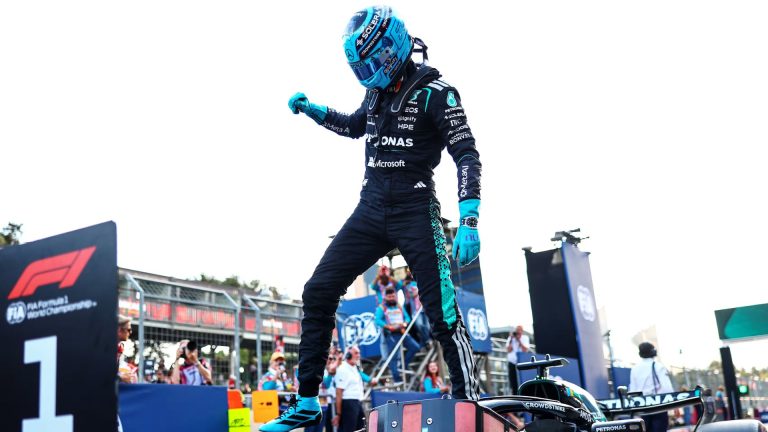
The medium-hard route should be the default strategy for the leading drivers, including pole-sitter George Russell. It provides enough grip for the start without forcing teams into an excessively early stop.
A predicted window of laps 18–24 would leave approximately 27–33 laps on the hard compound. However, teams can extend the medium stint if degradation remains as low as practice suggested.
Why could drivers start on hard tyres?
Drivers starting further down the grid may prefer the hard compound because it allows them to remain on track while the leaders stop.
That option is particularly relevant for Kimi Antonelli, who starts 16th after crashing in qualifying. The championship leader could run beyond lap 30, gain track position during the first pit cycle and wait for a Safety Car.
The same strategy could interest Gabriel Bortoleto, Nico Hülkenberg and the penalised Aston Martin and Cadillac drivers at the back.
However, the hard tyre presents two risks: lower grip at the start and difficulty generating temperature after a Safety Car or restart.
How powerful is the undercut in Baku?
The undercut is not expected to be especially powerful because tyre degradation is limited. A driver stopping early may gain from fresh rubber, but can lose that advantage while bringing the hard compound up to temperature.
Traffic is another important consideration. Baku’s long straight creates overtaking opportunities, but passing remains difficult when cars have similar straight-line performance.
Teams may therefore use an early stop primarily to find clean air—not because the tyres have reached the end of their competitive life.
A normal green-flag pit stop is expected to cost approximately 19.3 seconds, including stationary time. That loss falls substantially under a Safety Car or Virtual Safety Car.
Safety Car could decide the Azerbaijan GP
Baku’s concrete walls, narrow castle section and heavy braking zones make neutralisations a constant strategic threat. A Safety Car appearing close to a driver’s planned window would create an obvious opportunity for a cheaper stop.
The hard-medium strategy offers the greatest flexibility. A driver beginning on the hard compound could wait until laps 28–36, hoping for a neutralisation before switching to the faster medium for the finish.
Conversely, an early Safety Car would create a difficult decision for medium-tyre starters. Stopping would require an extremely long final stint on the hard, while remaining out would surrender the opportunity for a reduced-time pit stop.
Could anyone use the soft tyre?
The soft is unlikely to become a serious starting option for the leaders. Although it provides stronger initial grip, it would force an early stop and expose the driver to traffic.
Its most likely uses are:
- An aggressive opening stint from the midfield or back of the grid
- A late Safety Car restart
- A fastest-lap attempt near the finish
- A short final stint after an unexpected second stop
The soft-hard route could work with a stop around laps 8–13, but it sacrifices the strategic flexibility considered particularly valuable in Baku.
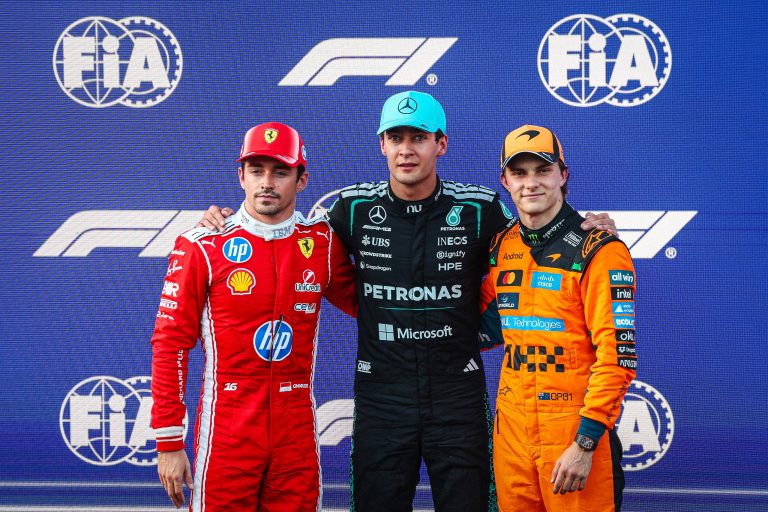
Russell begins from pole ahead of Charles Leclerc and Oscar Piastri, with four penalties reshaping the final Azerbaijan GP starting grid. The Mercedes driver holds the strongest conventional position, but the low degradation means rivals can extend their opening stints and attempt an offset.
The most likely winning strategy remains medium-hard with a stop around laps 18–24. The most dangerous alternative is hard-medium combined with a well-timed Safety Car.
GRANDE PRÊMIO follows the Azerbaijan GP LIVE and in REAL TIME.
F1 today: FAQ
What time does the 2026 Azerbaijan GP start?
The race starts on Saturday, September 26, at 12:00 UK time. It begins at 07:00 ET and 04:00 PT in the US, 16:30 in India and 21:00 AEST in eastern Australia.
Who starts on pole for the Azerbaijan GP?
George Russell starts from pole for Mercedes, ahead of Charles Leclerc and Oscar Piastri. Isack Hadjar qualified fourth, followed by Lando Norris and Lewis Hamilton.
Why is the Azerbaijan GP being held on Saturday?
The race was moved to Saturday because Sunday, September 27, is Azerbaijan’s Remembrance Day, a national day of mourning. The entire F1 weekend was brought forward by one day.
What is the fastest tyre strategy for the Azerbaijan GP?
A one-stop medium-to-hard strategy is expected to be fastest, with the primary pit window between laps 18 and 24.