News Summary
- The 2026 São Paulo Grand Prix has unveiled a titanium trophy inspired by the exhaust manifolds of Formula 1’s historic V10 engines.
- The 55cm, 5.7kg winner’s trophy contains references to Senna’s S, the Brazilian map, the chequered flag and musical notation.
- More than 20,000 layers of titanium were used in its production, with approximately 190 hours of metal printing and another 500 hours of finishing required per trophy.
The 2026 São Paulo Formula 1 Grand Prix has unveiled a titanium trophy inspired by the sound of the championship’s legendary V10 engines, incorporating references to Ayrton Senna, the Interlagos circuit and Brazilian culture into a design that took ten months to develop.
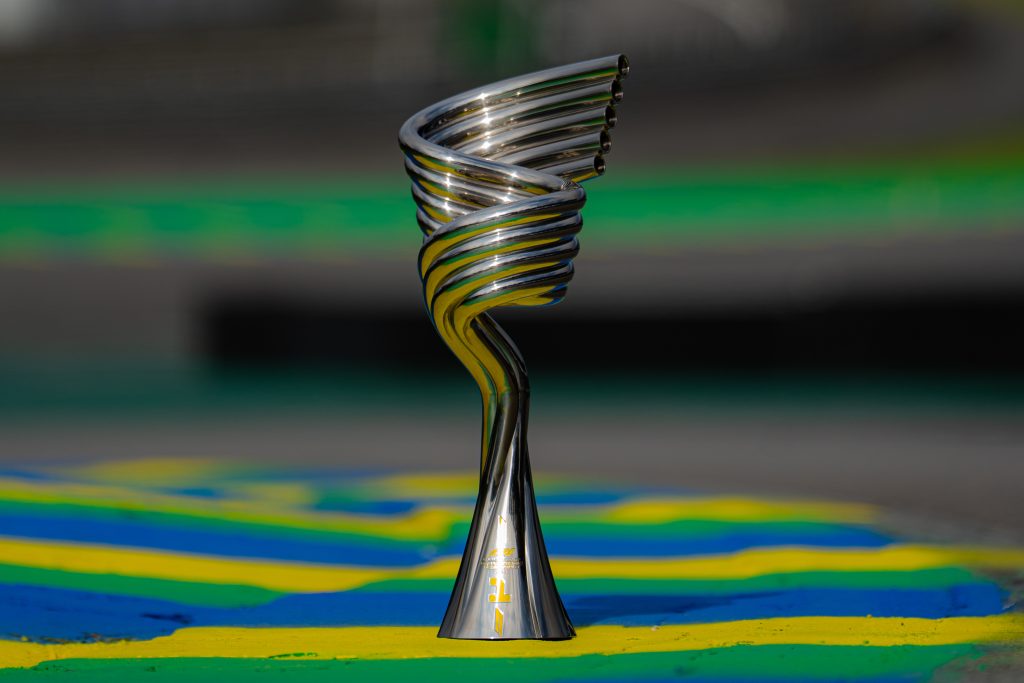
Presented on Tuesday, October 20, the trophy will be awarded during the Brazilian Grand Prix weekend on November 6–8. The winner’s version stands 55cm tall and weighs 5.7kg, with five curved titanium tubes representing the exhaust manifold of a V10 engine and creating different visual interpretations depending on the viewing angle.
The project was developed by designers Fábio Castellotti, Fernando Lambiasi and Gabriel Scholab, with production involving the Secret Weapon design studio and BTOMEC Ferramentaria e Usinagem de Precisão, based in Joinville, southern Brazil.
The sculpture combines advanced metal 3D printing with extensive manual finishing, turning the familiar sound of Formula 1’s previous engine generations into a physical object.
V10 exhaust design hides Senna’s S and Brazilian symbols
The central inspiration comes from the exhaust manifold of a Formula 1 V10 engine, whose distinctive sound became closely associated with the championship before the introduction of the V8 formula in 2006.
Five curved tubes rise from the trophy’s base, representing both the exhaust system and the five lines of a musical staff.
The designers incorporated several additional references into the structure, many of which become visible only when the trophy is observed from particular angles.
Viewed from above, its curved lines reproduce the shape of the Senna S, the opening sequence of corners at Interlagos named after three-time world champion Ayrton Senna.
From another perspective, the sculpture resembles a waving chequered flag, symbolising the finish of a motor race.
The frontal silhouette suggests the outline of Brazil, including part of its coastline, while details around the base recall the kerbs used on racing circuits.
The curved tubes also create the appearance of a musical note, reinforcing the connection between the sound of Formula 1 engines and Brazilian musical culture.
Castellotti explained that the project was designed to reveal different interpretations as the observer moves around it.
The lines follow an anti-clockwise direction, reflecting the layout of Interlagos, one of the relatively few Formula 1 circuits raced in that direction.
The sculpture also contains references to the letters S and P, representing São Paulo.
Designers turn the sound of F1 engines into a sculpture
One of the project’s most distinctive features is its attempt to represent sound through a three-dimensional design.
The V10 era remains particularly popular among Formula 1 supporters because of the engines’ high-revving characteristics and recognisable exhaust note.
Rather than creating a conventional cup or trophy, the designers chose to represent the mechanical component responsible for carrying exhaust gases away from the engine.
The five tubes also resemble the five lines of a musical staff, while their curved arrangement can create the outline of a musical note.
Castellotti described the design as a tribute to the music produced by Formula 1’s V10 engines.
The concept connects the technical heritage of the championship with the atmosphere traditionally associated with the São Paulo Grand Prix.
Interlagos has hosted numerous memorable races involving V10-powered machinery, including victories by Michael Schumacher, Mika Häkkinen, David Coulthard and Juan Pablo Montoya.
The circuit also hosted Senna’s emotional home victories in 1991 and 1993, when the Brazilian competed with V12- and V8-powered McLaren cars, respectively.
Those historical associations contribute to the trophy’s wider celebration of Formula 1’s past without suggesting that Senna’s Interlagos victories were achieved using V10 engines.
Titanium trophy required more than 20,000 printed layers
The trophy was manufactured using Selective Laser Melting (SLM), an advanced metal additive-manufacturing process.
Unlike conventional 3D printing with plastic, SLM uses a high-powered laser to fuse fine metal powder into solid structures, building an object layer by layer.
For the São Paulo Grand Prix trophy, the process involved more than 20,000 layers of titanium, allowing the manufacturers to reproduce the complex curved surfaces designed by the creative team.
The technology is particularly suitable for geometries that would be difficult to produce using traditional machining or casting.
According to the organisers, each trophy required approximately 190 hours of printing, equivalent to almost eight days of continuous production.
The printed structure then underwent an extensive finishing process involving approximately 500 hours of manual work.
That stage included removing temporary support structures, refining the surfaces and completing the final appearance of the titanium.
The work was divided between São Paulo, where the design was developed, and Joinville, where BTOMEC carried out the manufacturing process.
The project required approximately ten months from initial concept to completion.
How the São Paulo F1 trophy was made
| Feature | 2026 winner’s trophy |
|---|---|
| Material | Pure titanium |
| Height | 55cm |
| Weight | 5.7kg |
| Width | 22.5cm |
| Depth | 24.3cm |
| Manufacturing method | Selective Laser Melting |
| Printed layers | More than 20,000 |
| Printing time | Approximately 190 hours |
| Manual finishing | Approximately 500 hours |
| Development period | Approximately 10 months |
| Designers | Fábio Castellotti, Fernando Lambiasi and Gabriel Scholab |
The manufacturing process combines industrial technology with traditional craftsmanship, reflecting the complexity of the design.
The organisers have also highlighted the involvement of Brazilian companies in producing a trophy for one of the country’s largest international sporting events.
São Paulo trophy connects F1 history with Brazilian culture
The trophy continues the São Paulo Grand Prix’s tradition of creating distinctive awards that reflect Brazilian identity.
The 2025 edition featured references to Indigenous culture, while the 2026 design concentrates on engineering, music and motorsport history.
Interlagos is central to the new concept, with its anti-clockwise layout and famous Senna S incorporated directly into the sculpture.
The Brazilian Grand Prix has been a permanent fixture of Formula 1’s history for decades, with Interlagos hosting the event regularly since 1990.
The circuit is particularly associated with dramatic championship decisions, including the 2008 title battle between Lewis Hamilton and Felipe Massa.
Massa won that year’s Brazilian Grand Prix for Ferrari, but Hamilton secured the championship by finishing fifth after overtaking Timo Glock on the final lap.
The 2008 championship remains the subject of Massa’s £64 million legal action involving Formula One Management, Bernie Ecclestone and the FIA, with a Supreme Court appeal hearing scheduled for February 2027.
The trophy’s Senna references also connect the modern event to the circuit’s most celebrated Brazilian driver.
When is the 2026 São Paulo Grand Prix?
The 2026 São Paulo Grand Prix will take place at Interlagos from November 6–8, forming the 20th round of the Formula 1 World Championship.
The event follows consecutive races in the United States and Mexico, with the championship travelling to Brazil for the third race of the American sequence.
The Mexico City Grand Prix takes place one week after Austin, before the teams travel to São Paulo.
The Brazilian race is scheduled for Sunday, November 8, at 14:00 local time.
The new titanium trophies will be presented to the podium finishers following the race at the Autódromo José Carlos Pace.