
Ferrari knew it faced a significant technical disadvantage against Mercedes at Monza, but the Scuderia could hardly have expected such a disastrous Italian GP. The collision between Charles Leclerc and Lewis Hamilton at the start, Leclerc’s subsequent crash and Hamilton’s criticism of the team’s management have now intensified scrutiny on team principal Fred Vasseur.
According to The Race, Ferrari’s senior leadership is increasingly concerned about the image created by the team’s home-race collapse in front of the tifosi. The report says the situation could trigger a review of Vasseur’s position, although there is no indication that Ferrari has decided to replace him.
Ferrari arrived at Monza knowing the circuit’s long straights would expose the limitations of its power unit. The team nevertheless brought its second ADUO-related power-unit development of the season and made changes to the SF-26 in an attempt to compensate for the lack of outright performance.
Hamilton and Leclerc qualified on the second row, creating genuine expectations of a double podium despite Mercedes’ advantage.
Instead, the race unravelled almost immediately.
Ferrari’s home race falls apart
Leclerc and Hamilton went side-by-side through the first chicane after the start, with Hamilton running wide onto the gravel and dropping down the order. Formula 1 classified the incident as a racing incident.
Leclerc’s race ended even earlier than expected. On the second lap, the Monegasque lost control at the Parabolica while battling Oscar Piastri and crashed heavily into the barriers, triggering a red flag. Leclerc escaped without injury, but Ferrari was left with one car out of the race and the other compromised.
Hamilton eventually recovered to sixth, but could not match the pace of the Mercedes cars or the McLarens.
The result was particularly painful because Ferrari had started the weekend with both drivers on the second row and had hoped to challenge for the podium at its most important home event.
After the race, Leclerc admitted that he and Hamilton had gone too far in their battle at the first chicane, while Hamilton refused to share the blame and criticised Ferrari’s lack of clear rules between its drivers.
Hamilton puts pressure on Vasseur
Hamilton’s comments went beyond the first-lap incident.
The seven-time world champion argued that the problems Ferrari has experienced repeatedly need to be addressed at the top of the organisation.
“Ultimately, it comes from the top. It trickles down the decisions, and so it starts with Fred. There’s only so much you can say, so much you can push and shout from the mountain top,” Hamilton said.
He also repeated his call for Ferrari to change how it communicates and manages its drivers.
“Yesterday I said that we’ve got to look at just how we communicate, because if we continue to travel the same path, we get the same result. And it’s like, we keep getting the same result. We’ve got to change things, because this is not helping us to move forward.”
The comments put additional attention on Vasseur, who has ultimate responsibility for the team’s operational structure and for establishing how Hamilton and Leclerc are managed when their interests conflict.
Vasseur, however, insisted Ferrari had not yet reached the point of imposing team orders. He said it had been too early before Monza to choose one driver over the other, but acknowledged that the situation now needed discussion.
Vasseur’s position comes under scrutiny
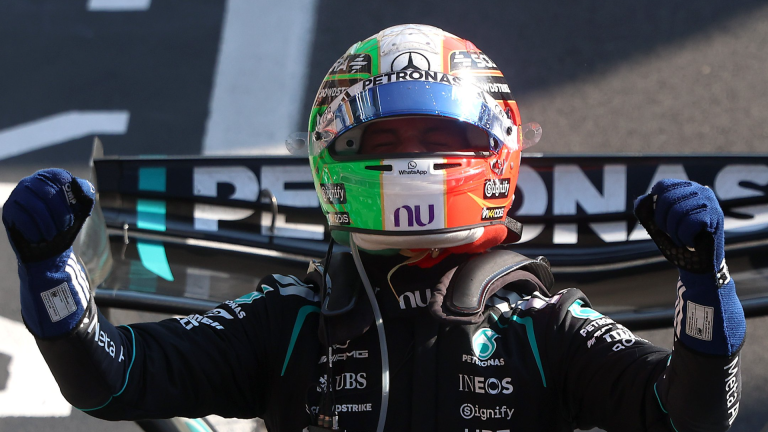
According to The Race, the Monza disaster has increased pressure on Vasseur within Ferrari’s senior management. Sources close to the situation reportedly believe the optics of Ferrari’s home-race collapse — particularly with Mercedes and Kimi Antonelli celebrating in front of the tifosi — have not been well received by the company’s leadership.
The questions surrounding Vasseur go beyond the relationship between Hamilton and Leclerc.
The Race also points to Ferrari’s decision-making around the 2026 power-unit regulations, including whether the team should have fought harder against changes to the start procedure that reduced the advantage created by its smaller turbo. It also questions whether Ferrari made the correct technical trade-off by sacrificing outright engine performance in favour of chassis performance and its approach to the Additional Development and Upgrade Opportunities system.
Vasseur himself acknowledged after Monza that Ferrari’s biggest problem was not simply deployment.
“When you have a lack of pure power, then you start to play with deployment to try to compensate in one straight line,” he explained. “Honestly, it’s not about deployment. I think deployment it was okay-ish. At the end, we are missing pure power.”
That assessment makes Ferrari’s Monza weekend particularly significant: the team knew the circuit would expose its weakness, brought an upgrade and still struggled to attack or defend effectively on the straights.
Coletta and Horner emerge as possible alternatives
The discussion around Vasseur has inevitably led to speculation over who could replace him if Ferrari eventually decided a change was necessary.
The Race identifies Antonello Coletta, Ferrari’s World Endurance Championship boss, as a long-standing candidate for an F1 leadership role and someone highly regarded within Maranello.
Christian Horner is another name mentioned. The former Red Bull Racing CEO was previously approached by Ferrari chairman John Elkann about the team’s top job, according to The Race, but turned down the opportunity at the time.
That does not mean Ferrari is currently negotiating with Horner or that a replacement for Vasseur has been decided. Rather, his name has resurfaced as a potential option if the situation surrounding Vasseur eventually becomes untenable.
For now, Vasseur remains Ferrari’s team principal and has already promised a response at the Spanish GP.
“We’ll come back next week much stronger,” Vasseur said after Monza.
Ferrari needs a response in Madrid
Ferrari has won two Grands Prix in 2026, with Hamilton triumphing in Barcelona and Leclerc winning in Britain. The team remains second in the Constructors’ championship on 346 points, but trails Mercedes by 122.
The bigger concern is the direction of the season.
Ferrari’s problems at Monza were not limited to outright performance. The team lost one car in an intra-team incident, the other failed to challenge for the podium despite starting fourth and fifth, and Hamilton left the weekend publicly demanding changes to the way the organisation operates.
For Vasseur, Madrid therefore represents more than simply another race.
Ferrari needs to demonstrate that Monza was an exceptionally bad weekend rather than evidence of deeper structural problems. The team has already said the Madrid circuit should suit the SF-26 better, particularly because its layout should place less emphasis on outright top speed.
If Ferrari responds, the pressure on Vasseur could ease.
If the same problems continue, the questions about his future are likely to become much louder.
F1 returns this weekend, September 11–13, for the Spanish GP at the new street circuit in Madrid. GRANDE PRÊMIO will provide full coverage of Round 14 of the 2026 season.

FAQ
Is Fred Vasseur at risk of losing his Ferrari job?
Ferrari has not announced any decision to replace Vasseur. However, The Race reports that Monza has increased pressure on him and that Ferrari’s senior leadership could review his position following the team’s operational and competitive problems.
Why is Lewis Hamilton unhappy with Ferrari?
Hamilton believes Ferrari needs clearer rules and better communication when managing its two drivers. After the Monza incident with Leclerc, he said the necessary changes had to come “from the top” and specifically pointed to Vasseur’s responsibility.
Who could replace Vasseur at Ferrari?
Antonello Coletta, Ferrari’s WEC boss, is identified by The Race as a potential long-term candidate. Christian Horner has also been mentioned as an option, having previously been approached by Ferrari chairman John Elkann. Neither represents a confirmed Ferrari replacement plan at this stage.