News Summary
- All 22 Formula 1 drivers finished Las Vegas FP1 without recording a lap time, despite the scheduled 60-minute session running without a red flag.
- A GRANDE PRÊMIO audit examined 4,054 historical session records and identified just one previous session without a valid time in that dataset: Belgium FP2 in 2005, which was interrupted by a red flag.
- Further historical research uncovered unusual circumstances at Monaco in 1960 and Watkins Glen in 1976, but neither has been established as an equivalent precedent.
Formula 1 completed one of the most unusual practice sessions in its history at the 2026 Las Vegas Grand Prix, when all 22 drivers finished the opening hour without recording a single lap time. Despite the rain, standing water and extremely low grip, the session ran to its scheduled conclusion without a red flag.
The circumstances prompted a historical investigation by GRANDE PRÊMIO: had Formula 1 ever completed a regularly scheduled, officially timed practice session with the track open throughout, no red-flag interruption and not a single valid lap time?
A review of historical databases covering the Formula 1 World Championship from 1950 to 2026, supplemented by contemporary race reports and historical regulations, found no conclusively documented equivalent. However, the investigation also exposed gaps in the surviving records of individual practice sessions, particularly during the championship’s first three decades, preventing an absolute claim that Las Vegas was the first occurrence in F1 history.
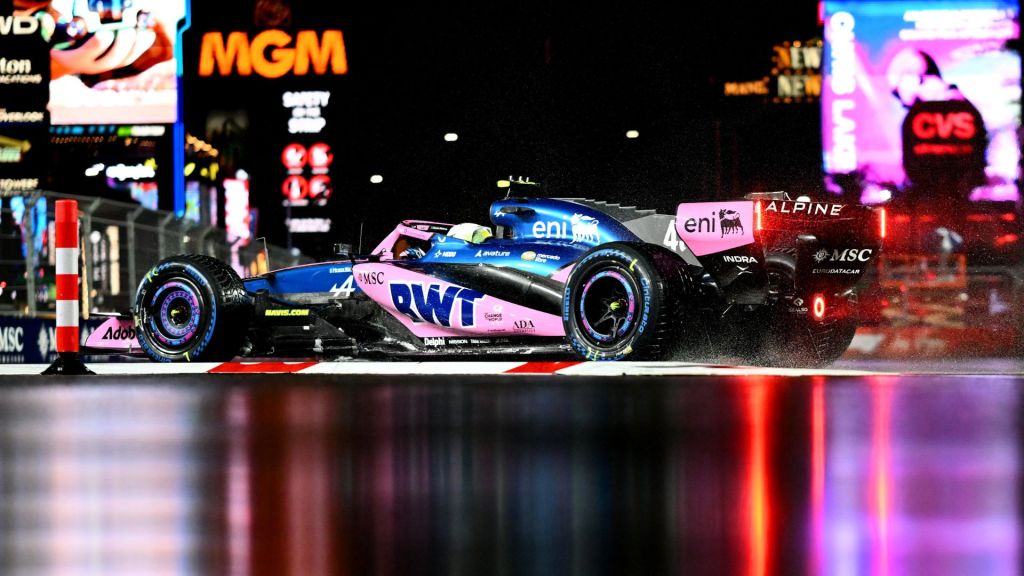
Las Vegas 2026: 60 minutes of green-flag running, zero lap times
Rain fell throughout Thursday, November 19, leaving the 6.2km Las Vegas Strip Circuit soaked before the first free practice session began at 4:30 PM local time.
Sergio Pérez was the first driver to venture out, completing an installation lap in his Cadillac before returning to the pits. Other drivers followed, including Max Verstappen, Charles Leclerc, Kimi Antonelli and the rookie drivers taking part in their scheduled practice appearances.
The track remained open, but nobody completed a flying lap. Seventeen drivers ventured onto the circuit, while Lando Norris, Oscar Piastri, Lance Stroll, Liam Lawson and Arvid Lindblad never left their garages.
Verstappen described the conditions as “almost like an ice rink”, while Antonelli complained of aquaplaning. With little prospect of representative running, teams chose not to risk their cars.
The chequered flag fell after 60 minutes with no official lap times recorded. The FIA’s session report and official timing documents confirmed the absence of a timed classification.
GRANDE PRÊMIO’s original report on the rain-hit Las Vegas FP1 documented the unusual conditions and their impact on teams’ programmes, particularly those of reserve and rookie drivers.
GRANDE PRÊMIO audits 4,054 historical F1 sessions
To establish whether Las Vegas had a historical equivalent, GRANDE PRÊMIO examined historical datase alongside supplementary Formula 1 records and contemporary reporting.
The structured database contained 92,834 individual driver records across 4,054 session-result groups, spanning different periods of the championship between 1950 and 2026.
The investigation covered free practice, qualifying, pre-qualifying, sprint qualifying and the warm-up sessions used in previous decades.
Of those 4,054 recorded sessions, only one contained participant results without a single valid lap time: the second free practice session at the 2005 Belgian Grand Prix.
That finding was significant, but it was not enough to establish an all-time record. While overall qualifying results are available from the inaugural championship in 1950, the database does not preserve separate free practice results comprehensively across the earliest decades.
The historical challenge is especially important because Formula 1 did not always operate under the modern three-practice-session structure. For many years, qualifying times were established across several practice periods, while other sessions were deliberately untimed.
A missing timing sheet therefore cannot automatically be interpreted as evidence that a session took place without any timed laps.
Additional research into historical regulations and contemporary reports identified three cases requiring particular attention.
Belgium 2005: no times, but a red flag interrupted practice
The clearest precedent in the structured results came on Friday, September 9, 2005, during FP2 for the Belgian Grand Prix at Spa-Francorchamps.
Heavy rain made the circuit extremely difficult to negotiate. Vitantonio Liuzzi was among the few drivers who ventured out, but spun on the treacherous surface, triggering a red flag after approximately four minutes.
The circuit was subsequently reopened at 2:13 PM local time, but conditions remained so poor that nobody recorded a timed lap.
A contemporary BMW motorsport report confirmed both the interruption and the subsequent reopening.
Consequently, Spa 2005 shares the absence of recorded times with Las Vegas 2026, but not the uninterrupted nature of the session.
The Belgian practice session had been stopped by a red flag. Las Vegas, by contrast, completed its scheduled hour without one.
Watkins Glen 1976: the closest historical complication
A more difficult historical case occurred at the 1976 United States Grand Prix, held at Watkins Glen on October 8–10.
The second day of official practice was disrupted by torrential rain, with conditions so severe that organisers feared parts of the circuit could deteriorate.
After the scheduled Saturday activity became impracticable, officials eventually announced that the circuit would be opened for approximately one hour for anyone willing to participate.
Only two drivers ventured out.
Vittorio Brambilla completed a single exploratory lap in his March before returning to the pits. Teammate Ronnie Peterson attempted to continue, but spun on a straight, damaging the front of his car before withdrawing.
Nobody else attempted to drive.
The account comes from Alan Henry’s contemporary report in the November 1976 edition of Motor Sport. The grid was ultimately determined by the times established on Friday, when James Hunt had recorded the fastest lap.
Watkins Glen therefore presents an important distinction. The Saturday qualifying programme had originally been scheduled, but the eventual opportunity to run was arranged under extraordinary circumstances after the weather had effectively prevented the normal session from taking place.
The surviving reports examined by GRANDE PRÊMIO do not establish that this later opening was formally classified as a completed, uninterrupted timed qualifying session with zero valid laps.
It must consequently be acknowledged as a close historical comparison, rather than counted as a verified equivalent to Las Vegas.
The distinction is not that Watkins Glen was an unscheduled race weekend activity. Its original qualifying programme was official. The uncertainty concerns the regulatory status of the exceptional period eventually made available to drivers.
Monaco 1960: an entire practice session had its times invalidated
Another unusual incident occurred during practice for the 1960 Monaco Grand Prix.
The official timing system developed problems, with its readings becoming increasingly unreliable. Organisers eventually invalidated the results of the affected session, leaving the times unusable for determining the starting order.
Contemporary reporting in Motor Sport confirms that drivers had circulated and that approximate times were subsequently published for reference.
This was therefore a case of recorded performances being invalidated, rather than a session during which no driver completed a timed lap.
Monaco 1960 cannot be treated as an equivalent to Las Vegas 2026.
Why the earliest decades are difficult to verify
The historical investigation also examined how the structure of Formula 1 practice evolved between 1950 and 1980.
The distinction between timed and untimed activity was particularly important. During different periods, organisers scheduled official qualifying sessions alongside practice or warm-up periods that were not intended to produce official lap times.
Contemporary accounts from the 1970s describe such arrangements, while the FIA’s standard regulations for 1981 formally distinguished official timed sessions from untimed practice and warm-up periods.
The investigation also found that individual Grands Prix sometimes used different formats. France in 1979, for example, featured three timed practice periods rather than the more familiar two-session structure.
This made it necessary to examine the actual schedule of individual events instead of assuming that every championship weekend followed an identical format.
GRANDE PRÊMIO’s research identified no additional documented case matching the precise circumstances of Las Vegas, but it could not independently certify every individual timed session from 1950 to 1980. Some historical records survive only as combined qualifying classifications, without identifying a valid lap for each separate practice period.
The absence of another identified case is therefore a finding of the audit, not proof that no undocumented exception ever existed.
What makes Las Vegas 2026 different?
The historical cases establish three distinct situations: Spa 2005 had no times but was interrupted by a red flag; Watkins Glen 1976 involved an exceptional opening of the circuit after the normal Saturday qualifying programme was disrupted; and Monaco 1960 involved times that were recorded but subsequently invalidated.
Las Vegas 2026 combined different circumstances. The regularly scheduled FP1 session began, the track remained available under green-flag conditions, the entire 60-minute period elapsed and no driver registered a valid lap time.
That combination remains without a conclusively verified historical equivalent in the records examined by GRANDE PRÊMIO.
GRANDE PRÊMIO is following every session of the Las Vegas Grand Prix and the latest developments in Formula 1.
FAQ
Has an F1 practice session ever ended without any lap times before Las Vegas 2026?
Yes. The second practice session at the 2005 Belgian Grand Prix ended without a valid lap time. Unlike Las Vegas 2026, however, it was interrupted by a red flag.
What happened during qualifying at Watkins Glen in 1976?
Torrential rain disrupted Saturday’s scheduled programme. Organisers later opened the circuit for approximately one hour, but only Vittorio Brambilla and Ronnie Peterson ventured out. The surviving reports do not establish the final regulatory classification of that exceptional activity as a completed timed session without laps.
Was Las Vegas 2026 the first uninterrupted F1 practice session without any lap times?
The GRANDE PRÊMIO investigation found no conclusively documented equivalent in the historical records examined. However, incomplete individual-session records from the championship’s earliest decades prevent an absolute claim that it was the first in Formula 1 history.