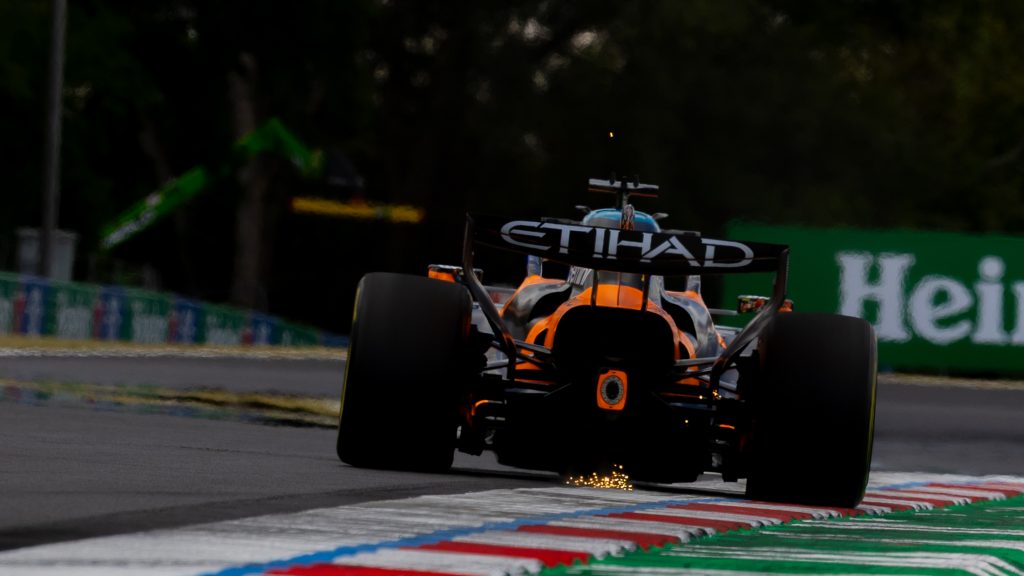
Andrea Stella approved the “Macarena” wing tested by McLaren during the Hungarian Grand Prix weekend and confirmed that the team intends to deploy it at several remaining rounds of the 2026 Formula 1 season, though he did not specify which circuits will see the new specification. However, the Team Principal underscored safety considerations, assuring that the Woking squad will thoroughly analyze the data collected on track.
The rotating wing mechanism first surfaced on Ferrari’s car during pre-season testing in Bahrain before subsequently being adopted by Red Bull. The radical concept sparked intense scrutiny from rival teams because reversing the flap angle significantly reduces drag, boosts aerodynamic efficiency, and eases the load on the power unit down straightaways—a critical advantage under technical regulations with a heavily increased reliance on electrical power.
Alongside continuous floor upgrades, McLaren brought its own version of the Macarena wing to Budapest. The device was run by Leonardo Fornaroli during FP1 and Lando Norris during FP2 before being removed for the remainder of the event. Even without the assistance of the new rear wing specification, the papaya squad secured victory with Norris—missed only a 1-2 finish due to Oscar Piastri’s retirement with 15 laps remaining.
“It was a complex engineering task, which comes as no surprise. Validating this concept is a positive step, and we look forward to introducing it at selected upcoming rounds,” Stella told British outlet PlanetF1, which also inquired about the safety profile of the component.
Notably, Red Bull competed in the Belgian GP without its version of the Macarena wing, as mechanical glitches had triggered high-speed incidents for Max Verstappen during qualifying in Austria and the race in Great Britain. The Fédération Internationale de l’Automobile (FIA) opened an investigation into the matter, even weighing a potential ban, though no formal verdict has been issued.
In Red Bull’s case, analysis showed that because the flap closes against the direction of primary aerodynamic forces, the airflow fails to reattach cleanly to the wing surface, causing rear-end instability. Ferrari avoids this risk, as its flap returns to the neutral position in the opposite direction.
Safety concerns regarding McLaren’s iteration stem from the fact that the papaya team adopted a closing mechanism similar to Red Bull’s design. Consequently, Stella explained that wind tunnel testing alone cannot guarantee flawless real-world behavior, making the empirical data gathered in Budapest essential for further refining the wing.
“I don’t believe the wind tunnel is the sole deciding factor in determining airflow reattachment characteristics. You rely on other simulation tools for that, but ultimately the most critical benchmark—especially on aerodynamically intricate projects like this—remains what you observe on track,” Stella noted.
“It was crucial for us to collect real-world track data because you could never rely exclusively on wind tunnel numbers for a concept this delicate,” he concluded.
Formula 1 is currently on its summer break. The series resumes its 2026 season activities from August 21 to 23 with the Dutch Grand Prix at Zandvoort.