News Summary
- Mercedes has confirmed that Antonelli’s upgraded W17 was faster than Russell’s older specification by the end of the Singapore weekend.
- Trackside engineering director Andrew Shovlin says the team found a better operating window after struggling with the package introduced at Sepang.
- The findings will guide Mercedes’ development for the United States Grand Prix, where Antonelli could secure the 2026 Formula 1 world championship.
Mercedes has confirmed that its latest Formula 1 upgrade package is faster than the previous specification, resolving a major technical question that emerged after the team’s disappointing performance at Sepang.
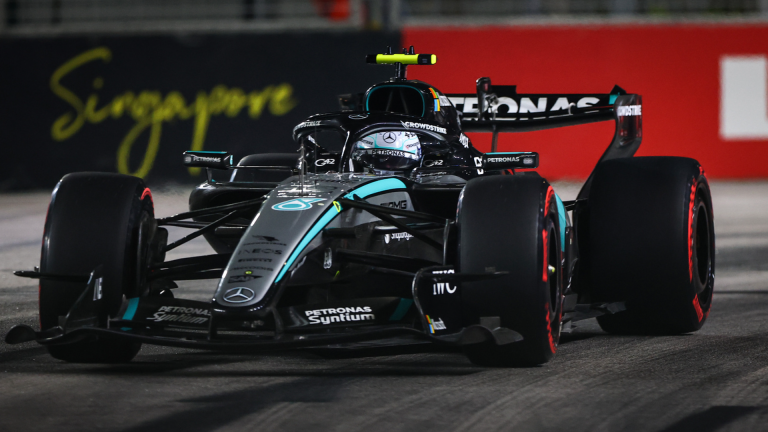
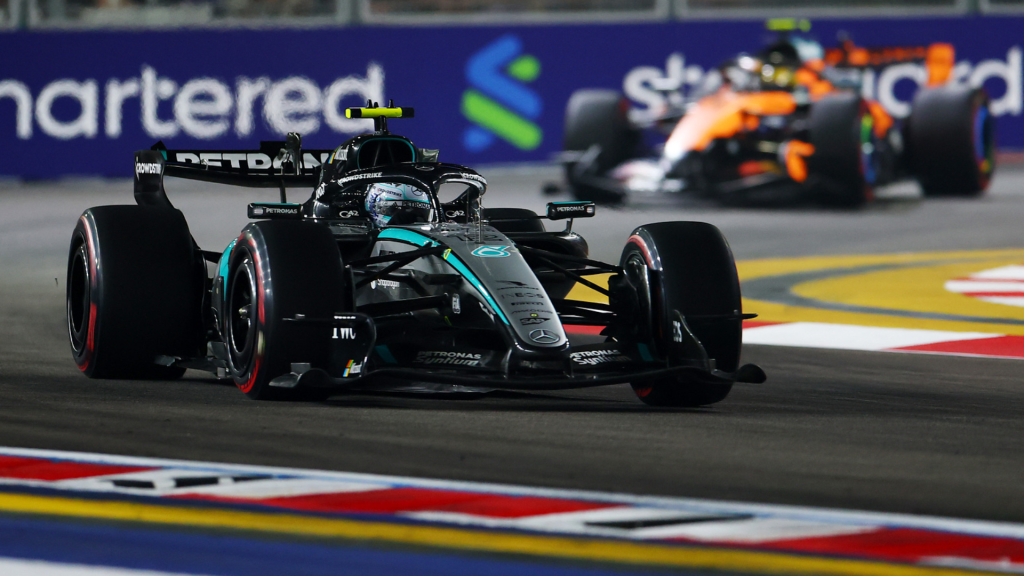
The German manufacturer used the Singapore Grand Prix weekend to compare two different versions of the W17, with Kimi Antonelli running the updated aerodynamic package while George Russell reverted to the older specification previously used in Azerbaijan.
Despite initial difficulties, Mercedes found improvements throughout the weekend, allowing Antonelli to finish third in Sunday’s race and extend his championship lead.
Following the race, trackside engineering director Andrew Shovlin confirmed that the updated car had ultimately demonstrated superior performance.
“By the end of the weekend, Kimi’s package was clearly the faster of the two,” Shovlin said in Mercedes’ official Singapore Grand Prix report.
The assessment provides the clearest answer yet to the questions raised when Mercedes introduced its first major aerodynamic update in four months.
Why Mercedes struggled with its Sepang upgrade
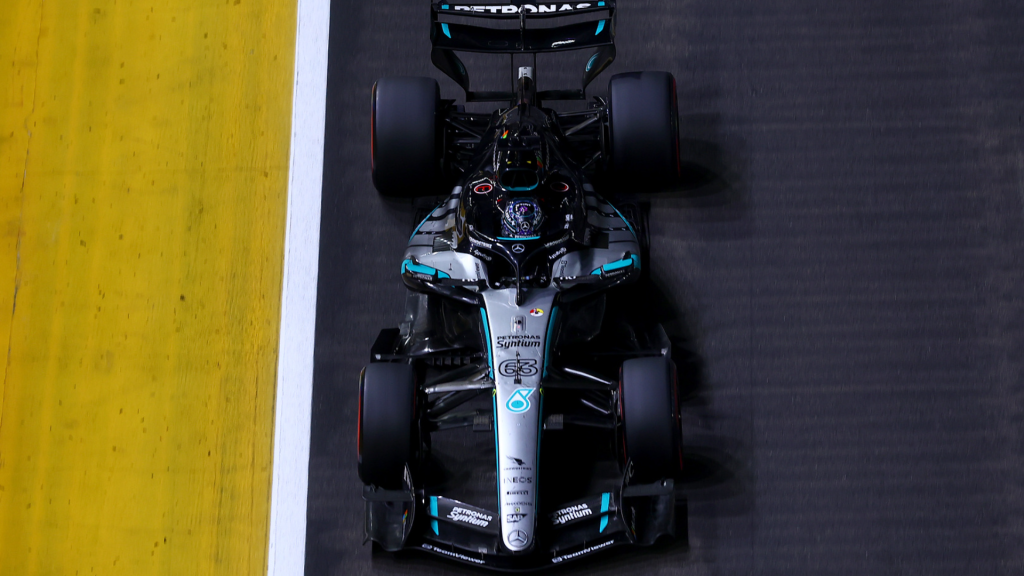
Mercedes introduced a substantial development package at the Bahrain Grand Prix in Malaysia, including changes to the W17’s bodywork and floor.
The team expected the new components to restore some of the performance advantage it had enjoyed earlier in the season.
However, the package failed to deliver the anticipated improvement during its first competitive outing.
Both drivers struggled to extract consistent performance from the updated car, raising questions about the relationship between Mercedes’ aerodynamic simulations and the behaviour of the W17 on track.
The difficulties were particularly concerning because rival teams, including Red Bull, had continued introducing developments that improved their competitiveness.
Mercedes subsequently decided to conduct a direct comparison at Marina Bay rather than continue running identical specifications on both cars.
Antonelli and Russell tested different Mercedes specifications
The Singapore experiment provided Mercedes with an opportunity to evaluate the upgrade against a known baseline.
Russell reverted to the aerodynamic specification used during his dominant Azerbaijan Grand Prix weekend, while Antonelli retained the newer package and tested an additional front wing.
Initially, the comparison appeared to favour Russell. The Briton finished ahead of Antonelli during Friday’s running and qualified second for the sprint, while his team-mate managed only seventh.
Antonelli initially described the upgraded car as difficult to drive, reinforcing concerns that the new components had introduced handling problems.
However, Mercedes continued refining the setup throughout the weekend.
By Saturday’s main qualifying session, Antonelli had improved considerably, securing fourth on the grid ahead of Russell in sixth. The Italian subsequently converted his starting position into third place during Sunday’s race, while Russell recovered from 19th to ninth after a power-unit penalty.
The different starting positions and race circumstances meant the final classification alone could not establish which specification was faster.
Mercedes’ conclusion instead came from the technical information gathered across the weekend.
Shovlin confirms Mercedes found performance in upgraded W17
Shovlin explained that the team had made significant progress in understanding how to operate the new components.
According to the engineering director, Mercedes identified encouraging signs in both qualifying and race conditions as it moved closer to the correct setup window.
The decisive finding was that Antonelli’s specification had become faster than Russell’s older package by the end of the weekend.
The result suggests that Mercedes’ difficulties at Sepang were not necessarily caused by a fundamentally unsuccessful aerodynamic development.
Instead, the team had struggled to operate the updated W17 within the conditions required to extract its intended performance.
Team principal Toto Wolff supported that assessment, acknowledging that the newer specification remained more difficult to optimise.
“It is no doubt a little trickier to get in the right set-up window, but it clearly has goodness,” Wolff said.
The team will now focus on improving consistency rather than abandoning the development direction established by the latest package.
Antonelli expects further improvements in Austin
Antonelli also expressed confidence in the progress achieved during the Singapore weekend.
The championship leader explained that Mercedes had collected valuable information despite the limitations of a sprint-format event, which reduced the available practice time.
“We have made some really good progress with our update package this weekend,” Antonelli said.
The Italian added that the experiment had provided a clearer direction for extracting additional performance from the W17.
That assessment is particularly significant ahead of the United States Grand Prix, where Mercedes will have more time to evaluate the package during a conventional race weekend.
The team will also need to decide whether to return Russell to the updated specification after using Singapore to complete its comparison.
Mercedes upgrade findings arrive at crucial championship moment
The development comes as Antonelli approaches a potentially decisive moment in the 2026 Formula 1 championship.
The Italian extended his lead over Russell to 102 points after finishing third in Singapore, while his team-mate recovered to ninth following a grid penalty.
Antonelli can mathematically secure his first world championship at the United States Grand Prix, although the required results make an Austin coronation difficult.
The championship scenarios for Antonelli to win the title in Austin underline the importance of the next race.
Mercedes is also facing renewed pressure from Red Bull, which has made substantial progress during the second half of the season.
Max Verstappen won the Singapore Grand Prix ahead of Charles Leclerc, continuing a strong run of results for the Austrian team.
The technical findings therefore arrive as Mercedes prepares for the final six rounds, with the championship leader potentially benefiting from a more competitive and better-understood car.
The next race is the United States Grand Prix at the Circuit of The Americas, scheduled for October 23–25.