News Summary
- George Russell topped the second Las Vegas Grand Prix practice session with a 1:47.272, taking advantage of rapidly improving track conditions.
- Pierre Gasly delivered a surprise second place for Alpine, while Charles Leclerc slipped to third despite leading much of the session.
- A late red flag caused by plastic debris interrupted running, while Max Verstappen completed only limited track activity.
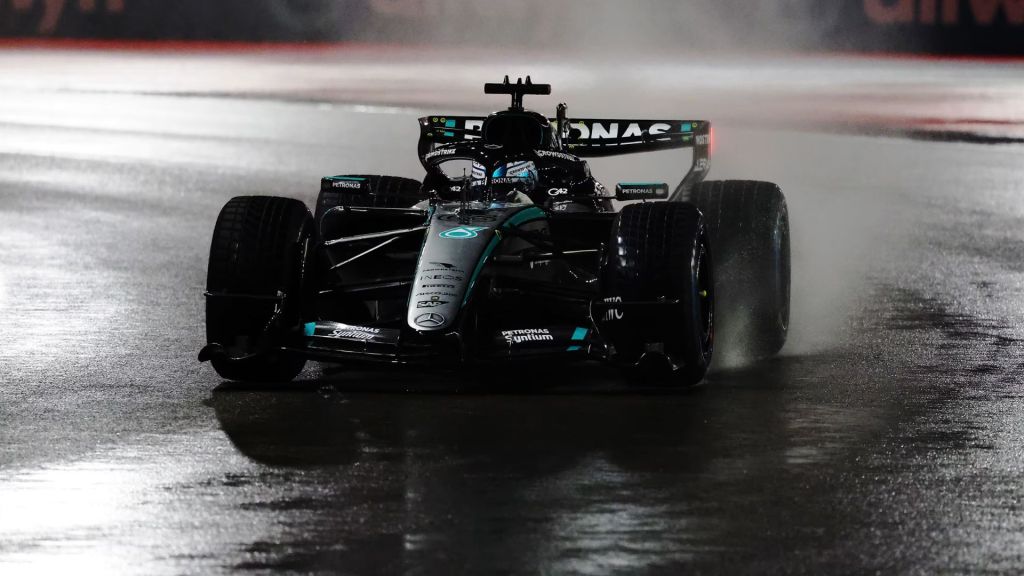
George Russell put Mercedes at the top of the timesheets in the second free practice session for the 2026 Las Vegas Grand Prix, snatching the lead from Charles Leclerc in the closing minutes before Pierre Gasly produced an impressive late lap to finish second for Alpine.
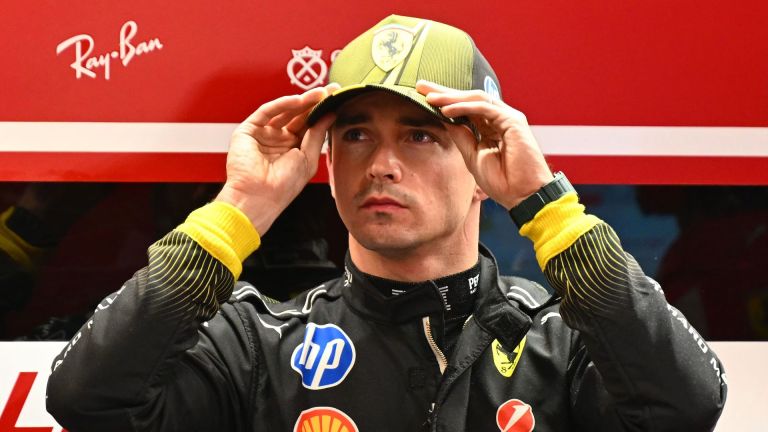
Russell clocked 1:47.272 as the Las Vegas Strip Circuit continued to dry, eventually leaving Leclerc 0.333 seconds behind. The Ferrari driver, who had controlled much of the session as conditions improved, was pushed down to third when Gasly unexpectedly moved into second place, finishing just hundredths of a second behind the Mercedes.
The session finally provided teams with meaningful running after heavy rain prevented every driver from setting a lap time in FP1. Although the weather improved considerably, the track remained wet and slippery, initially requiring full wet tyres before drivers gradually switched to intermediates.
Isack Hadjar finished fourth for Red Bull, followed by Oscar Piastri, Lewis Hamilton, Lando Norris, Kimi Antonelli, Franco Colapinto and Fernando Alonso. The result put Alpine’s two drivers inside the top ten, while Verstappen was largely absent from the timing screens.
Leclerc dominates early running as McLaren finds pace on intermediates
Conditions remained difficult when the pit lane opened for FP2, with ambient temperatures around 15°C and the track at just 13°C. Racing Bulls rookie Arvid Lindblad was first to venture out, but standing water meant that the opening laps were completed on full wet tyres.
Piastri became the first driver to register a timed lap during the Las Vegas weekend, recording 2:02.786. Leclerc soon improved that benchmark before Norris took over with 1:59.530, beginning a sequence of rapid improvements as the cars gradually cleared water from the racing line.
Piastri and Leclerc traded the lead before Norris established a temporary McLaren advantage. The world championship contender eventually lowered the benchmark to 1:52.432 after switching to intermediate tyres, demonstrating how quickly the circuit was becoming faster.
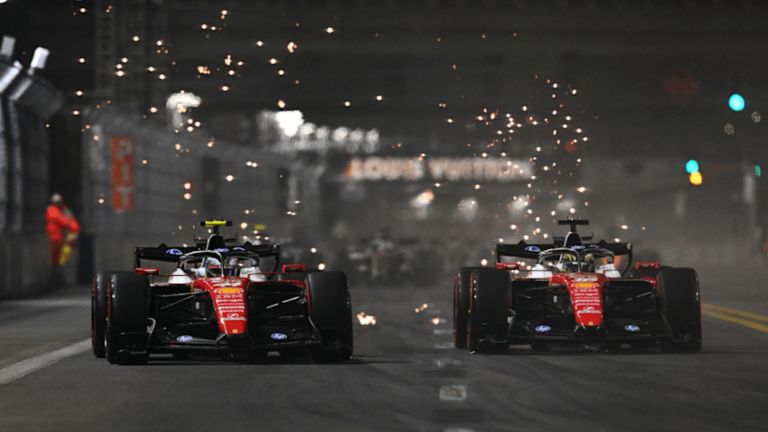
McLaren appeared particularly competitive along the straights, while Ferrari made up significant time through the slower corners. Leclerc repeatedly gained ground in the technical sections, suggesting that the teams had chosen different compromises for the unusual demands of the Las Vegas layout.
Russell and Leclerc followed McLaren onto intermediate tyres, although both initially struggled to match Norris as the conditions continued to evolve. Hamilton also improved steadily, eventually getting within two seconds of the fastest McLaren before making further progress.
With fewer than 30 minutes remaining, Leclerc began to make the Ferrari’s low-speed performance count. He moved ahead with a 1:49.166, opening a gap of approximately 1.7 seconds over Norris at that stage.
Hamilton subsequently reduced his deficit to just 0.096 seconds, briefly establishing Ferrari as the team to beat on the increasingly dry track.
Plastic debris causes late red flag before Russell takes control
The improving conditions suggested that slick tyres could become an option before the end of the session. Leclerc considered the possibility, although the first sector remained too wet while a visibly drier racing line emerged elsewhere.
Hadjar then produced a strong lap of 1:48.407, briefly moving ahead of the Ferrari drivers. Leclerc immediately responded, taking more than eight tenths of a second off the Red Bull driver’s time and moving comfortably into the 1:47s.
With approximately ten minutes remaining, however, race control stopped the session after plastic debris was spotted on the circuit. The interruption came at a crucial point, when track conditions were improving rapidly and several teams were preparing their final qualifying-style attempts.
Running resumed in time for Russell to exploit the faster surface. The Mercedes driver delivered his 1:47.272 to take the lead from Leclerc, whose earlier advantage had gradually disappeared as the track dried.
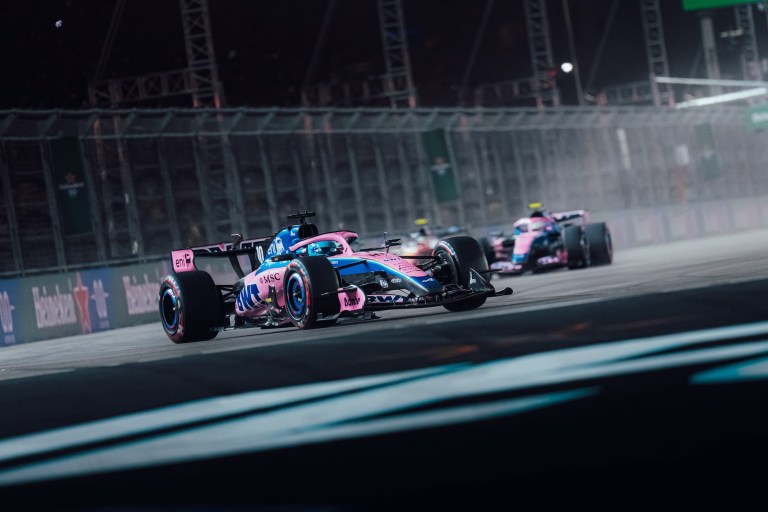
Gasly then produced one of the biggest surprises of the session. The Alpine driver, who had spent much of the hour without a representative lap time, climbed to second with a late effort and denied Leclerc a place on the front row of the practice classification.
The final order underlined how strongly the evolving conditions influenced performance, with the fastest times arriving in the closing minutes rather than during the period when Ferrari had appeared most comfortable.
Verstappen barely runs as Audi and Haas finish at the back
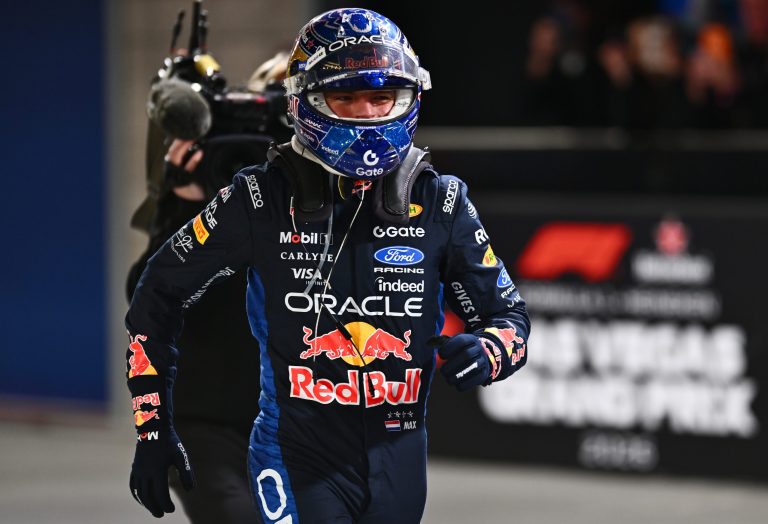
While Russell, Ferrari and McLaren accumulated valuable mileage, Verstappen completed very little meaningful running.
The Red Bull driver remained without a timed lap for much of the session and was seen outside his car speaking with engineers while his rivals continued improving their times. Hadjar’s fourth place nevertheless provided Red Bull with a useful reference on intermediate tyres.
The limited running also affected the preparation of the teams further down the order.
Gabriel Bortoleto briefly climbed to sixth for Audi after recording 1:53.582 on intermediates, but subsequently dropped down the classification as the surface improved and other drivers found more pace.
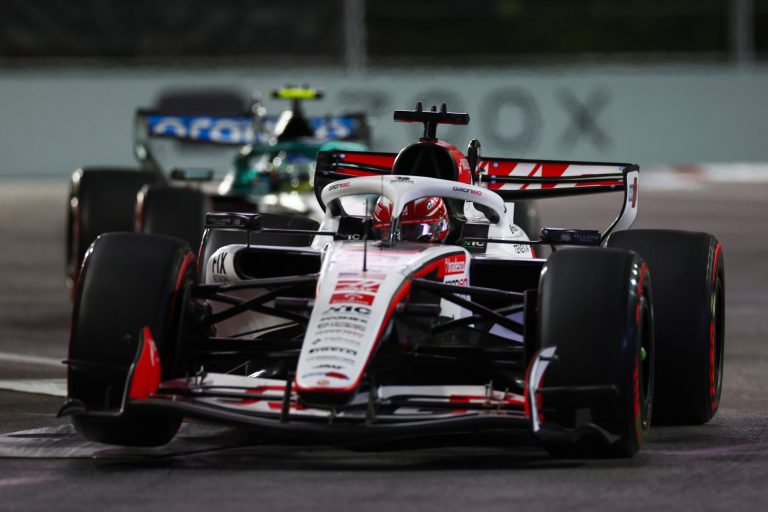
Rafael Câmara, meanwhile, continued learning the Las Vegas circuit following his severely restricted FP1 programme. The Haas driver recorded a 1:59.197 during the middle of the session and at one stage climbed to 14th before falling back as the field improved.
Bortoleto eventually finished 20th, while Câmara was 22nd and last, leaving both drivers with substantial ground to recover ahead of the final practice session.
The differing programmes and rapidly changing conditions make the FP2 classification an imperfect guide to qualifying pace. However, Mercedes, Ferrari, McLaren and Red Bull all showed competitive speed at different moments, while Gasly’s late performance put Alpine firmly among the session’s surprises.
GRANDE PRÊMIO is following every session of the Las Vegas Grand Prix, with complete coverage of the weekend’s Formula 1 action.
FAQ
Who was fastest in Las Vegas Grand Prix FP2?
George Russell topped the second practice session with a lap of 1:47.272 for Mercedes, ahead of Pierre Gasly’s Alpine and Charles Leclerc’s Ferrari.
Why was Las Vegas FP2 stopped by a red flag?
Race control briefly interrupted the session after plastic debris was found on the track with approximately ten minutes remaining.
Why did Max Verstappen complete so little running in FP2?
Verstappen spent much of the session in the Red Bull garage and did not record a representative time during the main period of running. The supplied report does not establish a definitive technical cause.