Formula 1 arrives in Madrid this weekend for one of the biggest unknowns of the 2026 season. The Spanish Grand Prix, scheduled for September 11–13, will be the first F1 race at the new Madring circuit and the first Spanish GP in the capital since the sport last raced at Jarama in 1981. GRANDE PRÊMIO’s latest Madrid GP coverage
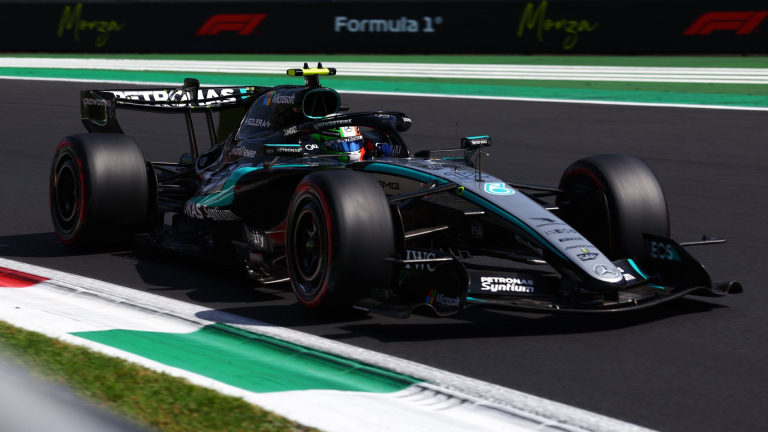
The timing could hardly be more interesting. Kimi Antonelli arrives after his extraordinary Monza victory with a 66-point championship lead, while Max Verstappen, Ferrari and McLaren will all be looking to understand whether Madrid can produce a very different competitive order from the one seen at the Italian GP.

A hybrid circuit unlike the rest of the calendar
Madring is 5.4 km long and has 22 corners, but its most important characteristic is the mixture of environments. The layout combines purpose-built sections around the IFEMA exhibition complex with public roads through Madrid’s Valdebebas area, giving the circuit a semi-urban character rather than making it a conventional street track.
The organisers describe the venue as fast and technical, with long straights, heavy braking zones and flowing sequences of corners. Carlos Sainz, who became the first driver to complete a lap of the finished circuit, highlighted the combination of the fast sections and more technical areas as one of its defining characteristics.
That variety should make the opening Friday particularly important. Teams will have no historical F1 race data from which to establish their baseline, meaning FP1 and FP2 will effectively become a live experiment in car setup, tyre behaviour and aerodynamic configuration.
The first corner could be one of the key overtaking zones
Madring’s opening section immediately creates an opportunity for overtaking.
The main straight is 589 metres long, with cars expected to reach more than 320 km/h before braking heavily for Turn 1. The circuit’s official technical information identifies the first corner as a prime overtaking opportunity, with the cars dropping to roughly 100 km/h before immediately attacking Turn 2.
That could make qualifying particularly valuable. A strong launch from pole should not guarantee the lead into Turn 1, but starting at the front will give drivers the cleanest opportunity to control the opening phase before the field reaches the faster middle section.
It also creates the possibility of one of the more important characteristics of modern F1: the first braking zone could become a DRS-style strategic battleground, especially if the field remains closely matched.
The longest straight may define the race
After Turn 2, the circuit heads through the fast Hortaleza section and onto a very long straight in the urban part of the layout.
Madring’s official circuit information describes an 837-metre section after Hortaleza, while other official circuit material identifies the urban straight as extending to around 1.3 km depending on how the section is measured. Either way, the important point is clear: Madrid contains one of the longest acceleration zones of the season.
Cars will again exceed 300 km/h, making energy deployment and straight-line efficiency particularly important. That could produce a very different picture from Monza, where Mercedes’ power-unit advantage was amplified by the circuit’s extreme low-drag characteristics.
The Madrid weekend should therefore provide one of the first meaningful indications of whether the performance hierarchy seen at Monza was circuit-specific or part of a broader competitive trend.

La Monumental is the biggest unknown
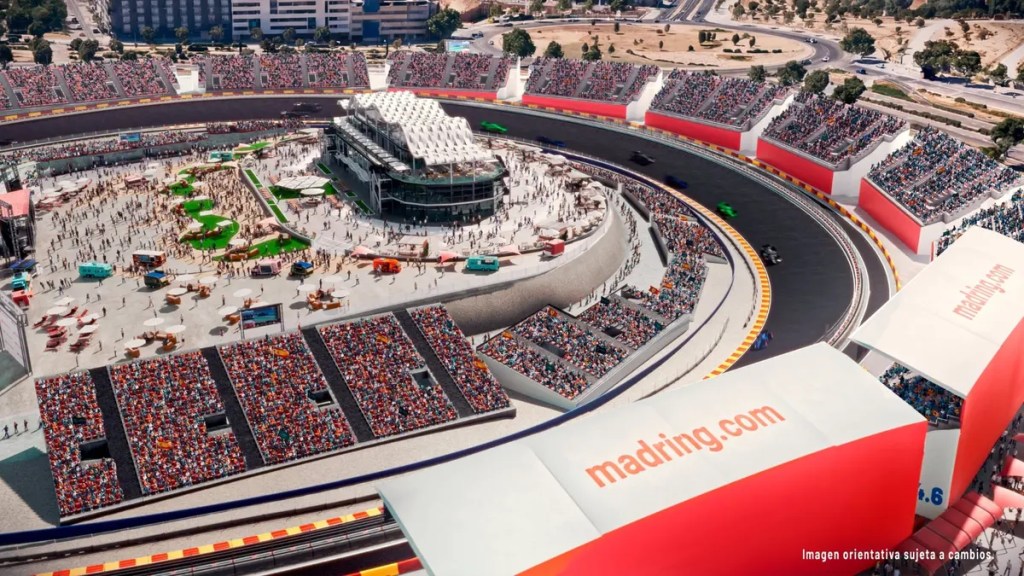
The feature that has attracted the most attention is Turn 12, La Monumental.
The banked corner stretches for around 550 metres and reaches a maximum banking of 24%, making it the longest banked corner on the current F1 calendar. Drivers will spend several seconds negotiating the section at an incline, with the corner reaching a height of around 10 metres.
Its significance goes beyond spectacle.
A heavily banked, high-speed corner places different demands on the car from a conventional flat circuit. The teams will need to understand how the 2026-generation cars respond to the sustained lateral load, how the tyres behave through the section and how much performance can be extracted without compromising the rest of the lap.
It is also one of the reasons Friday’s running could be particularly valuable. The teams have simulations and circuit models, but there is no substitute for real-world tyre and aerodynamic data from an F1 car.
Madrid could reward a different type of F1 car
The biggest sporting question is therefore what kind of car will perform best.
Madring contains enough long, fast sections to reward efficiency, but it also has slow corners and heavy braking zones where mechanical grip and traction become important. That makes it difficult to predict a straightforward advantage for either the low-downforce specialists or the cars that have been strongest on slower circuits.
Charles Leclerc has already expressed optimism about the layout, saying its characteristics suit his driving style and describing Madring as a circuit with the potential to become one of F1’s iconic venues. Leclerc’s expectations for the Madrid circuit
That is particularly interesting for Ferrari after a difficult home race at Monza. The Italian GP exposed some of the team’s weaknesses, while Madrid should provide a broader test of the SF26’s ability to combine straight-line performance with cornering and tyre management.
What about overtaking?
Madring was designed with overtaking opportunities in mind, particularly around the opening section and the long acceleration zones.
The combination of a long straight and heavy braking into Turn 1 should provide the most obvious opportunity, while the faster sections could create additional possibilities if drivers can remain close enough through the preceding corners.
The real question is whether the new-generation cars can follow each other closely enough to make those opportunities meaningful. That will only become clear once the teams have established the actual aerodynamic behaviour of the cars around the circuit.
Tyres could become a major factor
Madrid also presents an important tyre-management question.
The circuit’s mixture of long straights, heavy braking and sustained high-speed corners means the tyres will experience very different loads around a single lap. La Monumental, in particular, could become one of the defining tyre-management sections of the race.
That opens the door to different strategic approaches. If degradation is high, a two-stop race could become attractive; if the tyres remain stable, track position could become more important.
With no previous F1 race at Madring, the teams will have limited certainty about the real race degradation until Friday and Saturday running provide enough data.
The championship makes Madrid even more important
The first Madrid GP is not arriving in a neutral part of the season.
Antonelli has just produced one of the defining performances of 2026 by winning the Italian GP from 19th on the grid, extending his championship lead to 66 points. Russell remains second, while Hamilton, Lando Norris and Charles Leclerc are still mathematically relevant to the title picture. Antonelli’s historic Monza victory and championship lead
The new circuit could therefore either reinforce the existing hierarchy or disrupt it completely.
Antonelli himself has warned against assuming Mercedes will automatically remain dominant, pointing out that McLaren, Ferrari and Verstappen’s Red Bull could become stronger at a different type of circuit. Antonelli’s warning about the changing competitive order
That makes Madrid one of the most important weekends of the season for understanding the championship’s final phase.
What should we expect from the first Madrid GP?
The safest prediction is that Friday will be about discovery.
Teams will need to establish the correct ride heights, aerodynamic configuration, tyre behaviour and energy deployment strategy before qualifying reveals who has understood the circuit best. The long straights should create obvious opportunities for overtaking, while La Monumental could become the defining technical challenge of the weekend.
More importantly, Madrid could tell us whether the competitive picture is genuinely changing as F1 enters the final 10 races of the season.
After Monza, Mercedes looked difficult to beat. After Madrid, we may have a much clearer idea of whether that advantage travels to a completely different kind of circuit.
FAQ
What is the Madring circuit like?
Madring is a 5.4 km, 22-corner hybrid circuit around Madrid’s IFEMA and Valdebebas areas. It combines permanent sections with public-road sections, long straights, heavy braking zones and high-speed corners.
What is La Monumental at the Madrid F1 circuit?
La Monumental is Madring’s signature banked corner. It stretches for approximately 550 metres and reaches 24% banking, making it one of the most distinctive corners on the 2026 F1 calendar.
Can Madring produce overtaking in the 2026 Spanish GP?
The circuit was designed with several overtaking opportunities, particularly at Turn 1 after the 589-metre main straight and around the long acceleration zones. Whether those opportunities produce frequent overtakes will depend on how closely the 2026 cars can follow one another.