News summary
- Alonso and Stroll were among the slowest cars through Baku’s speed checks, although practice figures alone cannot identify the cause.
- Both Aston Martins retired from the Azerbaijan Grand Prix with separate reported problems.
- Sepang’s mix of long straights and fast corners will test both the car’s performance and its reliability.
Aston Martin left the Azerbaijan Grand Prix with a question that the Malaysian round could help answer: how much of its Baku deficit was specific to that circuit, and how much will follow the team to Sepang?
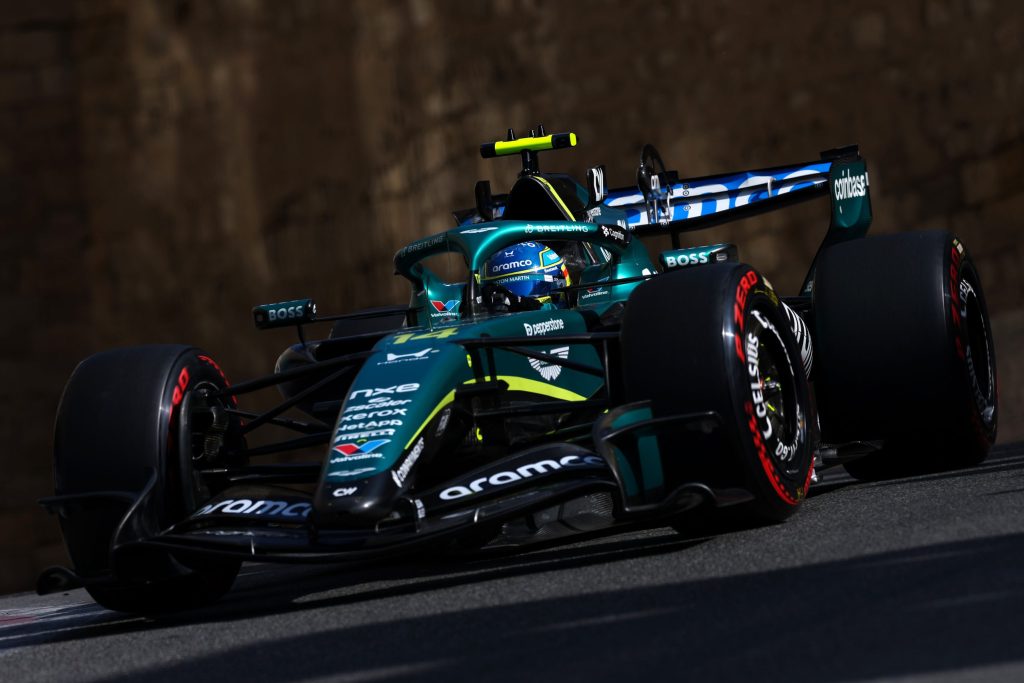
In Friday practice, Fernando Alonso was recorded at 311.0 km/h at Baku’s finish-line speed check, while Lance Stroll reached 309.0 km/h. Every Formula 2 car registered a higher figure at that checkpoint during its own session. As GRANDE PRÊMIO reported in its comparison, those readings came from different sessions and cannot be treated as a direct comparison of the two cars’ overall pace. Fuel loads, slipstreams, aerodynamic settings and energy deployment can all affect straight-line speed.
The concern extended beyond that comparison. Alonso qualified 19th and Stroll 21st in Baku. Alonso said he was happier with his driving and the car’s balance in qualifying than he had been earlier in the weekend, but that Aston Martin was losing considerable lap time on the straights. Stroll said the team was struggling with both power and downforce.
Neither driver reached the finish. Stroll stopped on lap eight with a water-pressure issue. Alonso retired on lap 20 after reporting a loss of time on the straights. Aston Martin described Alonso’s problem as a suspected power-unit issue and said it would investigate. The team has not established from those comments alone whether the race problem had the same cause as its earlier speed deficit.
Sepang gives Aston Martin a different way to assess the car. Baku’s long flat-out section placed particular emphasis on straight-line performance. The Malaysian circuit also has two long straights, but its faster corners ask more of the car’s aerodynamic balance. A better showing through those corners could help Aston Martin recover lap time it could not find in Azerbaijan; it would still need sufficient speed on the straights to defend or make positions.
Reliability is the other immediate concern. Aston Martin must understand why both cars stopped in Baku before the 2026 Bahrain Grand Prix in Malaysia. Practice at Sepang will offer the first comparison across the circuit’s contrasting sections, while the race will establish whether the team can turn that performance into a finish.
F1 today: FAQ
What time is Singapore GP sprint qualifying today?
Sprint qualifying starts at 20:30 Singapore time on Friday, October 9, equivalent to 13:30 BST in the UK, 08:30 ET in the United States and Canada, and 18:00 IST in India. The session determines the starting grid for Saturday’s sprint.
Who was fastest in Singapore GP FP1?
George Russell topped FP1 with a 1:32.274, driving Mercedes’ older W17 aerodynamic specification. Charles Leclerc finished second, 0.198s behind, followed by Lando Norris in third. Kimi Antonelli was seventh with the upgraded Mercedes, while Gabriel Bortoleto finished 16th.
Why is George Russell using the old Mercedes at the Singapore GP?
Mercedes is comparing its previous W17 specification with the aerodynamic upgrade introduced at Sepang. Russell is using the older package, while championship leader Kimi Antonelli retains the new version. Russell led FP1, but differences in tyre compounds and run programmes mean the result alone does not establish which specification is faster.
Why was Aston Martin slow on Baku’s straights?
The team acknowledged losing time on the straights, but the available speed checks do not isolate a single cause. Slipstream, setup and energy deployment can affect the recorded figures.