News Summary
- Mercedes arrives in Madrid after a dominant 1-2 at Monza, with Kimi Antonelli leading George Russell by 66 points.
- The new Madring has 22 corners, a fresh surface and no previous F1 race data, making setup and tyre behaviour major unknowns.
- McLaren, Ferrari and Red Bull could benefit from the circuit’s different characteristics and turn the Spanish GP into a much closer fight.
Formula 1 heads to Madrid this weekend for the first Spanish Grand Prix at the new Madring, and the timing could hardly be more interesting. Kimi Antonelli arrives as the championship leader after his extraordinary Monza victory, while Mercedes has won nine of the first 13 races and leads Ferrari by 122 points in the Constructors’ Championship.
But none of that guarantees the same hierarchy will appear in Spain.
Monza rewarded low-drag efficiency, straight-line speed and strong performance under heavy braking. Madrid offers a very different combination of long acceleration zones, medium- and low-speed corners and the spectacular La Monumental, a 550-metre banked section with up to 24% banking. The new circuit also has freshly laid asphalt, meaning teams have no previous Grand Prix data to use as a reference.
That makes the Spanish GP one of the most revealing weekends of the season. It could confirm that Mercedes has built the strongest all-round car of 2026, or expose weaknesses that were hidden by Monza’s unique characteristics.
Mercedes has the advantage — for now
There is little question that Mercedes starts the weekend as the favourite.
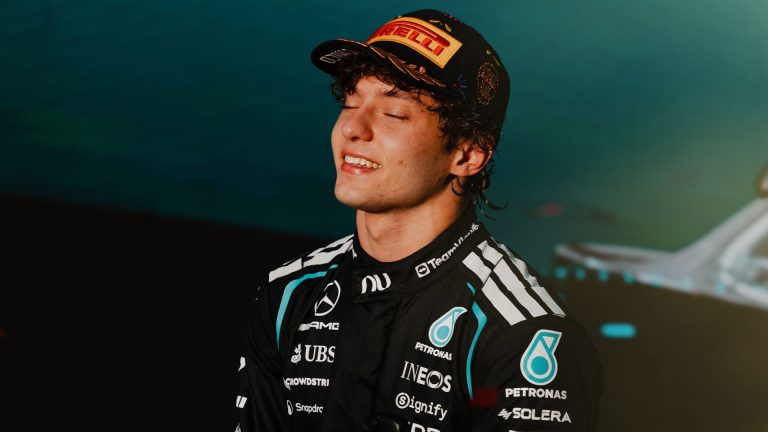
Antonelli has won seven races this season, including the last five, and his 66-point advantage over Russell gives the team an enormous cushion in the championship. His Monza victory was particularly significant because he recovered from 19th on the grid to beat his teammate and claim the first Italian home win at the circuit since 1966.
The championship picture is now so favourable to Antonelli that his 66-point lead over Russell has become one of the defining stories of the 2026 title fight.
Mercedes’ advantage, however, cannot be separated from the circuits it has visited. The team’s power unit was particularly valuable at Monza, where the cars spent a significant amount of the lap at full throttle and low-downforce efficiency was critical.
Madrid should provide a much broader test.
Toto Wolff has already warned that the characteristics of the new circuit are closer to places such as Budapest and Zandvoort, where cornering performance and tyre behaviour play a greater role.
If Mercedes remains clearly ahead in those conditions, its championship position will look even stronger.
Why Madrid is such a big unknown
The biggest variable is simple: nobody knows exactly how the cars will behave there.
Teams have spent months working with simulators and circuit models, but the first practice sessions will be their first opportunity to collect representative F1 data from the real track. That makes Friday particularly important, as engineers will need to understand the new asphalt, tyre temperatures, kerbs and aerodynamic balance almost from scratch.
The new Madrid circuit combines permanent and urban sections with long straights and heavy braking zones, creating a hybrid layout unlike most of the venues on the calendar.
The surface itself adds another layer of uncertainty. The newly laid asphalt is expected to offer relatively low grip, while the amount of rubber deposited during the weekend could change the balance of the cars considerably.
That could create a situation in which the competitive order changes from FP1 to qualifying.
A team that initially struggles to find grip may discover a much stronger setup as the track evolves, while another could lose the advantage it appeared to have on Friday morning.
La Monumental could be the defining feature
The most unusual part of the Madring is Turn 12, La Monumental.
The 270-degree banked corner stretches for around 550 metres and reaches up to 24% banking. It is the longest banked corner on the current F1 calendar and will place an unusual sustained load on the tyres.
That matters because the corner is not simply a spectacular addition to the circuit. It could influence how teams approach the entire car setup.
Engineers will need to understand how much downforce is required through La Monumental without compromising performance on the straights, while drivers will have to manage the sustained lateral load and the crest on the exit.
The corner could therefore favour a car that is particularly stable through high-speed sections, while the slower parts of the circuit will reward mechanical grip and traction.
That mixture makes it difficult to predict which of the leading teams will be strongest before the cars actually run.
McLaren has a major opportunity
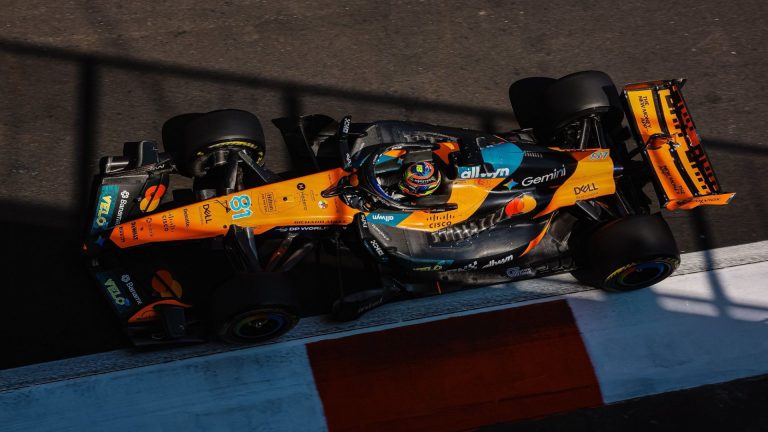
If Mercedes is beaten, McLaren could be the team most likely to take advantage.
Lando Norris and Oscar Piastri have already shown that the McLaren can fight for victories, and the team won the previous two Grands Prix before Monza. Norris remains mathematically alive in the championship, although the gap to Antonelli has become increasingly difficult to overcome.
The key question is whether McLaren’s strengths translate to Madrid.
The team struggled to match Mercedes’ pace at Monza, but the new circuit puts greater emphasis on the types of cornering and tyre behaviour that could produce a different competitive picture.
After Monza, Norris openly described Mercedes as being on “a completely different level”. Madrid will offer McLaren the opportunity to find out whether that gap was genuine or heavily influenced by Monza’s characteristics.
If Norris and Piastri are immediately close to Antonelli and Russell, the championship narrative could change quickly.
Ferrari has something to prove
Ferrari also arrives in Madrid looking for answers.
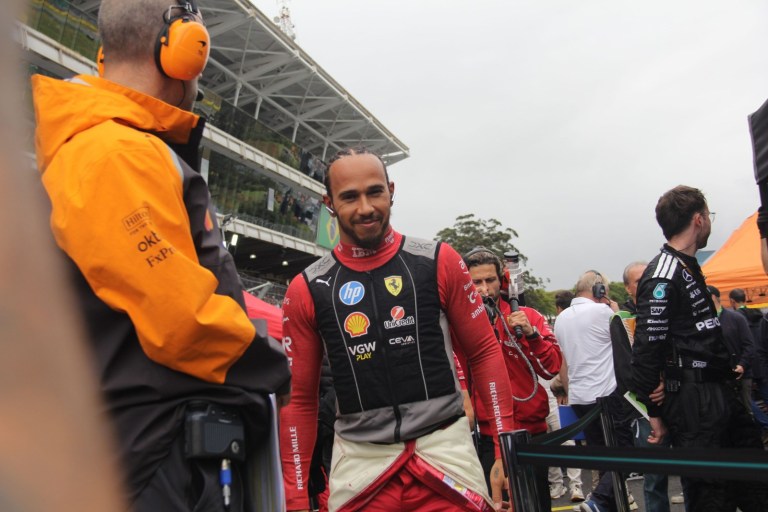
The team failed to reach the podium at its home race, with Lewis Hamilton finishing sixth and Charles Leclerc retiring after his crash. The result left Ferrari well behind Mercedes in the Constructors’ Championship and raised further questions about its ability to fight consistently at the front.
The situation could be different in Madrid.
Hamilton and Leclerc completed a filming-day run at the circuit in July, giving Ferrari some limited experience of the layout. Both drivers have nevertheless played down the value of those laps because the track was still dusty and had little grip at the time.
Ferrari therefore still has many of the same unknowns as its rivals.
The important question will be whether the SF-26 is better suited to the combination of medium- and low-speed corners than it was to Monza’s power-sensitive layout. The team has already acknowledged that the Italian GP was complicated by a lack of speed.
A competitive Ferrari in Madrid would immediately make the front of the field much more interesting.
Red Bull is the wild card
Red Bull may be the hardest team to place.
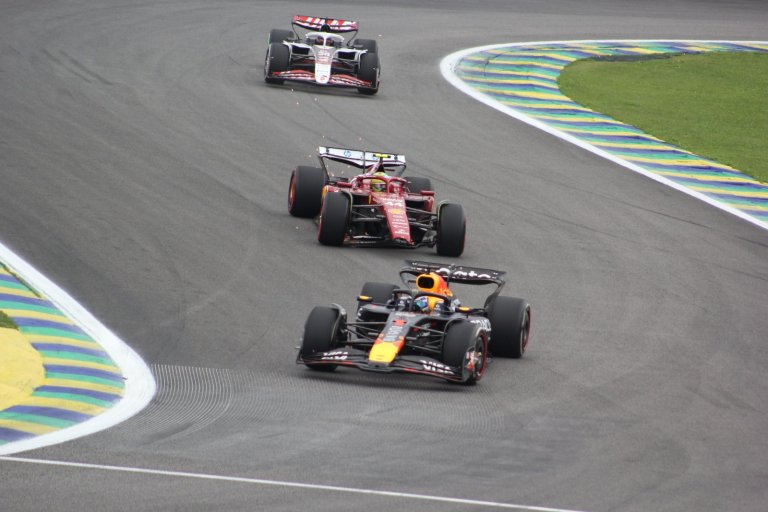
Max Verstappen finished third at Monza and ultimately could not match the Mercedes cars, but the RB22’s race performance was considerably more competitive than its qualifying result suggested.
Verstappen admitted that Mercedes was simply too fast for Red Bull at Monza, particularly in the areas where straight-line efficiency mattered most.
Madrid removes some of that advantage.
Red Bull has spent much of the season working to understand balance and rear-end limitations, and its performance at Monza suggested that some of those problems may be moving in the right direction. The new circuit will provide a much more useful test of whether that progress is genuine.
If Verstappen can extract strong performance from the car through Madrid’s technical sections, Red Bull could become another serious challenger to Mercedes.
The first few hours could tell us a lot
New circuits are often difficult to read, but Madrid could be particularly unpredictable because the track combines so many different characteristics.
The first sector is fast, the middle section contains several medium- and low-speed corners, and the final sector features a sequence of 90-degree turns. The 5.4 km lap therefore asks very different questions of the car within a single lap.
That means the teams may find themselves compromising between competing priorities.
A car optimised for the fast sections could struggle in the slow corners. A setup designed to maximise mechanical grip could sacrifice too much speed on the straights. And tyre behaviour through La Monumental could influence which compromises ultimately make sense.
This is where the opening practice sessions become especially important.
The order in FP1 may tell us very little about qualifying, but the rate at which each team understands the circuit could be almost as significant as its outright pace.
What Madrid could mean for the championship
The circuit’s uncertainty matters even more because of where the championship currently stands.
Antonelli leads with 267 points, while Russell has 201. Lewis Hamilton is third on 191, followed by Lando Norris on 171. Mercedes also has a substantial advantage in the Constructors’ Championship.
Antonelli does not need to dominate every remaining race. His priority is to keep collecting strong results while preventing his closest rivals from taking large chunks out of the lead.
For Russell, Norris and the others, the situation is different.
They need victories.
That makes a circuit capable of disrupting the established order particularly valuable to the challengers. If Mercedes suddenly finds itself fighting McLaren, Ferrari and Red Bull rather than controlling the front, the championship could become much more competitive even without Antonelli having a bad weekend.
The reverse is also true.
If Mercedes arrives in Madrid and immediately establishes a clear advantage on a completely different type of circuit, it would be one of the strongest indications yet that Antonelli has the best car in the championship.
Madrid could redefine the pecking order
That is ultimately what makes this weekend so intriguing.
Mercedes is the obvious favourite based on everything that happened at Monza. Antonelli is the driver to beat, Russell remains his closest teammate and the team has the strongest recent record.
But Madrid removes the certainty that comes with relying on established circuit characteristics.
McLaren could benefit from the technical layout. Ferrari has an opportunity to recover from a disappointing home race. Red Bull has to demonstrate that its recent progress extends beyond low-drag circuits. And all three teams will be learning the Madring alongside Mercedes.
The first Spanish GP in Madrid is therefore more than another round of the championship.
It is a benchmark.
If Mercedes dominates again, the rest of the field will have to accept that the gap is not simply a Monza phenomenon. If the leading teams converge, however, the competitive order could look very different from the one we saw in Italy.
After 13 races, the 2026 F1 hierarchy appears relatively clear.
Madrid could be the weekend that tears it up.
GRANDE PRÊMIO will follow every session of the inaugural Spanish GP, with coverage of practice, qualifying and the race from the new Madrid circuit.
FAQ
Why could the new Madrid circuit change the F1 pecking order?
Madring has never hosted an F1 Grand Prix, so teams have no previous race data for the circuit. Its combination of fast sections, technical corners, heavy braking zones and the banked La Monumental could favour cars differently from Monza.
Is Mercedes still the favourite for the 2026 Spanish GP?
Yes. Mercedes arrives after a 1-2 at Monza and has won nine of the first 13 races. Kimi Antonelli also leads George Russell by 66 points in the Drivers’ Championship.
Which teams could challenge Mercedes in Madrid?
McLaren, Ferrari and Red Bull are the main candidates. McLaren has won the previous two Grands Prix before Monza, Ferrari has limited prior running at the new circuit, and Red Bull will be hoping its recent improvement can translate to a track with very different characteristics.