News Summary
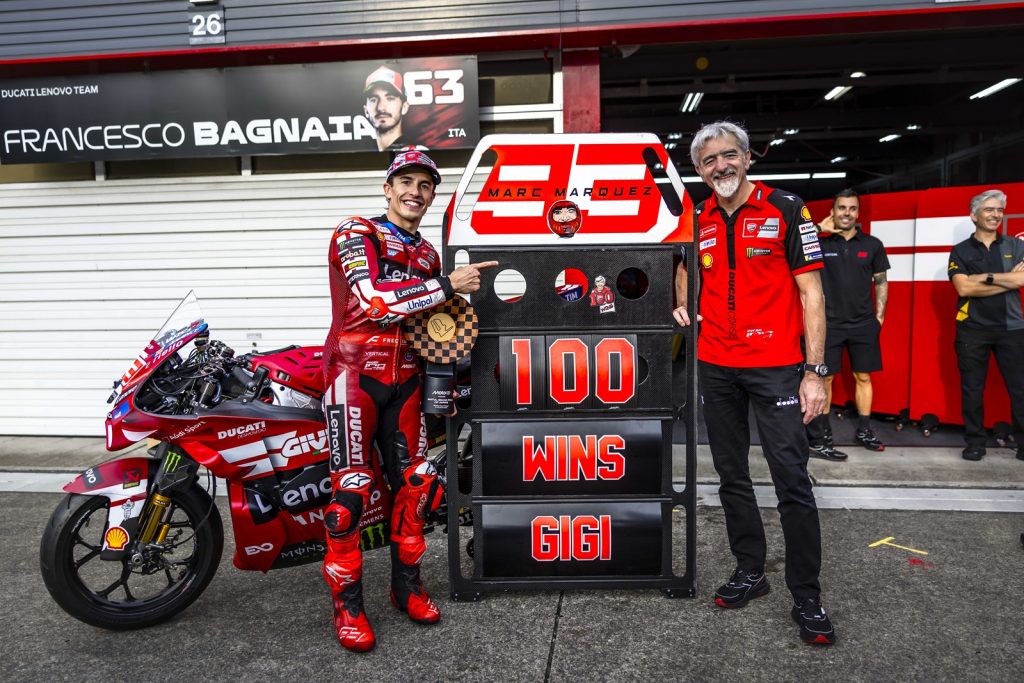
- Marc Márquez’s Japanese GP victory gave Ducati its 100th MotoGP win under Gigi Dall’Igna
- Ducati had managed only 31 victories before Dall’Igna arrived at the end of 2013
- The manufacturer has won 100 of the last 203 Grands Prix, including 19 of 20 races in its dominant 2024 season
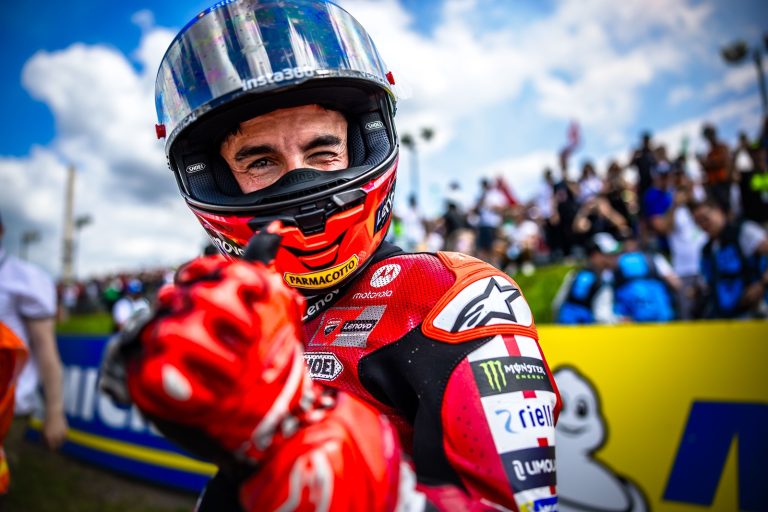
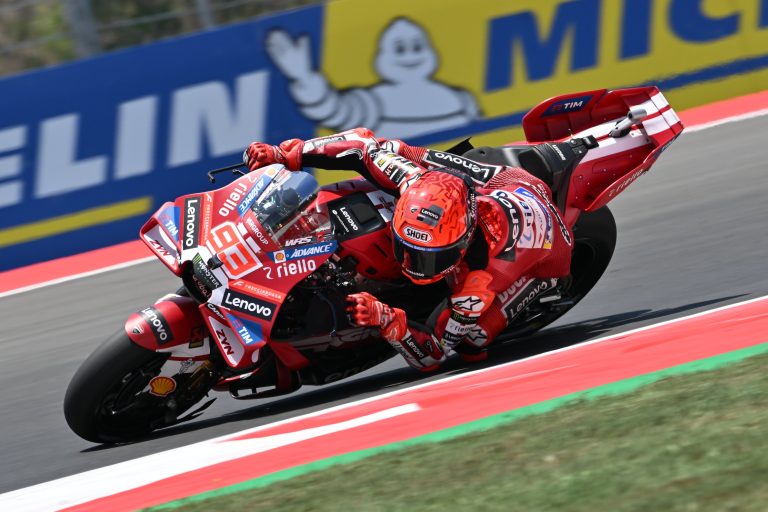
Marc Márquez’s victory at Motegi carried much greater significance for Ducati than another addition to its 2026 total. It was the manufacturer’s 100th MotoGP Grand Prix win under Gigi Dall’Igna, completing a transformation that began when the Italian arrived at Borgo Panigale at the end of 2013.
The comparison with what came before is striking. Ducati had accumulated only 31 MotoGP victories before Dall’Igna’s arrival and had gone through the entire 2011-2015 period without winning a race. Valentino Rossi’s two seasons with the manufacturer produced only three podiums, while even Andrea Dovizioso initially struggled to return the Desmosedici to regular contention.
Dall’Igna did not immediately solve the problem. But from Andrea Iannone’s breakthrough victory in Austria in 2016 to Márquez at Motegi in 2026, Ducati has won 100 of 203 Grands Prix — almost one race in every two.
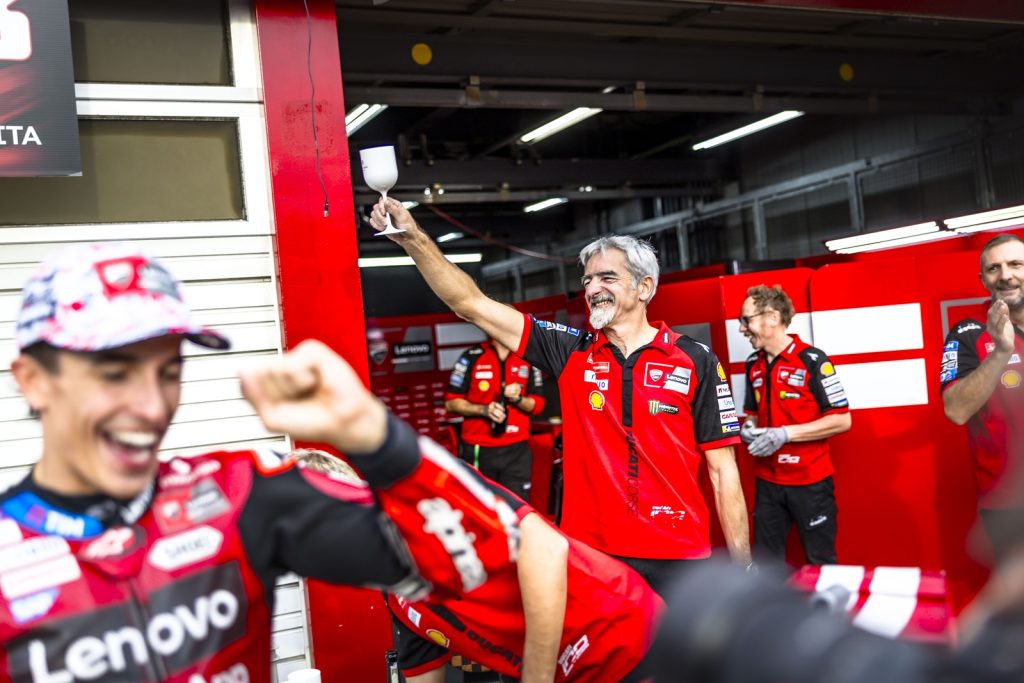
“For sure, I’m proud about the job that all Ducati employees did during these years,” Dall’Igna said after reaching the milestone. “I’m happy and proud. And 100 is a nice number, that means that I’m old. This is the worst part.”
The 2015 Ducati changed the direction
Asked which motorcycle mattered most during the transformation, Dall’Igna did not choose one of the Desmosedicis that eventually won a championship. He chose the GP15.
“Honestly, the 2015 machine was the most important, because with that machine, we made a real step,” he explained. “It was not easy, there was a lot of pressure at that time. So, I think that bike, that machine, stays in my heart more than all the others.”
The GP15 did not win a race, but it represented Dall’Igna’s first clean-sheet MotoGP project at Ducati and immediately made the manufacturer considerably more competitive. Dovizioso and Iannone combined for podiums before the next evolution finally ended Ducati’s six-year victory drought.
Iannone won the 2016 Austrian GP, with Dovizioso completing a Ducati one-two.
“The first victory with Iannone in Austria was the one that was more important and I remember with the best memories,” Dall’Igna said.
That breakthrough began the sequence that has now reached 100.
Ducati went from following MotoGP to changing it
Dall’Igna’s transformation was not built around a single regulation change. MotoGP’s fundamental engine and chassis framework remained relatively stable, forcing Ducati to improve progressively rather than exploit a completely new formula.
Once competitive, however, Ducati began introducing ideas that changed how MotoGP bikes were designed.
The manufacturer became the reference for increasingly sophisticated aerodynamics and pioneered devices designed to control ride height and improve acceleration. Rivals were eventually forced to develop similar concepts, while regulations repeatedly changed in response to the increasing technical complexity.
“I think that in the last 10 years, the bike has changed more than in all the other years,” Dall’Igna said. “So it’s an important evolution that we push on in motorsport and we are really happy about that.”
Michelin tyres, standard electronics, restrictions on aerodynamic devices, tyre-pressure regulations and engine freezes all altered MotoGP during the period, but none ended Ducati’s progression.
The numbers behind Ducati’s transformation
The first victories arrived slowly. Then Ducati’s growth accelerated dramatically.
| Season | Ducati GP wins under Dall’Igna |
|---|---|
| 2016 | 2 |
| 2017 | 6 |
| 2018 | 7 |
| 2019 | 3 |
| 2020 | 2 |
| 2021 | 7 |
| 2022 | 12 |
| 2023 | 17 |
| 2024 | 19 |
| 2025 | 17 |
| 2026* | 8 |
| Total | 100 |
*2026 season ongoing.
The most extraordinary campaign was 2024. Ducati won 19 of the 20 Grands Prix, with 16 victories for the GP24 and another three for the previous year’s GP23.
The manufacturer had already won its first Constructors’ Championship of the Dall’Igna era in 2020 and has remained unbeaten in that competition since. Francesco Bagnaia then ended Ducati’s 15-year wait for a Riders’ Championship in 2022.
Ducati has subsequently produced four consecutive riders’ champions with three different riders: Bagnaia, Jorge Martín and Márquez.
Bagnaia leads 14 Ducati winners of the Dall’Igna era
Ducati’s 100 victories have not depended on one dominant rider.
Fourteen different riders have won on a Ducati during the Dall’Igna era, with Bagnaia contributing the largest share.
| Rider | Wins |
|---|---|
| Francesco Bagnaia | 31 |
| Marc Márquez | 20 |
| Andrea Dovizioso | 14 |
| Jorge Martín | 8 |
| Enea Bastianini | 7 |
| Álex Márquez | 4 |
| Jorge Lorenzo | 3 |
| Jack Miller | 3 |
| Marco Bezzecchi | 3 |
| Danilo Petrucci | 2 |
| Fabio Di Giannantonio | 2 |
| Andrea Iannone | 1 |
| Johann Zarco | 1 |
| Fermín Aldeguer | 1 |
That spread also reflects Ducati’s satellite strategy. Pramac, Gresini and VR46 have all won with Desmosedici machinery, allowing the manufacturer to collect extensive data while giving independent teams equipment capable of fighting at the front.
The current championship again demonstrates the depth of that structure. Márquez arrives at the Indonesian GP only two points behind Jorge Martín in the 2026 title fight, although Ducati expects Mandalika to be a difficult venue.
Team manager Davide Tardozzi has even admitted that Ducati would consider Márquez losing 10-12 points to Martín an acceptable outcome given the characteristics of the Indonesian circuit.
Ducati enters the end of the 1000cc era as MotoGP’s benchmark
Dall’Igna’s 100th victory arrives as MotoGP approaches another major technical reset. The current 1000cc regulations will disappear after 2026, with 850cc engines, reduced aerodynamics and the removal of ride-height devices forming part of the new rules.
That makes the milestone an appropriate measure of what Ducati achieved during the current technical era.
The company went from five consecutive winless seasons to winning almost half of the Grands Prix held since its 2016 breakthrough, while several technologies it helped introduce became defining features of modern MotoGP.
Dall’Igna still identifies the GP15 that started the recovery and the GP22 that finally delivered the riders’ title as particularly significant motorcycles.
Motegi added another number to that history: 100 victories under his leadership.
GRANDE PRÊMIO provides full coverage of the MotoGP championship throughout the 2026 season.
MotoGP today: FAQ
Who was fastest in Indonesian MotoGP Practice at Mandalika?
Raúl Fernández topped Friday’s Practice with a new Mandalika lap record of 1:28.725, leading an Aprilia 1-2-3 ahead of Marco Bezzecchi and Jorge Martín. Marc Márquez finished fifth, 0.220s behind championship rival Martín. All four qualified directly for Q2.
Can Marc Márquez take the MotoGP championship lead in Saturday’s sprint?
Yes. Márquez trails Jorge Martín by just two points, 331 to 333. The Ducati rider can move ahead by scoring at least three more points than Martín during Saturday’s sprint. A Márquez victory would guarantee the championship lead regardless of Martín’s result.
What time is Indonesian MotoGP qualifying and the sprint on Saturday?
Qualifying begins at 10:50 local time on Saturday, October 10, equivalent to 03:50 BST in the UK and 22:50 EDT on Friday in the United States and Canada. The sprint starts at 15:00 local time, equivalent to 08:00 BST and 03:00 EDT on Saturday.
How many MotoGP races has Ducati won under Gigi Dall’Igna?
Ducati has won 100 MotoGP Grands Prix under Dall’Igna, beginning with Andrea Iannone’s 2016 Austrian GP victory and reaching 100 with Marc Márquez at Motegi in 2026.