News Summary
- Charles Leclerc told GRANDE PRÊMIO that he underwent several medical examinations after his heavy crash at Monza and that all results were normal.
- The Ferrari driver said he experienced neck stiffness and some pain in the days after the impact but is now feeling well.
- Leclerc briefly experienced a problem with his vision immediately after the crash, but said his sight returned to normal within seconds and he was never seriously concerned about missing the Spanish GP.
Charles Leclerc has revealed new details about the physical effects of his heavy Italian GP crash, telling GRANDE PRÊMIO that he underwent several medical examinations and treatments in the days following the accident but found no abnormalities.
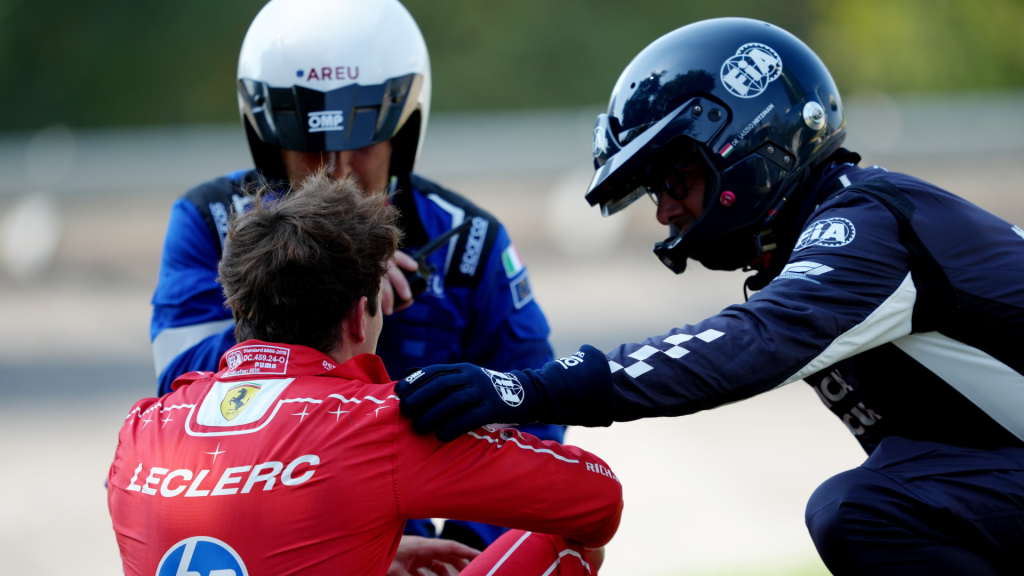
The Ferrari driver crashed heavily at Monza’s Parabolica on the second lap of Sunday’s race after losing control of his SF-26 at more than 230 km/h. The impact was severe enough to destroy the car and damage the tyre barrier, forcing the race to be red-flagged. Leclerc’s crash brought the Italian GP to its first major interruption.
Leclerc was taken to the medical centre immediately after the accident and subsequently underwent additional checks away from the circuit. Ferrari later confirmed that he was OK, while further examinations also cleared him to race in Madrid. Ferrari had already confirmed that Leclerc’s additional medical checks found no problems ahead of the Spanish GP.
Speaking to GRANDE PRÊMIO in Madrid on Thursday (10), Leclerc explained that the medical follow-up was extensive, particularly because of the impact on his neck.
“I did many tests. It was a big crash — for those who watched from the outside as well as from the inside. Sometimes it can look big from the outside, but it’s fine for the person inside. But when I got out of the car, I wasn’t feeling very well. In fact, it was just because of the impact,” Leclerc said.
“I did many tests and treatments in the first few days, mainly for my neck, because I felt it was a little stiff — which I imagine is normal — but now I’m fine. All the tests I did were normal,” he added.
The Monegasque was unable to specify exactly which medical examinations he underwent.
“Honestly, I can’t tell you [which tests I had]. In the medical world, every neck test has a name that’s far too difficult for me to remember,” Leclerc said with a laugh. “But I did many tests and everything was fine.”
Leclerc was never seriously concerned about missing Madrid
Despite feeling some pain and stiffness in the days following the crash, Leclerc said he never reached the point of believing that his participation in Formula 1’s first Spanish GP in Madrid was in doubt.
“Not to that point [of missing the Spanish GP]. I felt the stiffness and probably a little bit of pain in my neck on Monday, but in terms of my vision, it was very quick,” he explained.
Leclerc had already revealed immediately after the Monza accident that his right eye had briefly been affected. The Ferrari driver said at the time that his vision returned to normal shortly after he climbed out of the car. Leclerc previously described the brief vision problem immediately after the impact.
“Right after I got out of the car, it was just… I don’t know, one eye wasn’t maybe working properly,” Leclerc said in Madrid, laughing. “But then it was completely normal after a few seconds, so I wasn’t very worried.”
The driver said the strength of the crash was nevertheless obvious and acknowledged that a heavy impact inevitably takes a physical toll.
“Of course, I knew it had been a big crash and, obviously, that’s never good for the body, but immediately afterwards I could see very well,” Leclerc concluded.
The latest medical update removes one of the main uncertainties surrounding Ferrari’s preparations for Madrid. Leclerc will therefore return to the cockpit for the first Spanish GP at Madring, while Ferrari also avoided a potentially costly power-unit penalty after confirming that his engine survived the Monza impact. Leclerc will retain the power unit used at Monza after Ferrari determined that only the transmission casing needs to be replaced.
Ferrari faces a different challenge in Madrid
Leclerc’s return comes at an important moment for Ferrari. The team endured a difficult home race at Monza, where Lewis Hamilton finished sixth and Leclerc’s crash ended his race early.
Madring presents a very different challenge from Monza, with 22 corners, long acceleration zones, heavy braking areas and the highly unusual banked La Monumental section. Leclerc had already expressed optimism about the circuit, saying its layout suits his driving style. He previously praised Madring and said its characteristics could make it one of the most iconic circuits on the F1 calendar.
The first Spanish GP in Madrid therefore gives Leclerc an immediate opportunity to put the Monza crash behind him and assess Ferrari’s competitiveness on a completely new circuit.
The Spanish GP runs from September 11-13 at Madring. Qualifying takes place at 4:00pm local time on Saturday, while the race starts at 3:00pm on Sunday. GRANDE PRÊMIO will cover all the action from Madrid.
FAQ
Is Charles Leclerc fit to race at the 2026 Spanish GP?
Yes. Leclerc said all the medical tests he underwent after his Monza crash were normal and confirmed that he is feeling well ahead of the Spanish GP in Madrid.
What happened to Charles Leclerc’s vision after his Monza crash?
Leclerc experienced a brief problem with his vision immediately after the impact. He said one eye was not functioning normally for a few seconds, but his vision quickly returned to normal.
Did Charles Leclerc suffer a neck injury in the Monza crash?
Leclerc said he experienced neck stiffness and some pain in the days after the crash and received treatment focused mainly on his neck. However, he said all the medical examinations he underwent were normal.