
News Summary
- George Russell, Lewis Hamilton, Max Verstappen and Charles Leclerc are separated by just nine points in the fight for second place in the 2026 Formula 1 World Championship.
- A four-way points tie after the Mexican Grand Prix is mathematically impossible, but four different combinations of race results could leave three of the drivers level.
- The possible three-way ties range from 242 to 251 points, depending on the finishing positions, with the official championship order determined by countback.
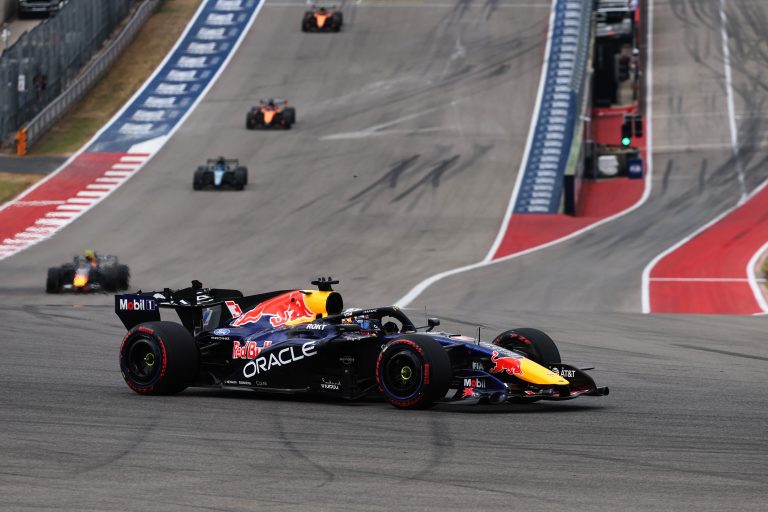
Formula 1’s extraordinary battle for second place could produce a rare mathematical outcome at the 2026 Mexico City Grand Prix, with four different combinations of results capable of leaving three drivers tied on championship points. George Russell, Lewis Hamilton, Max Verstappen and Charles Leclerc are separated by only nine points after Austin, and the scoring system creates several opportunities for that gap to disappear after Sunday’s (November 1) race.
A complete four-way tie is impossible, however. The differences between the drivers’ existing totals cannot all be overcome simultaneously by the points available in a single Grand Prix. Nevertheless, four separate three-way ties are possible, involving different combinations of Mercedes, Ferrari and Red Bull drivers as the battle behind runaway leader Andrea Kimi Antonelli intensifies.
Four F1 drivers separated by nine points after Austin
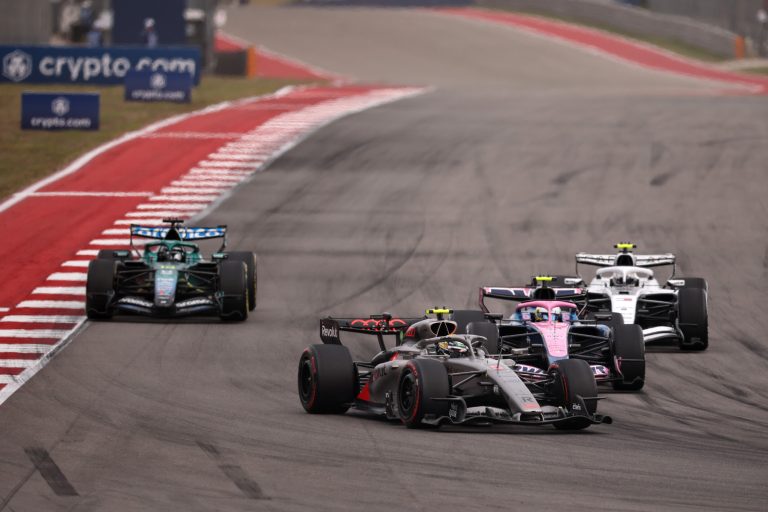
Russell enters the Mexican Grand Prix second in the Drivers’ Championship with 242 points, having collected only four points from eighth place in the United States Grand Prix.
Hamilton is just one point behind, with 241, after finishing fourth for Ferrari in Austin.
Verstappen occupies fourth with 236 points, while Leclerc sits fifth with 233 after finishing second in Texas.
F1 2026 — Battle for second before Mexico
| Pos. | Driver | Team | Points | Gap to Russell |
|---|---|---|---|---|
| 2 | G. RUSSELL | Mercedes | 242 | — |
| 3 | L. HAMILTON | Ferrari | 241 | -1 |
| 4 | M. VERSTAPPEN | Red Bull | 236 | -6 |
| 5 | C. LECLERC | Ferrari | 233 | -9 |
Championship standings following the United States Grand Prix on October 25.
The situation is particularly unusual because the battle for second has become considerably closer than the fight for the championship itself.
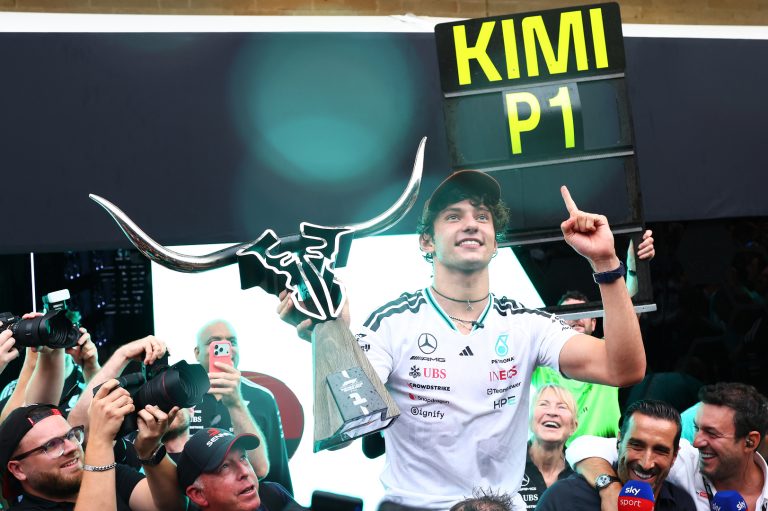
Andrea Kimi Antonelli leads Russell by 123 points, having won nine Grands Prix this season.
The Italian needs only ninth place in Mexico to secure the World Championship, regardless of his rivals’ results.
Meanwhile, the four drivers immediately behind him are close enough that a single race could significantly change the classification.
Can all four drivers finish the Mexican GP tied on points?
No. A four-way tie between Russell, Hamilton, Verstappen and Leclerc is mathematically impossible after the Mexican Grand Prix.
The reason is Formula 1’s points system.
The first ten finishers receive 25, 18, 15, 12, 10, eight, six, four, two and one point respectively.
Drivers finishing outside the points receive zero.
There is no sprint in Mexico, and Formula 1 no longer awards a point for the fastest lap.
For the four drivers to finish level, Hamilton would need to score one more point than Russell, Verstappen six more and Leclerc nine more.
There is no combination of four distinct finishing positions producing exactly those differences.
Points each driver must gain relative to Russell
| Driver | Current points | Additional points needed relative to Russell |
|---|---|---|
| G. RUSSELL | 242 | — |
| L. HAMILTON | 241 | +1 |
| M. VERSTAPPEN | 236 | +6 |
| C. LECLERC | 233 | +9 |
For example, if Russell fails to score, Hamilton could draw level by finishing tenth and Verstappen by finishing seventh.
But Leclerc would need nine points, a total that cannot be earned from a single Grand Prix finishing position.
Conversely, there are combinations involving Leclerc that produce three-way ties but exclude one of the other contenders.
That is why the possibility of a four-way tie disappears, even though three-way ties remain possible.
Scenario 1: Russell, Hamilton and Verstappen finish level on 242 points
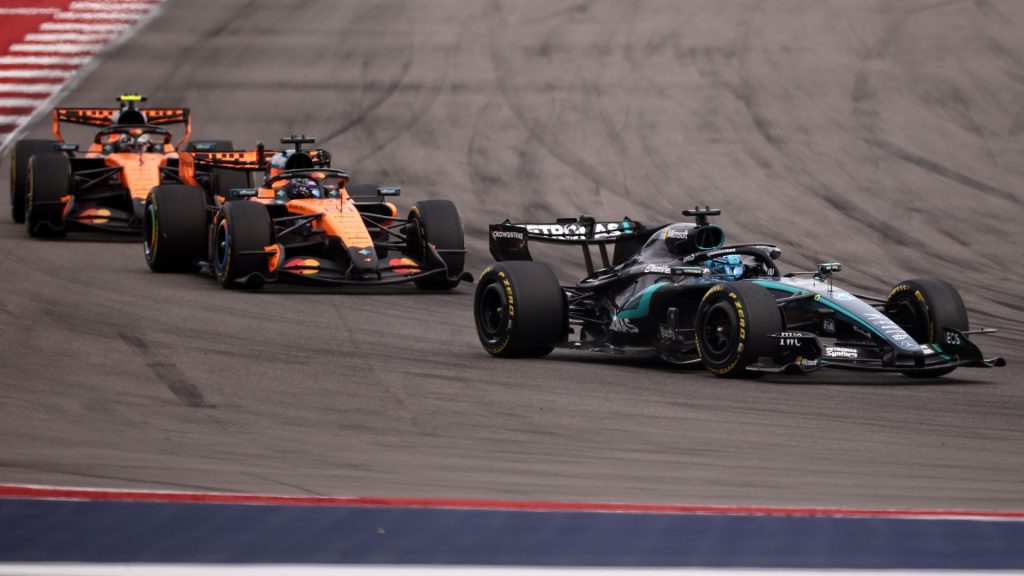
The first possible three-way tie involves Russell, Hamilton and Verstappen.
Russell would need to finish outside the points, remaining on 242.
Hamilton would have to finish tenth, collecting one point and also moving to 242.
Verstappen would need seventh place, earning six points to reach the same total.
Scenario 1 — Three-way tie on 242 points
| Driver | Mexico result | Points gained | New total |
|---|---|---|---|
| G. RUSSELL | Outside top 10 | 0 | 242 |
| L. HAMILTON | 10th | 1 | 242 |
| M. VERSTAPPEN | 7th | 6 | 242 |
Leclerc cannot join this tie because he would need nine points to move from 233 to 242.
This scenario would produce a three-way championship points tie among the drivers currently occupying second, third and fourth.
However, their official positions would be separated through the championship’s countback rules.
Scenario 2: Russell, Hamilton and Leclerc finish level on 243 points
The second possibility includes both Ferrari drivers alongside Russell.
Russell would need tenth place in Mexico, collecting one point to reach 243.
Hamilton would need ninth, adding two points.
Leclerc would have to finish fifth, earning ten points.
Scenario 2 — Three-way tie on 243 points
| Driver | Mexico result | Points gained | New total |
|---|---|---|---|
| G. RUSSELL | 10th | 1 | 243 |
| L. HAMILTON | 9th | 2 | 243 |
| C. LECLERC | 5th | 10 | 243 |
Verstappen could not join the group because he would need seven points to reach 243, and seventh place awards six rather than seven.
This outcome would significantly change the positions behind Antonelli while keeping three drivers level on points.
Scenario 3: Russell, Verstappen and Leclerc finish level on 248 points
The third scenario requires all three drivers to score more substantial points.
Russell would have to finish seventh, earning six points.
Verstappen would need fourth place, collecting 12 points.
Leclerc would have to secure third, adding 15 points.
Scenario 3 — Three-way tie on 248 points
| Driver | Mexico result | Points gained | New total |
|---|---|---|---|
| G. RUSSELL | 7th | 6 | 248 |
| M. VERSTAPPEN | 4th | 12 | 248 |
| C. LECLERC | 3rd | 15 | 248 |
This is a particularly interesting combination because it includes a podium for Leclerc and a strong result for Verstappen.
Hamilton would not be able to match the total because he would need seven points from the race, which is not available under the Grand Prix scoring system.
The scenario illustrates how a relatively modest Russell result could allow both rivals to catch him despite starting six and nine points behind.
Scenario 4: Hamilton, Verstappen and Leclerc finish level on 251 points
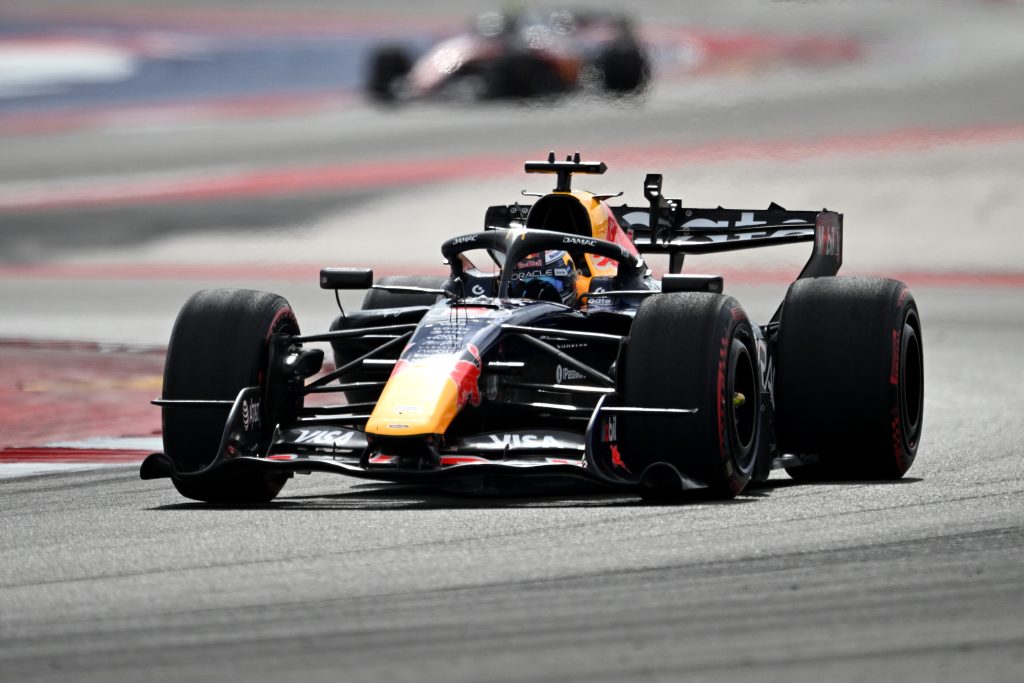
The final three-way tie possibility excludes Russell and involves Hamilton, Verstappen and Leclerc.
Hamilton would need fifth place, collecting ten points to reach 251.
Verstappen would have to finish third, earning 15.
Leclerc would need second place, gaining 18 points.
Scenario 4 — Three-way tie on 251 points
| Driver | Mexico result | Points gained | New total |
|---|---|---|---|
| L. HAMILTON | 5th | 10 | 251 |
| M. VERSTAPPEN | 3rd | 15 | 251 |
| C. LECLERC | 2nd | 18 | 251 |
This is the highest-scoring three-way tie available among the four drivers after Mexico.
Russell would be unable to join them because he would need nine points, which cannot be scored in a single Grand Prix.
The scenario would be especially significant for Ferrari, with both of its drivers finishing among the top five while Verstappen secures another podium.
Every possible three-way tie after Mexico
The complete calculation produces four valid combinations, and all are compatible with a single race classification.
| Drivers tied | Championship total | Required finishing positions |
|---|---|---|
| Russell / Hamilton / Verstappen | 242 | Outside points / 10th / 7th |
| Russell / Hamilton / Leclerc | 243 | 10th / 9th / 5th |
| Russell / Verstappen / Leclerc | 248 | 7th / 4th / 3rd |
| Hamilton / Verstappen / Leclerc | 251 | 5th / 3rd / 2nd |
The calculations assume a full-points Grand Prix without post-race penalties changing the relevant finishing positions.
They also refer to equal championship points, not necessarily equal official championship positions.
What happens if drivers finish level on championship points?
Formula 1 uses countback rules to separate drivers who have accumulated the same number of points.
The first criterion is the number of Grand Prix victories.
If drivers have the same number of wins, the championship compares second-place finishes, followed by third places and progressively lower finishing positions until the tie is resolved.
That means two or three drivers can finish a race with identical points totals without sharing the same official championship position.
The distinction is particularly relevant in 2026.
Russell has won three races, Verstappen two, while Hamilton and Leclerc have one each.
Those victory totals would influence the countback if the drivers finished Mexico with equal points, although the complete sequence of results would determine the precise official order where necessary.
The mathematical scenarios therefore do not guarantee that the second-place position itself would be shared.
They demonstrate that the drivers could end the weekend tied on points, with countback determining who ranks ahead.
Why Mexico could transform F1’s fight for second
The Mexican Grand Prix arrives at an important moment for all four drivers.
Russell has endured a difficult sequence of results while Antonelli has extended his championship advantage.
The British driver admitted that his pace at Austin was poor and that he lacked an explanation.
Hamilton, meanwhile, has remained competitive for Ferrari and finished fourth in Texas, reducing Russell’s advantage to only one point.
Leclerc’s second-place finish strengthened his position, while Verstappen’s third place kept him within six points of the Mercedes driver.
The Dutchman can no longer win the 2026 World Championship, having been mathematically eliminated after Austin.
However, the runner-up position remains a realistic objective.
The same applies to Hamilton and Leclerc, who have benefited from Ferrari’s stronger competitiveness during recent rounds.
With five Grands Prix remaining before Mexico, a maximum of 125 points is available to each driver.
The battle for second is therefore far from decided.
Mexico’s altitude and race strategy could influence the outcome
Autódromo Hermanos Rodríguez is one of Formula 1’s most technically unusual circuits.
Located approximately 2,240 metres above sea level, it creates significant challenges for engine cooling, aerodynamic efficiency and energy management.
The effects of Mexico’s altitude on the new 2026 hybrid engines may influence the competitive order.
Mercedes, Ferrari and Red Bull have all demonstrated race-winning pace during the season, but their relative performance at Mexico remains uncertain before practice.
A small change in competitiveness could have major consequences for the championship order because the four drivers are separated by so few points.
The same applies to race strategy, pit stops, penalties and incidents.
A retirement for one driver combined with a strong result for a rival could alter the classification considerably.
The 71-lap Mexican Grand Prix starts on Sunday, November 1, at 2:00pm local time, equivalent to 8:00pm GMT in the United Kingdom and 3:00pm EST in New York.
The complete Mexican Grand Prix schedule and worldwide start times provide further details.
GRANDE PRÊMIO is following every session of the Mexican Grand Prix this weekend, with breaking news, full coverage and real-time updates in its Formula 1 section.