News Summary
- Ford has ended its evaluation of a potential IndyCar engine programme for the 2028 regulations.
- Mark Rushbrook says the manufacturer’s resources are committed to existing projects and the upcoming Hypercar and WRC programmes.
- Chevrolet and Honda remain IndyCar’s only confirmed engine suppliers for the introduction of the Dallara IR-28.
Ford has ruled out developing an engine for IndyCar’s new 2028 regulations, ending its evaluation of a possible return to American open-wheel racing as the manufacturer concentrates its resources on Formula 1, the World Endurance Championship and its factory comeback in the World Rally Championship.
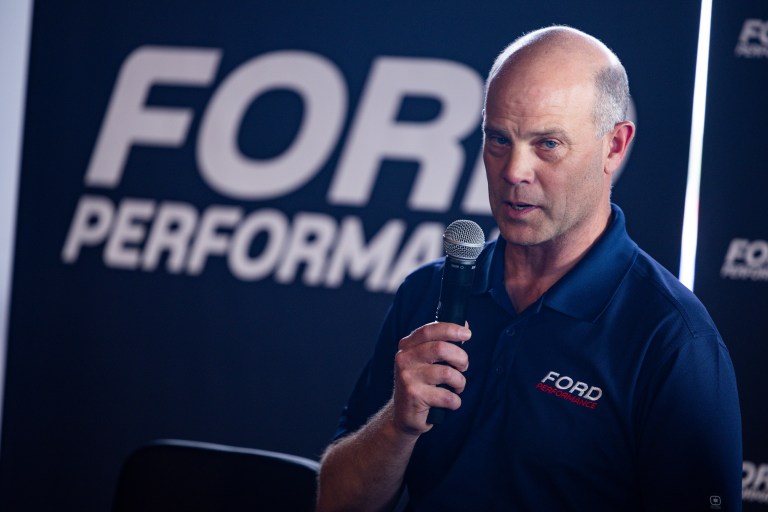
The decision was confirmed by Mark Rushbrook, Ford Racing’s global director, in a statement to RACER. The manufacturer had recently acknowledged that IndyCar was among the championships being considered as part of its long-term motorsport strategy, but the evaluation has now concluded without progressing beyond internal discussions.
The announcement means Ford will not develop the 2.4-litre twin-turbocharged V6 hybrid engine required for IndyCar’s next generation of cars, scheduled to debut in 2028.
“Ford Racing’s focus is on our existing racing programs, and all of our resources are fully focused on delivering the upcoming Hypercar and WRC programs,” Rushbrook told RACER.
The decision represents a setback for IndyCar’s long-standing ambition to attract a third engine manufacturer, leaving Chevrolet and Honda as the only companies committed to the new regulations.
Ford reverses course after acknowledging IndyCar interest
Ford’s latest position comes just days after Rushbrook publicly discussed the possibility of returning to IndyCar.
The executive explained that the manufacturer regularly evaluates opportunities across international motorsport, including the American single-seater championship.
“We race almost everywhere, but we’re always looking at our five-year plan for future participation and continuously evaluating every series, including IndyCar,” Rushbrook said at the time.
The comments suggested that Ford had not permanently closed the door to the category, particularly with IndyCar preparing for a major technical reset.
As GRANDE PRÊMIO reported in its original interview with Rushbrook, the manufacturer viewed the timing of any potential expansion as a central consideration.
However, the subsequent evaluation did not result in an approved programme.
According to RACER, Ford’s internal discussions were relatively brief and never reached the stage of developing a formal engine project.
The distinction is important: Ford has not cancelled an engine already under development. Instead, it has decided not to proceed with an opportunity it had been evaluating.
Rushbrook’s latest statement does not establish a permanent prohibition on returning to IndyCar in a later regulatory cycle, but it removes Ford from consideration for the immediate 2028 programme.
Formula 1, Le Mans and WRC absorb Ford’s resources
Ford’s decision comes during one of the most ambitious periods of international motorsport expansion in the company’s recent history.
The American manufacturer returned to Formula 1 in 2026 through its technical partnership with Red Bull Powertrains, supplying expertise and support for the power units used by Red Bull Racing and Racing Bulls.
The programme achieved its first Grand Prix victory at Sepang in October, when Max Verstappen won the relocated Bahrain Grand Prix. He followed that success with another victory in Singapore, strengthening the partnership’s competitive position.
Red Bull has also continued improving the operation of its power unit without introducing a new homologated engine specification, concentrating on calibration and energy management.
Those developments have become increasingly important under Formula 1’s 2026 regulations, which place greater emphasis on electrical energy deployment.
Ford is simultaneously preparing its return to the top category of the World Endurance Championship.
The manufacturer will introduce a new Hypercar programme in 2027, targeting overall victories in the WEC and at the 24 Hours of Le Mans.
That commitment will require substantial investment in engineering, testing, personnel and race operations, particularly as Ford prepares to compete against established manufacturers such as Ferrari, Toyota and Cadillac.
The company has also confirmed a full factory return to the World Rally Championship in 2028, expanding its partnership with M-Sport before introducing an all-new rally car in 2029.
Those projects help explain why Ford has decided against adding another major engine-development programme to its schedule.
The manufacturer already competes across NASCAR, IMSA, off-road racing and other international championships, making resource allocation an increasingly important consideration.

IndyCar loses another opportunity to attract third manufacturer
Ford’s decision leaves IndyCar facing a familiar challenge.
The championship has relied on Chevrolet and Honda as its two engine suppliers since 2013, following Lotus’ unsuccessful participation during the opening year of the current turbocharged engine regulations.
IndyCar has spent years attempting to attract another manufacturer, but the substantial investment required to develop and supply engines has repeatedly complicated negotiations.
The introduction of the IR-28 in 2028 was intended to create a more attractive opportunity for new manufacturers.
The new chassis will be accompanied by 2.4-litre twin-turbocharged V6 engines, replacing the current 2.2-litre units that have been used since 2012.
The regulatory reset would theoretically allow a new manufacturer to enter without facing the accumulated development advantage enjoyed by Chevrolet and Honda under the existing formula.
However, Ford’s decision demonstrates that new regulations alone are not sufficient to guarantee additional manufacturer participation.
Both Chevrolet and Honda have already committed to long-term engine supply agreements and are preparing their new power units.
The two manufacturers will therefore continue competing against each other when the new technical era begins.
Chevrolet and Honda prepare for Dallara IR-28
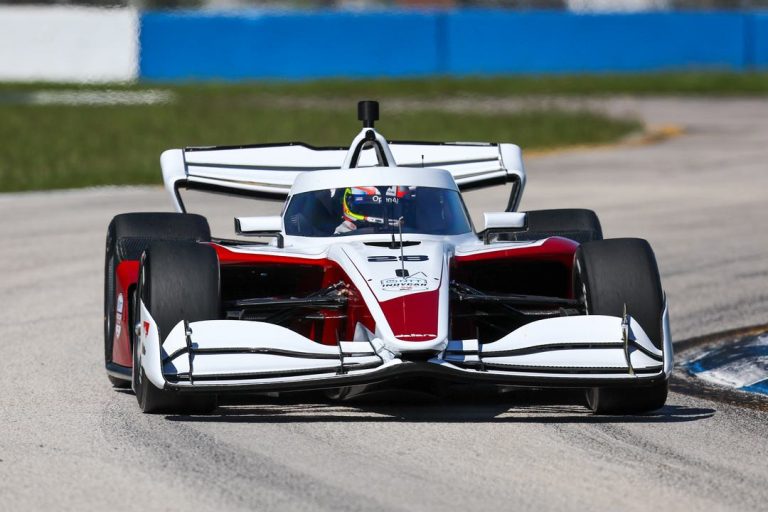
Ford’s announcement comes as development of IndyCar’s next-generation chassis reaches an important milestone.
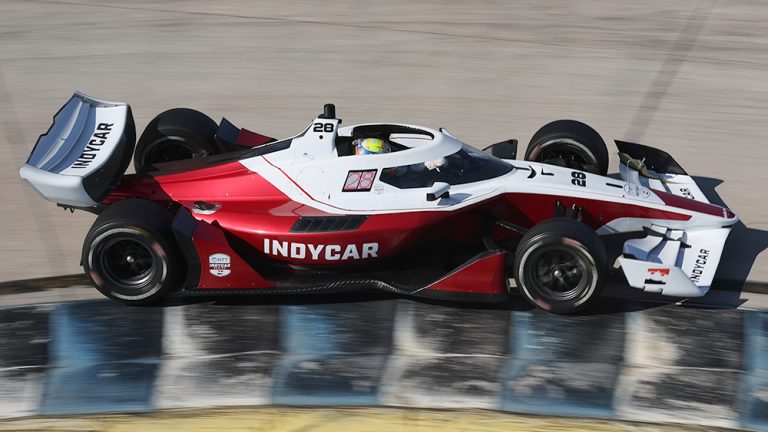
Dallara has completed the first six monocoques for the IR-28, with Chevrolet and Honda preparing to receive their initial development cars in November.
As GRANDE PRÊMIO reported on October 16, the manufacturers will use those cars to begin installation and validation work before testing their new power units.
The chassis has already completed development running at Indianapolis Motor Speedway and Sebring, with Álex Palou and Alexander Rossi participating in the test programme.
The new car is designed to be lighter than the current machine, with revised aerodynamics, improved safety structures and a more powerful hybrid system.
IndyCar expects the new engines to produce up to 760 horsepower from their internal-combustion component, supplemented by electrical power.
The championship has also introduced changes intended to improve racing and make it easier for drivers to follow competitors.
For Chevrolet and Honda, the coming months will involve integrating the new power units into the IR-28 and preparing for the first manufacturer-specific tests.
Ford will not participate in that process.
Ford’s historic IndyCar connection remains
Although Ford will not join the 2028 programme, the manufacturer has a long history in American open-wheel racing.
Ford-powered cars achieved major success at Indianapolis during the 1960s, including Jim Clark’s victory in the 1965 Indianapolis 500 with Lotus.
The manufacturer later competed extensively in CART and Champ Car through its relationship with Cosworth.
Ford’s last direct competition against rival engine manufacturers in the American open-wheel championship came in 2002, before Cosworth-built engines carrying Ford branding became the standard power unit in Champ Car.
The company subsequently withdrew from American open-wheel racing following the reunification of IndyCar and Champ Car in 2008.
A return under the IR-28 regulations would have marked the manufacturer’s first participation as an engine supplier in the modern unified IndyCar Series.
For now, Ford’s motorsport strategy remains focused on its existing commitments and the expansion into Hypercar and factory WRC competition.
GRANDE PRÊMIO will continue following IndyCar’s preparations for 2028, the development of the IR-28 and the championship’s search for additional manufacturers through its IndyCar coverage.